

The Software Modernization Playbook: Cloud, Architecture, and Data Alignment
Modernization often starts with technology but fails without structure. This e-book from CHI Software explains how to approach software modernization as a continuous discipline — connecting architecture, cloud strategy, data readiness, and measurable business impact.
Not sure how to move forward with software modernization? This e-book offers practical perspectives and real-world guidance.
Download PDF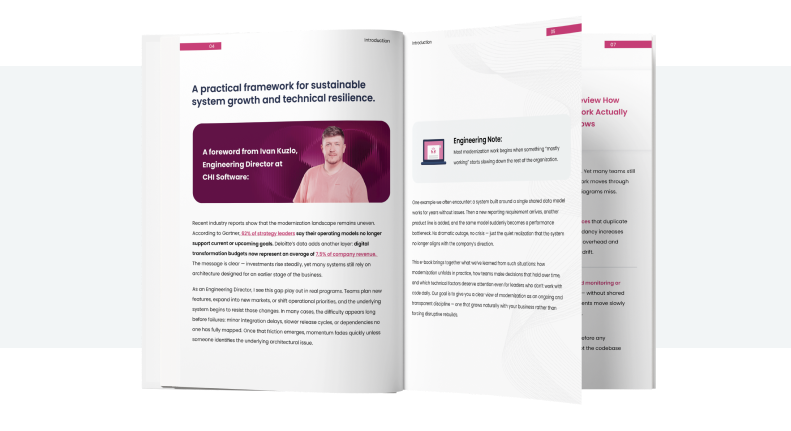
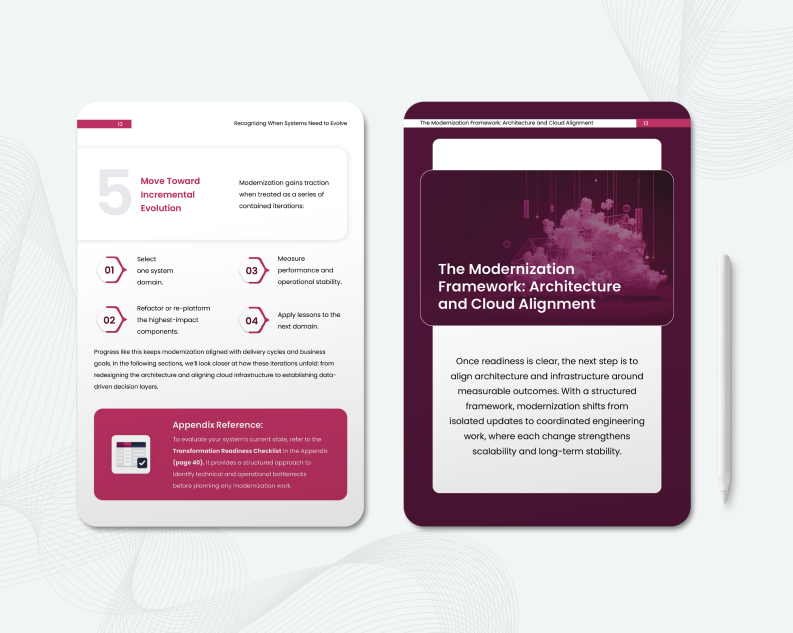
Learn how to identify early signs that existing systems no longer align with the business direction. Our e-book explains how friction appears long before failures — through delivery delays, data inconsistencies, and growing operational effort.
Explore a structured framework for aligning system architecture and cloud infrastructure. This section shows how engineers document the current state, introduce modularity gradually, and connect cloud decisions to measurable outcomes.
Understand how modernization moves beyond infrastructure into data. This e-book covers data architecture fundamentals, pipeline consistency, engineering governance, and building a reliable foundation for analytics and decision-making.

Learn how to track modernization progress using clear metrics. This section explains how to connect architectural and delivery changes with performance, reliability, cost efficiency, and long-term business value.
See how modernization benefits from clear collaboration structures. Our guide outlines roles, delivery cadence, knowledge transfer practices, and governance models that keep modernization predictable over time.
Access a set of ready-to-use tools, including a Transformation Readiness Checklist, Architecture Readiness Map, Continuous Delivery Maturity Model, Data Architecture Decision Map, Cloud Alignment Worksheet, and Modernization ROI Scorecard.

FAQs
Below are answers to common questions that help clarify who this playbook is for and how you can apply it in real modernization scenarios.
-
Who will benefit most from reading this e-book?

This e-book is written for people who make or influence technical decisions: – CTOs and technical leaders responsible for system stability and long-term evolution;
– Product leaders working with platforms that need to change without breaking user experience;
– Engineering managers balancing delivery speed, technical debt, and reliability;
– Companies facing growing complexity in architecture, data, or cloud setup;
– Businesses that want to modernize deliberately, not reactively. -
What real-world cases are covered in the e-book?
Our e-book includes several concrete case snapshots that illustrate different modernization scenarios: – Direct Store Delivery platform stabilization, showing how architectural refinement and integration improvements restored performance and operational stability in a mature system.
– Financial data architecture modernization for a multi-product platform, focusing on unifying data flows, improving reporting reliability, and enabling automation at scale.
– Modernization of a trading platform, where we evolved a monolithic system step by step to improve performance, scalability, security, and delivery speed without interrupting daily operations. Each case highlights the context, core challenges, modernization approach, and measurable outcomes. -
Is this e-book relevant if our systems are still working?
Yes, in fact, that’s exactly the situation it addresses. The playbook focuses on systems that keep running but gradually create friction: slower releases, harder maintenance, or unclear architectural decisions. Our guide can help you recognize these signals early and approach modernization before problems become blockers.
-
Is the playbook suitable for smaller teams or growing products?
Absolutely. The ideas in the e-book are not tied to company size or maturity — they are designed to scale, from smaller teams refining their foundations to growing products preparing for the next stage. The emphasis is on clear thinking and structured decisions, not large transformation programs.
-
Do we need to plan a full system rebuild to use these approaches?
Not at all. The e-book shows how teams evolve existing systems gradually by improving architecture, delivery, and data foundations without interrupting ongoing work or introducing unnecessary risk.
