Most engineering teams are already experiencing faster workflows thanks to artificial intelligence. A more complex question is whether this speed translates into metrics that truly matter to the CFO. This article breaks down the ROI of AI in software development into three parts — including gains, costs, and a formula your board can defend. PwC’s 2026 survey shows the gap clearly: 56% of leaders expect AI to improve profitability, but only 12% are seeing it in the numbers so far. It also explains why AI ROI in software development often looks impressive on a dashboard but weak on the balance sheet, and what distinguishes teams that generate real returns from those that merely record activity.
Each section below answers one question: did every dollar invested in AI generate more than a dollar of demonstrable business value, after accounting for its downstream consequences?
What ROI Can AI Bring Without Raising Delivery Risk
Start with the board-level answer. Real return shows up when AI lowers the cost per release, shortens time to market, or cuts your exposure to outages and compliance failures. It does not show up when AI simply produces more code.
Google’s DORA team, in its 2026 ROI report, describes AI as a magnifier: it multiplies whatever delivery system you already run. Strong foundations get stronger. Weak ones get exposed faster. So the honest version of the return on investment question is not “how much faster do we type,” but “does the extra output survive review, deploy cleanly, and reach a customer.” The same report is careful to separate localized speed from system-level throughput. The team can work significantly faster, while deployment frequency and the change failure rate remain virtually unchanged; it is precisely these delivery performance metrics — rather than coding speed that the board of directors can translate into profit.
What Does AI ROI Mean Beyond Developer Productivity
For a CEO, COO, or CFO, developer productivity is an input, not the outcome. AI ROI is not a developer-experience metric — it shows up as revenue pulled forward, margin protected, legacy cost reduced, and risk taken off the table. DORA’s 2025 research explains the reason: because AI magnifies whatever system it lands in, a weak modernization foundation can erase apparent gains before they reach the income statement. Vendors like to pitch the ROI of AI solutions for developers as one clean percentage. Treat that number as a starting point, not a conclusion.
Why AI ROI Must Reach Margin, Speed, And Risk
A benefit that stalls at the point of implementation is no benefit at all. It must complete the journey: from a faster change request to a quicker release, leading to earlier revenue generation or reduced costs. If it gets stuck in a review queue or bogged down by fragile legacy systems, you have paid for speed without actually capturing it. This is the difference between perceived productivity and financial return — and precisely where most business cases quietly fall apart.
Legacy systems erase AI productivity gains before they reach your margin: find out how much your current technical debt is costing you before you invest in AI tooling.
Get a Legacy Cost and AI ROI Assessment
Where AI Creates Measurable Value Across Delivery, Risk, And Margin
Value manifests throughout the entire software development lifecycle — but it only truly matters once translated into business terms: shorter cycle times, less rework, faster launches, and easier audit preparation. The 2026 DORA report highlights code generation, review, testing, documentation, and refactoring as visible use cases. For regulated teams, resilience and compliance go hand in hand, as a lack of control carries a far higher cost than a slow build.
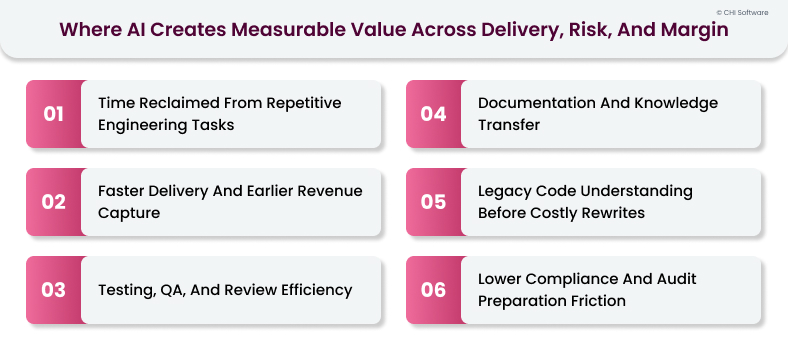
Time Reclaimed From Repetitive Engineering Tasks
Boilerplate, scaffolding, test stubs, config files. AI handles the repetitive work that used to eat up an afternoon. The point is not the minutes saved per task but where that reclaimed time goes. DORA’s advice is to reinvest that capacity into higher-value work rather than cut headcount, which is how a productivity gain turns into extra output instead of a smaller team.
Faster Delivery And Earlier Revenue Capture
A feature that ships in July instead of September earns two extra months of revenue. That is the clearest way developer productivity converts into a number a CFO respects. The gain is real only when the whole pipeline keeps pace — shipping code faster while it queues behind a slow release process changes nothing at the customer end.
Testing, QA, And Review Efficiency
AI develops unit tests, suggests edge cases, and flags obvious defects earlier. Early detection is cheaper. There is a specific caveat here: AI increases the volume of code submitted for review, so review capabilities must scale accordingly. Otherwise, the review process will become a new bottleneck.
Documentation And Knowledge Transfer
Documentation is a task that teams often skip and later regret. Artificial intelligence can generate useful baseline documentation, summarize implementation requests, and explain unfamiliar modules to newcomers. The value is subtle but real — shorter onboarding times, reduced risk regarding key personnel, and faster knowledge transfer when a contractor leaves.
Legacy Code Understanding Before Costly Rewrites
Before you rewrite a twenty-year-old module, you have to understand it. AI reads unfamiliar code and explains intent, which lowers the risk and the price of modernization decisions instead of leaving teams to guess. That understanding step is often where the largest hidden savings sit.
Lower Compliance And Audit Preparation Friction
In regulated sectors, audit preparation takes weeks. For FinTech and healthcare teams, this represents an ongoing expense rather than a one-time cost. AI can gather evidence, draft documentation regarding controls, and map code to regulatory requirements, thereby reducing the manual effort needed in each cycle. In compliance-driven operations, such a reduction directly translates to saving specialists’ time and, in some cases, fewer audit findings.
What Costs Should Be Included In AI ROI For A Real Business Case
Most AI ROI models flatter themselves. They count benefits in full and costs by half. A business case a board can defend does the opposite; it front-loads the costs so the return survives scrutiny. IBM’s 2026 finding of a 29% measurement confidence gap is exactly why AI ROI models need to include more, not fewer, cost lines. High-performing AI organizations — those that attribute 5% or more of EBIT to AI — are almost three times more likely to have fundamentally redesigned their workflows instead of simply adding AI capabilities on top of existing processes.
Tool, Platform, And Model Usage Costs
Per-seat licensing is the obvious line. API usage, token-based model costs, platform fees, and premium tiers are the costs that creep upward without warning. Track the total cost per active AI developer and model usage at realistic volumes, not pilot volumes.
Implementation And Workflow Integration Costs
Tools do not integrate themselves. Wiring AI coding tools into your IDEs, CI pipelines, and security controls takes engineering hours, and those hours belong in the AI cost model rather than being written off as free setup. For enterprises rolling out AI across many teams, that integration effort is part of the overall cost of ownership.
Training, Adoption, And The Initial Productivity Dip
Here are the costs that most models overlook. The 2026 DORA report refers to this phenomenon as the “J-curve”, a kind of “learning tax” your team pays while mastering a new way of working. Productivity often dips before it begins to rise. Explicitly accounting for this slump in the budget is what distinguishes a realistic business case from an overly optimistic one.
Security, Governance, And Compliance Costs
Someone must verify the model’s outputs, establish rules for its use, and validate everything during audits. In regulated industries, this level of governance is mandatory and entails real, ongoing costs that must be factored in for any serious model.
Technical Debt And Rework Costs From AI-Generated Code
GitClear’s 2025 research, which covered 211 million lines of code changes, found that the number of duplicate code blocks increased eightfold in 2024, while refactoring continued to decline. More cloning today means more maintenance tomorrow, so treat AI code volume as the future impact of refactorings, not the net result. High adoption rates tell you nothing about this debt. Worse, cloned logic spreads the tax on changes across the entire codebase. Fix a bug in one copy, and now you’re responsible for the work of finding and fixing every duplicate, often in files the original author never saw.
Parallel Run And Business Continuity Costs
While a new AI-assisted workflow proves itself, the old one usually keeps running in parallel. Two systems, briefly, cost more than one. That overlap is a legitimate line in the assessment, and it is easy to forget when the pilot looks cheap in isolation.
How To Calculate AI ROI In Software Development For The Board
The board of directors wants to see a single, well-founded metric, not a slideshow. In the 2026 DORA ROI report, this metric is calculated using a standard formula that accounts for costs most teams forget to deduct.
A Practical AI ROI Formula That Includes Hidden Costs
ROI is calculated as the incremental financial gain, minus direct and indirect costs as well as risk management expenses, divided by the total investment. According to an illustrative model in the DORA report, an organization with 500 employees could achieve a return of approximately 39% in the first year, with the investment paying for itself within eight months. It is more prudent to develop conservative, realistic, and optimistic calculation scenarios rather than relying on a single “impressive” figure.
How To Convert Time Savings Into Financial Value
Take the hours saved, multiply by the fully loaded cost of the engineer, then discount for the share that never reaches delivery. Unconverted time is not money. Only the reclaimed capacity that actually ships work should show up in the gain. If you are asking how to define the return on investment (ROI) in AI tools for software development in a single sentence, the answer is this: value only counts once it survives that discount.
How To Calculate Quality And Technical Debt Savings
The model avoided defects and rework. A bug caught in review costs a fraction of one caught in production. If AI raises rework instead of lowering it, this term turns negative, which is precisely why you measure it rather than assume it.
Example: Risk-Adjusted AI ROI For A FinTech Team
For instance, the payments team saves about 3,000 engineering hours annually, valued at approximately $300,000. Deduct $90,000 for licensing and platform costs, $60,000 for management and verification, and $50,000 for additional rework. A net gain of $100,000 on a $200,000 investment represents a 50% return — a plausible and justifiable figure, rather than an expected 300% return. (The figures are illustrative.)
How To Measure ROI Of AI Coding Assistants In Software Development
To measure the ROI of AI coding assistants in software development, pair one group using the tools with a control group that does not, hold the work comparable, and compare cycle time, rework, and shipped features. That design filters out the false positives you get when a team was already fast before the tools arrived.
Metrics That Prove AI ROI Without Misleading The Board
Choose metrics that link software behavior to business outcomes rather than relying on vanity dashboards. For CFOs, that means reporting AI P&L, AI spend, AI-driven savings, and AI-enabled revenue as evidence that engineering performance is translating into measurable financial impact. DORA’s measurement recommendations for 2025 are clear — combine delivery, product, and business perspectives instead of trusting a single number. This is also how the ROI of AI tools in software development should be measured, by results, not by output volume.
Productivity Metrics: Cycle Time, Lead Time, And PR Throughput
Cycle time and lead time indicate whether work is moving faster from start to finish. PR throughput adds context regarding volume. Consider them together; any one of them in isolation could highlight a team that is simply churning out more work.
Quality Metrics: Rework, Defects, And Incident Rates
Speed without stability is a total trap. Track rework volumes, defect detection rates (before they reach production), and the number of production incidents. If these metrics rise alongside AI adoption, you are increasing throughput at the expense of reliability.
Business Metrics: Cost Per Feature And Time To Market
Cost per feature and time to market are the metrics the board understands without explanation. Cost per feature only matters when it improves gross margin, EBITDA, and the P&L. These metrics turn engineering movement into money and calendar, providing the reporting layer CFOs need to track AI P&L, AI spend, AI-driven savings, and AI-enabled revenue, without mistaking activity for value.
Metrics To Avoid: Lines Of Code, Prompt Volume, And Acceptance Rate Alone
Lines of code reward the very duplication you are trying to avoid. Request volume measures activity, not value. And the acceptance rate — the proportion of AI suggestions a developer keeps is tempting but ultimately hollow. A high acceptance rate coupled with an increase in defects and false positives in your test suite suggests that developers are keeping code that breaks later. Evaluate these figures only in the context of quality and business outcomes.
How To Run An AI ROI Pilot Before You Commit Budget
Treat the pilot project as a small-scale bet with a fixed scope and clear financial and operational exit criteria. Fintech teams should bear in mind that the EU DORA regulation became mandatory as of January 17, 2025. Therefore, launch pilot projects within established governance safeguards rather than as experimental tools that regulators might later call into question.
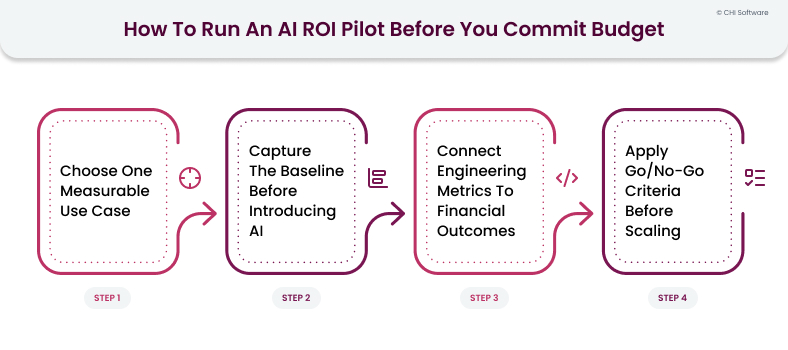
Choose One Measurable Use Case
Choose a single, high-volume, and repetitive task with easily measurable results. Generating tests or using a template-based approach provides a much clearer initial signal than spreading AI efforts across everything and hoping the numbers will change.
Capture The Baseline Before Introducing AI
You cannot prove an improvement that was never measured. Track cycle time, as well as the number of reworks and defects, for several weeks before the tools arrive. Without a baseline, there is no business case, regardless of how well the pilot project seems to be going.
Connect Engineering Metrics To Financial Outcomes
During the pilot project, convert every metric into its monetary equivalent — not months after it. Translate hours into costs, defects into avoided incidents, and speed into early revenue. The finance department must track the path from engineering decisions to effective financial results in real time.
Apply Go/No-Go Criteria Before Scaling
Define threshold metrics in advance. If the pilot project meets them, go ahead and scale. If it does not, stop and be glad the experiment was inexpensive. Criteria devised after the results are in are merely attempts to rationalize them.
Common Reasons AI ROI Fails Despite Faster Coding
Pilot sprawl is the new AI bottleneck. The number of AI experiments is growing, but they aren’t translating into scalable ROI. Teams count gross output and skip the deductions. Faster coding is easy to see. The review time, the instability, the technical debt, and the compliance effort behind it are easy to ignore, and that gap is exactly where the return disappears.
AI Is Used Without A Clear Business Use Case
Adoption for its own sake creates activity, not value. Without a business objective tied to revenue growth, cost reduction, or risk mitigation, there is no meaningful way to measure the investment, making ROI impossible to assess honestly.
Productivity Gains Never Reach Revenue Or Margin
Engineers finish faster — but a slow release cadence, a long sales cycle, or a legacy bottleneck absorbs the slack. The savings evaporate before they ever touch the profit and loss statement. Meanwhile, the dashboard still looks green, creating the illusion that everything is going according to plan and masking the gap between operational improvements and real business outcomes.
Review, Rework, And Risk Costs Are Ignored
Count the gross gains, ignore the costs they create, and any project looks brilliant. Extra review load, rework from AI code that does not quite fit, and compliance efforts are all real — and all routinely omitted. A business case that skips them is not measuring ROI. It is measuring hope.
AI Tools Stay Outside The SDLC
When AI lives inside experiments instead of the real pipeline, its output never faces production standards. Value that never enters the SDLC never becomes business value, however impressive the demo looked.
If your team is shipping more code but delivery speed and margin are not improving, the gap is usually found in the modernization layer beneath your AI tools.
Book a Fixed-Scope AI ROI Pilot
When AI In Software Development Is Most Likely To Pay Off Safely
Payback is most reliable under a few conditions, including repetitive, high-volume work, disciplined review, a clearly measurable bottleneck, modern delivery foundations, and use cases close to revenue or regulated workflows.
This is precisely how the DORA “amplification effect” plays out in practice across software projects, from small product initiatives to enterprise-wide programs. Where there is a solid foundation and a clear goal, AI turns speed into profit. Where the foundation is weak, those same tools turn speed into debt, which is why the foundation matters more than the chosen model. The practical takeaway for the buyer is to get the order of investment right: first, establish a solid foundation for delivery processes and a disciplined approach to verifying results; only then implement AI, rather than buying tools in the hope that they will mask problems in a process that was already causing value loss.
How CHI Software Can Help Reduce Legacy Drag And Improve AI ROI
The gap between faster coding and real return usually sits in the layer beneath the tools. CHI Software works on that layer. Our legacy software modernization company eliminates outdated technologies, our machine learning development company services cover AI and generative AI, and our DevOps strategy consulting, MLOps, and data engineering services make your delivery infrastructure and internal data AI-ready. For regulated clients, our fintech software development services and AI transformation consulting services add the resilience and compliance support needed to protect your investment. This is the foundation that enables enterprise AI investments to actually achieve profitability, rather than stalling before reaching the break-even point.
CHI holds ISO 27001 and ISO 9001 certifications and delivers AI modernization inside DORA-compliant governance guardrails, with a security and compliance package available before engagement starts.
Request the Compliance and Security Package
FAQs
-
What Is A Realistic ROI For AI In Software Development?

For teams with solid foundations, a first-year return in the range of 30 to 50 percent is credible, often after an early productivity dip. Triple-digit claims usually rest on counting gross output while ignoring review, rework, and licensing. Expect the honest curve to dip before it climbs, and judge the investment on year two, once the learning cost is behind you and the workflow has settled.
-
How Do You Calculate AI ROI In Software Development?
Take the incremental financial gain, subtract direct costs such as licensing and platform, indirect costs such as integration and training, and risk-control costs such as governance, rework, and parallel runs, then divide by total investment. If your real question is how to measure the ROI of AI tools in software development, isolate the tools with a baseline and a control team, so you are not crediting AI for a successful quarter.
-
What Hidden Costs Should Be Included In AI ROI?
The initial productivity dip during adoption, workflow integration effort, governance and compliance overhead, and above all, the future maintenance cost of AI-generated code. GitClear's data on rising duplication is the clearest warning here: cheap code today can be expensive to maintain tomorrow.
-
Which Software Development Tasks Usually Deliver The Fastest AI ROI?
High-volume and low-ambiguity work — boilerplate, test generation, documentation, and reading or explaining legacy code before a rewrite. These tasks often deliver the fastest ROI because the effort is repetitive, the output is easy to check, and the blast radius is limited if corrections are needed.
-
Why Can AI Productivity Gains Fail To Become Real ROI?
Because saved time never reaches a financial line, because review and rework costs cancel the gains, or because the tools sit outside the pipeline, where nothing governs or measures them. Faster coding is not the same as faster delivery, and only faster delivery creates outcomes the board of directors values.
-
How To Measure ROI On Custom AI Development?
For a custom AI solution, base the assessment of AI ROI in software development on the business outcome it targets, such as fraud detected or hours automated, then weigh that against the full cost of building, running, and maintaining the model across its lifecycle. Measure the outcome the model was built to move, whether that is revenue, cost, or risk, and hold it against every dollar of that full cost, including the ongoing model maintenance most teams forget.
About the author
Yana oversees relationships between departments and defines strategies to achieve company goals. She focuses on project planning, coordinating the IT project lifecycle, and leading the development process. In their role, she ensures accurate risk assessment and management, with business analysis playing a key part in proposals and contract negotiations.
Rate this article
45 ratings, average: 4.9 out of 5