case-banner

Generative AI Case Study: Scalable AI Agent Platform & Workflow Builder

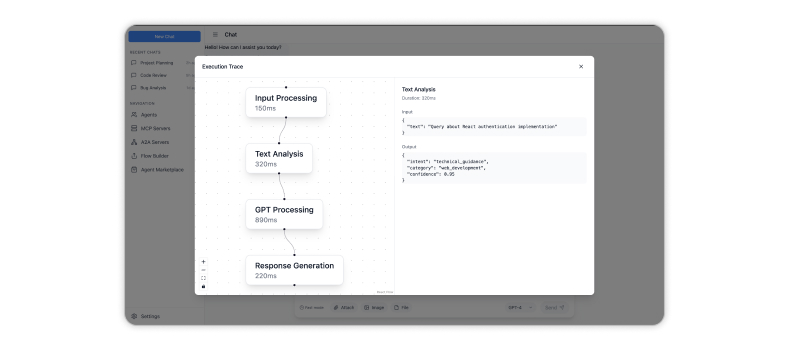
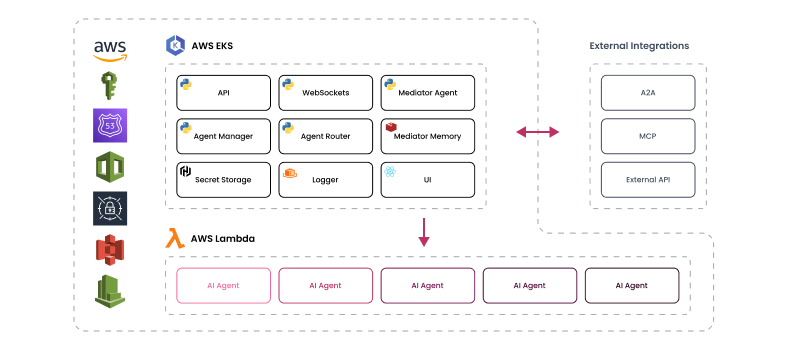
Behind the interface is a scalable generative AI platform designed for AI agent orchestration and agent orchestration frameworks. Enterprise AI systems gain flexibility to connect AI assistants, integrate external services, and process real-time data from multiple data sources.
Quick Project Facts and Key Achievements

Quick Project Facts

Client Industry

Generative AI, Enterprise Artificial Intelligence

Client Location

USA, Europe

Challenge

Creating a unified generative AI ecosystem where AI agents, assistants, and applications collaborate across multiple AI models.

Solution

Full-cycle generative AI platform development focused on AI agent orchestration, model context protocol, MCP architecture, and a custom workflow builder.

Team Size

10 specialists

Timeline

3.5 months, ongoing (6+ months MVP phase)

Project Key Achievements

faster workflow creation through agent orchestration frameworks

40%

reduction in manual coordination between AI agents

5

major large language models unified through MCP servers

higher stability in complex AI systems powered by agentic AI orchestration

Story Behind the Numbers

Challenge

The goal was not simply to build a chatbot. The ambition was to develop a scalable AI system where autonomous AI agents coordinate complex workflows using agent orchestration and model context protocol, the MCP architecture.

Traditional AI applications often rely on previous technologies, such as static integrations or isolated AI tools. These approaches struggle to support complex workflows, customer interactions, and real-time data access from multiple external data sources.

To unlock business value, the platform needed a new orchestration approach capable of managing AI agent capabilities, tool usage, and function calling while maintaining human oversight and strong risk management.

Engagement Stage

Our team joined during the early stages of product development. Architectural decisions centered on the Model Context Protocol (MCP), an open protocol designed to connect AI assistants with external systems and tools.

Instead of building isolated integrations, the architecture relied on MCP hosts, MCP servers, and MCP clients communicating through a transport layer with server-sent events and asynchronous messaging.

This standardized protocol enabled AI agents to retrieve relevant information, access local resources, and interact with remote resources in a plug-and-play environment, much like a USB-C port that connects multiple devices through a single interface.

Transformation

The platform evolved into a modular agentic AI environment where AI assistants, AI agents, and AI tools collaborate through agent orchestration frameworks.

The architecture also supports fine-grained control over tool permissions, data access, and agent performance, ensuring safe interaction between AI systems and enterprise environments while enabling more reliable AI-assisted decision-making in business processes.

Services Provided

  • Generative AI platform development
  • AI agent orchestration architecture
  • MCP server and MCP client implementation
  • Custom AI workflow builder development
  • LLM integration services
  • AI deployment infrastructure design
  • Continuous monitoring and performance optimization
  • Security architecture and risk management aligned with our broader AI-driven software development services

Development Team

  • 2 Python Developers
  • 2 JavaScript Developers
  • 1 ML Engineer
  • 1 DevOps Engineer
  • 2 QA Engineers
  • Team Lead & Architect
  • Project Manager
  • UI and UX Designer

Key Areas for Improvement

Multi-Agent Coordination

Early versions relied on loosely connected agents, which made complex flows unpredictable. Strengthening AI agent orchestration and structured multi-agent communication has become essential to building a reliable execution environment.

Workflow Flexibility

Static execution chains limited experimentation. A need emerged for a custom AI workflow builder that would allow teams to customize agent workflows without rewriting core logic.

LLM Interoperability

Supporting multiple providers required deeper LLM integration services. True Generative AI for agent orchestration demanded seamless switching between models while maintaining stable execution.

Scalability and Deployment

As adoption grew, scalable infrastructure and flexible AI deployment options became critical. The platform had to support both cloud and self-hosted environments to meet enterprise AI expectations.

Ecosystem and Marketplace Readiness

To encourage community growth, the solution needed extensibility. Enabling reusable agents and tool publishing positioned the platform for long-term modernization and AI marketplace expansion.

Our Implementation Approach

Strategy

The architecture was designed around the Model Context Protocol MCP to create a stable orchestration environment for AI agents. Our goal was to enable AI assistants to access external systems, data sources, and remote resources using function calling while maintaining human oversight and security controls.

Development Phases

01
Agent Communication Layer

A foundational communication library was created to support structured tool invocation and stable multi-agent communication between autonomous AI agents operating inside the platform.

02
Protocol-Based Orchestration Engine

A protocol-driven execution engine was developed with support for MCP, Model Context Protocol, A2A, and internal standards, enabling consistent AI agent orchestration across complex workflows.

03
Custom AI Workflow Builder

A modular custom AI workflow builder allowed users to design and customize agent workflows, combine tools, and create reusable logic for different execution scenarios.

04
Dynamic LLM Integration

Advanced LLM integration services enabled dynamic provider switching, fallback handling, and guided execution to maintain reliability across multiple models.

05
Multi-Platform Experience

Web, CLI, and early desktop interfaces were introduced to ensure accessible orchestration while maintaining a unified execution core.

06
Scalable AI Deployment Infrastructure

Cloud-based pipelines and billing logic were implemented to support scalable infrastructure, enterprise AI deployment readiness, and future self-hosted environments.

Technology Stack

  • Backend: Python, Flask
  • Frontend: React, React Flow
  • AI Frameworks: LangChain, LangGraph
  • Protocols: MCP, Model Context Protocol, A2A
  • LLMs: OpenAI, Azure OpenAI, Gemini, LLaMA, Anthropic, Bedrock
  • Infrastructure: AWS Lambda, Redis, PostgreSQL

Product Features

01
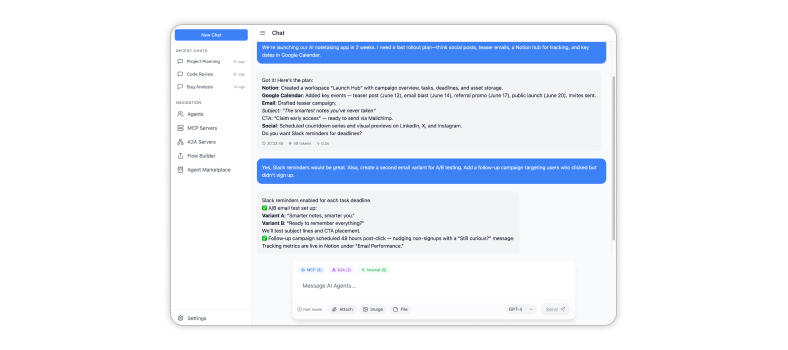
Multi-Agent AI Chat Interface

An interactive interface powered by AI agents, AI assistants, and natural language processing to support customer interactions.

02
Customizable Workflow Builder

A visual tool enabling users to design AI workflows, integrate external tools, and automate repetitive tasks.

03
Protocol-Based Agent Engine

Execution layer implementing Model Context Protocol MCP architecture for reliable agent orchestration.

04
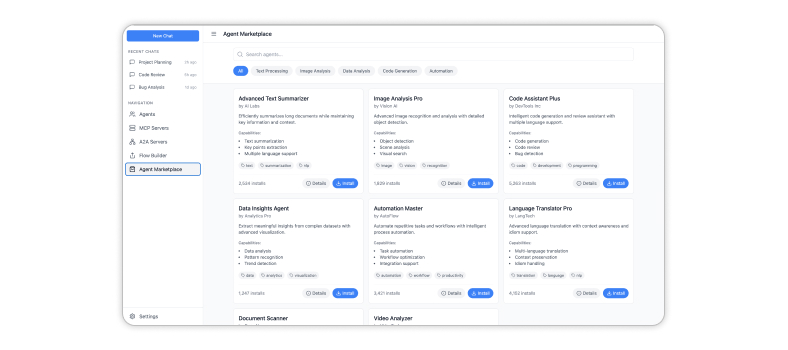
Agent Marketplace

A marketplace where software developers publish reusable AI tools, AI assistants, and AI applications.

05
Cross-Platform Access

Web application, CLI interface, and integrations with development environments that can also host custom AI chatbot solutions for businesses.

06
Cloud And Self-Hosted Deployment

Infrastructure supporting enterprise AI deployment, security monitoring, and scalable AI systems that are suitable for highly regulated domains.

Measurable Improvements

01
2× Faster Workflow Creation

The introduction of a custom AI workflow builder accelerated execution across teams. Users can now customize agent workflows and deploy new logic significantly faster.

02
40% Reduction in Manual Agent Coordination

Structured AI agent orchestration reduced friction between autonomous AI agents and improved multi-agent communication, making complex processes easier to manage at scale.

03
5 Major LLM Providers Unified in One Environment

Advanced LLM integration services enabled seamless use of multiple models within a single platform, strengthening enterprise AI flexibility and supporting long-term AI development goals.

04
3× Higher Stability in Complex Workflows

Protocol-driven execution based on MCP and Model Context Protocol improved reliability across multi-agent communication flows and reduced operational uncertainty.

05
Scalable AI Deployment Across Cloud and Hybrid Environments

The solution supports flexible AI deployment and scalable infrastructure, preparing the platform for enterprise growth and marketplace expansion.

06
Stronger Ecosystem Through Agent Marketplace Enablement

Reusable workflows and extensible orchestration capabilities transformed the solution into a scalable generative AI environment ready for monetization and expansion.

Interested in AdTech Data Management Platform Modernization?

Companies planning to develop a generative AI platform or seeking enterprise AI orchestration solutions can rely on CHI Software as a long-term technology partner.

What We Specialize In

  • Generative AI platform development
  • Generative AI for agent orchestration
  • Custom AI workflow builder development
  • Multi-agent communication architecture
  • LLM integration services
  • Enterprise infrastructure modernization

Businesses We Support

  • Generative AI startups
  • Enterprise AI platforms
  • AI marketplaces and tool ecosystems
  • Technology companies building autonomous AI agents

Let’s bring your idea to
life together!

    Successfully applied!