Time goes by — yet legacy applications are still widely used. Once they helped businesses stand out in the market, but now they do the opposite — they drag companies down.
Organizations continue to maintain heavy monolithic infrastructure, rely on technologies their CTO recommended 20 years ago, and operate with rigid deployment processes.
The consequences are clear: new features are released more slowly, maintenance costs continue to rise, and scalability is barely even discussed. Modern market demands remain unmet. Everyone loses.
Legacy systems were heroes of their time. But time changes technologies, digital workloads, and the factors that determine competitiveness.
And modernization comes to the rescue.
Quick win: Jonas Fitness moved their main app from mainframe to AWS, cutting costs by ~90% in under a year!
And this is far from the only case where application modernization with Amazon Web Services (AWS) has revolutionized outdated systems.
As a leading cloud platform, AWS helps organizations transform legacy software into cloud-based, resilient architectures. AWS is often the reason businesses become more flexible, scalable, and capable of leveraging intelligent capabilities (analytics tools, machine learning) that are essential in a data-driven economy. In addition, AWS can reduce total cost of ownership (TCO) by up to 64%.
And these are only some of the many advantages of running applications on AWS.
In this guide, we will explore how organizations can modernize legacy systems using AWS. We will explain what application modernization means, when companies should begin the process, and how to move through the modernization journey from decision-making to release. You will also learn about the key AWS services that accelerate transformation, along with practical insights and real modernization examples from CHI Software.
What Is AWS Application Modernization?
AWS application modernization is the process of transforming outdated legacy systems using AWS cloud services combined with modern architectures and advanced development practices. The primary purpose of AWS modernization is to convert legacy applications into scalable, resilient, cloud-native platforms.
So what exactly does modernization “modernize”? Typically, it includes several strategic changes.
Organizations often begin their transformation by migrating applications to the cloud to gain access to managed services. At this stage, it is important not only to move away from monolithic systems but also to update business logic to ensure proper operation and minimize risks.
The next major transformation is restructuring monolithic architectures into microservices.
Why is this important? The more a system is broken down into smaller components, the more flexible it becomes. This dramatically increases scalability and adaptability. The transition from monoliths to microservices is usually supported through containerization.
Databases are also often upgraded to cloud-native or managed solutions. Security and scalability improve through automated monitoring, access management systems, and infrastructure-as-code practices.
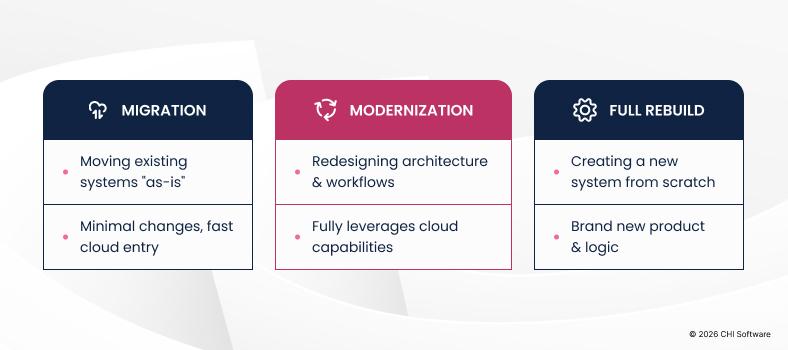
Side note: how to distinguish modernization from simple cloud migration?
- Migration means moving systems to the cloud with minimal changes.
- Modernization implies deeper transformation of architecture and processes.
- Rebuild means creating the system from scratch.
Why Businesses Choose Application Modernization With AWS
There are many cases where companies prioritize modernization investments. So why do they often choose AWS?
First, visible stagnation.
Over time, infrastructure becomes increasingly complex, technical debt accumulates, and development cycles slow down. Statistics and operational data clearly demonstrate this (if the metrics are properly tracked).
Businesses realize that:
- teams spend more time maintaining unstable systems than building new features
- monolithic applications struggle to handle modern workloads, especially during demand spikes
- maintenance costs for old systems continue to grow
Global legacy spending is estimated to exceed $1.5 trillion per year.
The problems are numerous — but AWS application modernization helps solve them.
AWS provides flexible cloud infrastructure that scales dynamically according to business needs. As a result, organizations gain:
- Faster time-to-market. Docker containers simplify scaling and application development, making releases easier and faster.
- Greater flexibility. A modular microservices architecture allows teams to modify individual components without affecting the entire system.
- Improved security. RBAC, single sign-on (SSO), and AWS multi-account environments allow teams to deploy and manage infrastructure without sacrificing business flexibility or governance.
- And finally — AWS allows businesses to scale without fear. Teams can run a single application instance or scale systems to thousands of instances to support continuous integration, delivery, and product improvement.
As a result, AWS modernization can reduce overall technology costs by about 20%, and infrastructure costs by 30–50%.
Step-by-Step of AWS Application Modernization Process
Technology does not tolerate chaos. Application modernization is not a chaotic process either.
Successful transformations require a roadmap — one that guides organizations step by step toward stability and technological maturity.
A structured approach reduces risks and gradually unlocks the full potential of cloud architectures.
Let’s begin.
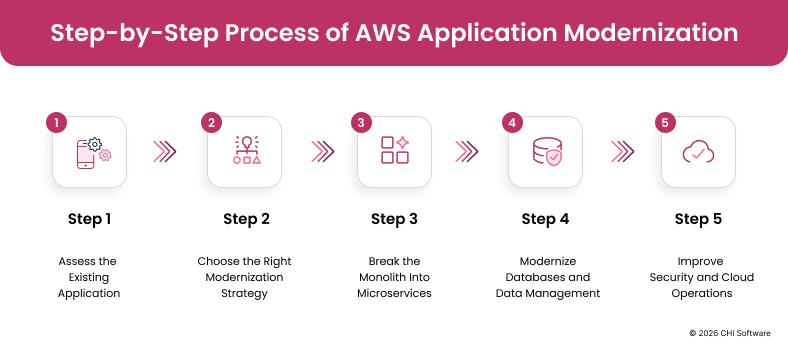
Step 1: Assess the Existing Application
The first step is gaining a complete understanding of the current system.
Legacy environments have evolved over years, forming complex networks of dependencies between services, databases, and infrastructure components. It is easy to get lost in this maze.
During assessment, organizations analyze:
- application architecture
- service interactions
- database structure
- infrastructure usage
- performance metrics
AWS assessment tools help quickly identify dependencies, evaluate resource utilization, and determine migration readiness. (We will discuss AWS tools later in this article)
This enables organizations to create a clear, data-driven modernization roadmap.
Step 2: Choose the Right Modernization Strategy
After assessing the current environment, the next step is planning the future — defining the modernization strategy.
Not every application requires the same modernization approach. AWS offers the 6R model, which helps determine the optimal strategy.
Choosing the right strategy allows organizations to modernize systems without disrupting critical business processes.
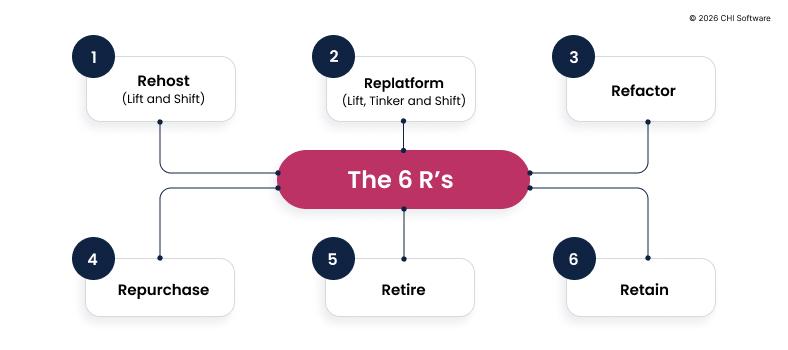
- Rehost involves moving applications to the cloud with minimal changes. It is the fastest way to migrate workloads while immediately benefiting from cloud infrastructure.
- Replatform introduces small architectural improvements during migration, such as switching to managed databases or container platforms.
- Refactor represents deeper transformation. Applications are redesigned to fully leverage cloud-native architectures such as microservices or serverless computing.
- Repurchase replaces legacy software with modern SaaS solutions when maintaining internal systems is no longer practical.
- Retire eliminates outdated applications that no longer deliver business value.
- Retain keeps certain systems unchanged when modernization is not immediately necessary.
Choosing the right strategy allows organizations to modernize systems without disrupting critical business processes.
Step 3: Break the Monolith Into Microservices
Many legacy applications were originally built as monolithic systems where all functionality exists within a single codebase.
Today, this approach severely limits scalability.
Microservices break large systems into smaller, independent services that can be developed, updated, and scaled separately without risking system-wide failures.
This enables teams to release new features faster and scale only the components that require additional resources.
AWS provides a broad ecosystem for microservices — from container platforms to serverless architectures.
Here’s an example.
One of our clients — a global investment company — needed to modernize its trading platform. At CHI Software, we transformed their monolithic system into a microservices architecture on AWS.
As a result, the company achieved:
- 5× scalability
- 60% faster system performance
- 30% improvement in security and compliance
- significantly faster release cycles
By embracing microservices, organizations transform rigid systems into agile digital platforms ready for continuous innovation.
Step 4: Modernize Databases and Data Management
Where application modernization is implemented, modernization of the data layer becomes unavoidable.
Database modernization typically begins with migrating legacy systems to cloud-based managed databases. Managed services reduce administrative overhead while providing automated backups, patching, and high availability.
Beyond migration, organizations frequently restructure data architectures to support real-time analytics and AI-driven insights. AWS enables advanced analytics and machine learning capabilities, empowering organizations to extract deeper insights from their data and drive innovation. These advanced analytics tools, combined with machine learning, are critical for transforming legacy systems and enabling data-driven decision-making.
Amazon Web Services provides a powerful set of AWS resources for managing large datasets and high-performance workloads. These tools enable organizations to process data at scale while maintaining reliability and security.
CHI Software recently demonstrated this approach while modernizing a digital assessment platform for a Norwegian EdTech company. The modernization introduced a cloud-native data architecture that integrated analytics, AI-based grading, and adaptive assessment capabilities. By leveraging AWS technologies, the platform significantly accelerated grading workflows by 70% and improved data-driven insights, enabling 45% earlier identification of students at risk through the assessment system modernization.
Modern data architectures unlock actionable intelligence, allowing organizations to transform raw information into strategic advantage.
Step 5: Improve Security and Cloud Operations Modernizing Applications
Where manual processes dominate — and they are common in legacy systems — security risks inevitably emerge. That is why security and operational resilience are among the key goals of application modernization.
Modern cloud environments are designed with these challenges in mind. When modernizing applications, they provide automated security mechanisms and continuous monitoring, ensuring organizations maintain full visibility and can respond quickly to potential threats.
AWS is widely recognized as one of the leaders in cloud security. Tools such as AWS IAM and Amazon GuardDuty provide encryption and automated threat detection. Meanwhile, the infrastructure-as-code approach enables teams to define infrastructure programmatically, ensuring consistency across environments and reducing the risk of configuration errors.
By modernizing security and operations alongside application architecture, organizations build resilient platforms capable of scaling safely and efficiently.
Key AWS Tools for Application Modernization
AWS provides a powerful ecosystem of tools designed to accelerate application modernization and reduce operational complexity for applications in the AWS Cloud.
AWS Migration Hub centralizes migration tracking and helps organizations coordinate large modernization projects across multiple applications and teams. During migration and modernization, orchestrating business logic is crucial to ensure data migration, infrastructure updates, and application functionality are aligned, minimizing risks and technical debt.
AWS Lambda enables serverless computing, allowing developers to run code without managing infrastructure. This model is ideal for event-driven workloads and microservices architectures, supporting the modernization of applications in the AWS Cloud by increasing agility and scalability.
Amazon ECS and Amazon EKS provide robust container orchestration platforms. These services simplify deploying and managing containerized applications at scale, making them essential for modernizing applications in the AWS Cloud and supporting microservices-based approaches.
AWS Database Migration Service (DMS) helps organizations migrate databases securely and with minimal downtime. It supports both homogeneous and heterogeneous database migrations, facilitating the modernization of data layers within applications in the AWS Cloud.
Amazon CloudWatch delivers powerful monitoring and observability capabilities. It collects metrics, logs, and events across AWS environments, enabling teams to maintain visibility and respond quickly to operational changes during and after modernization.
In addition to these tools, AWS Partners and Managed Services Providers offer professional services, delivering specialized expertise and operational support to help organizations modernize applications and optimize their AWS environments.
Together, these tools and professional services form a resilient modernization toolkit that empowers organizations to transform legacy systems into scalable, cloud-native platforms.
Common Challenges in AWS Application Modernization
Despite its advantages, modernization can present several challenges. Legacy systems often contain deeply interconnected components that make architectural changes complex. Untangling these dependencies requires careful planning and technical expertise.
Data migration is another common obstacle. Large databases must be transferred securely while maintaining integrity and minimizing downtime. Even small inconsistencies can disrupt critical business operations.
Skill gaps also pose a challenge for organizations transitioning to cloud environments. Teams may need to develop expertise in container orchestration, infrastructure automation, and modern DevOps practices.
Operational disruptions during migration must also be carefully managed. Systems must remain available while modernization efforts progress in parallel.
These risks can be significantly reduced through a clear modernization roadmap and experienced cloud engineering teams. With the right strategy and expertise, organizations can navigate modernization confidently while maintaining business continuity.
Conclusion
Legacy systems once powered digital transformation. Today, they often slow it down. AWS application modernization provides a transformative pathway for turning outdated infrastructure into resilient, scalable, and cloud-native platforms.
By modernizing architecture, upgrading data systems, and automating operations, organizations gain the agility needed to innovate at high velocity. Development cycles accelerate, performance improves, and operational costs become far more predictable.
To maximize success, organizations should start with manageable pilot projects to demonstrate quick wins in their AI modernization journey. Successful AI pilots provide valuable insights for enterprise-wide scaling and help capture the transformative potential of AI. AI adoption is an iterative process that relies on continuous learning and adaptation — ongoing improvement, education, and refinement are essential to keep pace with technological advancements.
As cloud adoption continues to expand across industries, modernization is becoming a strategic priority rather than a technical upgrade. Companies that modernize their applications today position themselves to harness the full power of cloud computing, AI, and data-driven decision-making tomorrow.
FAQs
-
What is AWS application modernization?

AWS application modernization is the process of transforming legacy software systems using AWS cloud services, modern architectures, and automated development practices. It typically involves migrating applications to the cloud, redesigning monolithic architectures into microservices, upgrading databases, and improving security and scalability.
-
How long does application modernization with AWS take?
The timeline varies depending on system complexity, architecture, and modernization strategy. Smaller applications may be modernized in a few months, while large enterprise systems can require phased transformations over one or two years to ensure stability and minimize operational disruption.
-
What are the main AWS modernization benefits?
The key benefits include improved scalability, faster development cycles, stronger security, reduced infrastructure costs, and the ability to integrate modern technologies such as AI, analytics, and real-time data processing.
-
Can startups benefit from AWS app modernization?
Yes. While startups may not always have legacy systems, modernization principles help them build cloud-native architectures from the beginning. This ensures their platforms remain scalable, resilient, and ready to evolve as their products and user bases grow.
-
What tools are used for legacy application modernization on AWS?
Common tools include AWS Migration Hub for migration tracking, AWS Lambda for serverless computing, Amazon ECS and EKS for container orchestration, AWS Database Migration Service for data transfer, and Amazon CloudWatch for monitoring and operational visibility.
About the author
Yana oversees relationships between departments and defines strategies to achieve company goals. She focuses on project planning, coordinating the IT project lifecycle, and leading the development process. In their role, she ensures accurate risk assessment and management, with business analysis playing a key part in proposals and contract negotiations.
Rate this article
27 ratings, average: 4.8 out of 5