If the legacy BI system you’ve been using for decades is still working smoothly, and you don’t even think about BI modernization…
Consider yourself lucky — but don’t get too comfortable.
Imagine it’s Black Friday: a marketing manager notices a sudden drop in reach for a key ad campaign. Naturally, they turn to the BI system they’ve trusted for years to analyze the data, check competitor statistics, and identify bottlenecks. But the system hits a data limit. You need to upgrade to a Pro package.
Between two days for approval, another day for the migration to the new tier, and the time spent reconfiguring system connections, the BI tool is finally ready to show ad analytics again.
Then comes the next hurdle: the data hasn’t been updated since yesterday. On days like Black Friday, each passing minute turns into lost money. Marketers often abandon slow BI dashboards to manually check Google Ads, Meta Ads, and the CRM just to keep up. They needed a decision making solution yesterday, not tomorrow.
Low scalability, lack of flexibility, delayed decision making, unplanned expenses, and a burnt-out marketer are all symptoms of a system that missed its window for BI modernization.
This scenario is just one of many pitfalls awaiting a business that avoids a BI system modernization. In this article, we will explore why an organization requires business intelligence modernization, outline the typical modernization journey toward full performance, and identify the core components that require your attention.
Stay with us!
What Business Intelligence Modernization Really Means?
In most companies, BI modernization begins with a flawed assumption: that it is merely the act of swapping one tool for another. In reality, business intelligence modernization is a comprehensive transformation of the entire analytical ecosystem. It stretches from the foundational data architecture and data sources to the logic governing metrics, governance, and overall approach to decision making.
Modernizing business intelligence represents a complete overhaul of the entire analytical ecosystem. When executed correctly:
- The costs associated with maintaining legacy BI begin to plummet;
- Conflicts between metrics from different BI platforms move toward zero;
- System stability improves, increasing confidence in reports;
- New opportunities for integration with machine learning and AI tools emerge;
- Data-driven decisions are reached in seconds rather than days.
The example of Databricks illustrates this efficiency perfectly: just five months after their business intelligence platform modernization, they migrated over 1,300 dashboards, cut $880K in annual costs, and delivered 5x faster performance with 80% higher user satisfaction.
Therefore, the core strength of business intelligence platform modernization lies in creating a single source of truth. It ensures that all reports and dashboards are based on unified metrics rather than fragmented Excel files or crumbling legacy BI systems.
Is your BI stack slowing down the decision-making process at board level, and do you know how much it's costing you to maintain legacy reports?
Get a Free BI Readiness Assessment
Why Companies Need Business Intelligence Modernization?
About 94% of organizations see data and analytics as critical to growth. However, only 3% of companies can process data in seconds; most still rely on manual spreadsheets.
Modern business operates in an environment of exploding data volumes, fierce competition, and a desperate need for data driven insights. Traditional BI tools simply cannot keep up, leading to rising service bills and outdated data that slows down essential processes.
In one of our previous articles, we outlined typical legacy modernization examples, showcasing real-life success stories from companies around the world.
Rising Licensing And Maintenance Costs
Maintaining legacy BI often involves expensive licenses, custom-coded patches, and a mountain of technical debt. A BI system modernization allows an organization to significantly reduce these overheads. According to CHI Software’s findings, over half of businesses dedicate more than 50% of their IT budget to sustaining outdated systems.
Time-Consuming Manual Reporting
Many teams still waste hours on manual report generation. This drain on efficiency slows down internal processes and prevents real-time reactions to a fast-paced market.
Slow Access To Trusted Insights
In legacy BI environments, extracting actionable insights can take days. In today’s high-speed market, this delay is an unacceptable risk that compromises your competitive advantage.
Low Adoption Of Legacy BI Tools
Old BI tools usually feature clunky, non-intuitive interfaces that hinder onboarding and slow down the transfer of dashboards between specialists. Because of the poor UI/UX, engagement drops. Instead of driving efficiency, these tools become redundant “data graveyards” that fail to contribute to the company’s growth.
Conflicting KPIs And Versions Of The Truth
Poor user experience lowers engagement and leaves dashboards unused. Modern BI should establish a common understanding of metrics across teams. Legacy BI tools struggle with unification; they might collect data in one place but leave the final “truth” to be manually adjusted by an analyst. This creates a fragmented view of performance.
Limited Scalability For Cloud And AI Growth
Without transitioning to a modern BI architecture, companies quickly hit a technical ceiling. In legacy BI systems, analytics are often built on rigidly coupled data sources and limited local computing resources.
As data volumes grow, the system begins to degrade: queries take longer, dashboards crash under load, and new use cases become prohibitively expensive. According to Gartner and McKinsey, over 70% of companies face scaling issues when moving to data-driven models if their architecture wasn’t modernized in advance. Furthermore, integrating machine learning requires access to clean, massive datasets and a flexible data architecture — something nearly impossible in a legacy environment.
Growing Governance And Compliance Risks
As a business grows, data control shifts from a technical concern to a business-critical one. In older systems, governance is often a manual, undocumented process with limited auditing. This introduces a triple threat:
- Decision making risk: Conflicting data versions damage accuracy.
- Security risk: The median cost of a data breach exceeds $4.4 million, largely driven by uncontrolled access in older environments.
- Compliance risk: Regulations like GDPR require transparent data usage and audit trails, which are rarely fully implemented in legacy BI.
Get a prioritised modernisation plan without disrupting daily analytics, assess your current BI environment, identify which reports can be retired, consolidated, or migrated, and deliver a prioritised modernisation plan. All without disrupting your daily analytics.
Request a Legacy BI Audit
Steps in the BI Modernization Journey
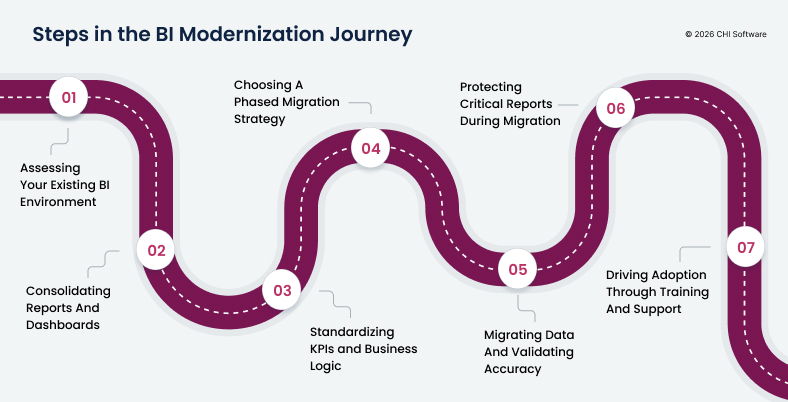
An effective BI modernization, like all legacy software modernisation services, is a phased approach, not a “Big Bang” replacement. While it is tempting to use AI tools like Anthropic to simply “fix” legacy code, true success requires strategic planning. Anthropic’s Code Modernization Playbook emphasizes that quality digital transformation requires an honest assessment of organizational capabilities.
Assessing Your Existing BI Environment
Fixing legacy code isn’t the main goal — strategic planning is. Start with a complete inventory of your Business Intelligence environment. You must track the number of available reports, their users, and the data sources they draw from. Audits often reveal that 40–60% of existing dashboards haven’t been opened in a year. This stage also includes a technical audit of metadata and SQL complexity.
Consolidating Reports And Dashboards
Before moving to a new home, you must clear out the clutter. Consolidation involves merging similar reports into functional, multi-level dashboards. The goal is to reduce the maintenance burden while increasing the density of insights.
Standardizing KPIs and Business Logic
This is the most difficult but important stage. Move calculation logic into a central layer. When margins are hardcoded across different reports, updates become error-prone and inconsistent.
Choosing A Phased Migration Strategy
It is disastrous to cut over in one day. Instead, migrate high-impact areas first (like sales dashboards) to secure early wins and build user trust gradually.
Migrating Data And Validating Accuracy
Once the architecture is ready, data transfer begins. Accuracy validation is paramount here; users will not forgive a new system if the numbers don’t match the old ones, even if the old ones were technically flawed.
Protecting Critical Reports During Migration
A business cannot stop operating for repairs. You must achieve BI modernization without losing reports that govern daily operations, such as inventory levels or financial balances. This often requires a “hybrid state” where both systems run in parallel.
Driving Adoption Through Training And Support
Even the most advanced modern BI system will be ignored without proper training. The journey ends not when the code is written, but when users can confidently navigate the new BI solutions to find the answers they need.
In our previous article, we explained how your company can use an app modernization roadmap to move from addressing issues related to legacy systems to achieving tangible business benefits.
Core Components of Business Intelligence Modernization
In line with legacy modernization trends, modern BI is a sophisticated engine where every part plays a specific role in creating a holistic view of the organization.
Let’s look at the “gold standard” of modern architecture.
Cloud Migration For Scalability And Flexibility
The cloud is the foundation. Platforms like Snowflake, Google BigQuery, or Microsoft Azure Synapse Analytics enable instant resource scaling. Platforms like Snowflake or BigQuery allow you to quickly add or remove resources. You can spin up capacity to analyze a terabyte for an annual report, then shut it down to reduce costs — a level of flexibility traditional on-premise servers can’t match.
Governed Self-Service Analytics For Faster Decisions
Governed self-service is about balancing freedom and control. Users gain access to trusted datasets and can create their own visualizations using drag-and-drop interfaces. At the same time, IT retains control over data access and quality but is no longer a bottleneck for every new dashboard or report. High usability increases adoption across roles, from warehouse staff to executives.
AI And Machine Learning For Actionable Insights
Modern BI integrates AI directly into the user interface. Modern BI allows users to ask questions like “What were the sales in Oslo last Tuesday?” and get instant visual answers. Algorithms proactively highlight unusual patterns, such as: “This metric has dropped unexpectedly,” enabling managers to act before issues escalate.
Semantic Layers For Consistent KPIs And Reporting
The semantic layer acts as a translator between the language of databases (tables, keys, joins) and the language of business (customers, revenue, regions). It ensures a true “single source of truth.” Regardless of the visualization tool — Microsoft Power BI, Tableau, or Looker — they all rely on the same semantic definition of data.
Automated Data Pipelines For Near Real-Time Analytics
Instead of moving large batches of data once per day, modern data pipelines operate continuously. Tools like Fivetran, Airbyte, or dbt automate the flow of data from source to warehouse within minutes. This ensures analytics remain up-to-date and relevant in near real time.
Access Controls And Auditability For Trusted BI
Trust in data starts with security. Modern systems support Row-Level Security (RLS), meaning two managers can open the same report but see different data — one for the USA, another for Germany. Audit capabilities allow organizations to track who accessed what data and when, which is critical for compliance with international security standards.
Benefits of Business Intelligence Modernization
Investing to modernize your stack yields returns that go far beyond “better looking charts”
Faster Decision-Making With Trusted Data
When a leader gets an answer in 5 seconds instead of 5 days, the quality of management improves exponentially.
For example, when an Italian AdTech company partnered with CHI Software to modernize their system, converting a monolithic architecture into microservices, their operational speed increased by 30%.
Lower Reporting Licensing And Maintenance Costs
While there are upfront costs, the Total Cost of Ownership (TCO) is lower in the long run. Shifting from expensive local licenses to cloud-based efficiency provides a significant boost to the operating budget.
Greater Efficiency Through Automation
Automation frees up your most expensive resource: your analysts’ brains. Instead of manual data cleaning, they can focus on machine learning, pattern recognition, and strategic planning.
Better Adoption Through Governed Self-Service
When a tool is as easy to use as a smartphone, everyone — from warehouse staff to the CEO — starts using it. This fosters a true data driven culture.
Stronger Agility And Board-Ready ROI
A modernized system allows a company to pivot quickly. Whether integrating a new acquisition or launching a new product, the BI modernization without losing reports ensures that your performance tracking remains uninterrupted.
Ready to build the business case for BI modernization? We help CIOs and CEOs develop board-ready financial justifications for BI modernization based on your current licensing costs, infrastructure spend, and ARR. Fixed-price pilot available.
Get an ROI Estimate
Common BI Modernization Challenges and Risk Controls

The path to BI modernization is full of hidden pitfalls. Understanding the risks is already half the battle in overcoming them.
Inconsistent Metric Definitions Across Reports
This is often the legacy of years of unstructured growth. Different departments get used to calculating key metrics — such as profitability — in their own ways. The main risk during modernization is triggering a “holy war” over definitions. When BI is poorly configured, management may optimize for the wrong indicators, which distorts Rule of 40 interpretation, hides EBITDA leakage, and weakens ARR forecasting.
Risk control: To avoid “metric wars” create an interdepartmental team to agree on a unified KPI glossary before development begins.
Duplicate Logic And Shadow Reporting
Even after implementing a new system, users may continue maintaining their own Excel files and parallel reports — commonly known as Shadow BI. Your analytics environment is built around BI platforms and data warehouses designed mainly for scheduled, human-facing reports. While your data engineering layer reliably transfers data across systems, it often loses critical context along the way. Real-time streaming tools process live events, but struggle to link insights across different business areas. Meanwhile, your machine learning capabilities remain siloed, operating separately from actual operations.
Risk control: Decommission legacy data sources in stages while engaging feedback groups to resolve any usability issues in the new system.
Complex Report And Data Source Dependencies
Legacy systems often evolve into “spaghetti architecture,” where reports depend on other reports, which in turn rely on outdated procedures written years ago—sometimes by employees who are no longer with the company.
Risk control: Use automated data lineage analysis tools to visualize all dependencies before starting the migration.
Large-Scale Migration Risks And Downtime Fear
Concerns about maintaining operational continuity and service reliability often stall modernization. Organizations struggle to balance run vs. change without compromising control execution or regulatory compliance.
Risk control: Apply a Blue-Green deployment strategy with phased user switching. Keep the legacy system in read-only mode until the new environment is fully validated.
Matching New Dashboards To Legacy Outputs
Modern BI tools may visualize and aggregate data differently, leading to discrepancies caused by rounding or changes in aggregation logic.
Risk control: Define acceptable variance thresholds and thoroughly document why the new system’s numbers are more accurate and reliable.
Worried about breaking critical reports during migration? We use phased Strangler Pattern delivery with validation checkpoints and a documented rollback plan at every stage to ensure zero loss of report accuracy.
See How We Protect Business Continuity
How To Choose Business Intelligence Modernization Services
Selecting a partner is a strategic choice. You need more than just report developers; you need data architects and ETL engineers to design pipelines and validation tests. Look for vendors with demonstrated experience in platforms like Snowflake or BigQuery. When evaluating business intelligence modernization services, look for:
- Legacy Stack Experience: If they don’t understand how your old system worked, they can’t migrate it properly.
- Cloud Expertise: Deep knowledge of modern warehouses is non-negotiable.
- Change Management: They should have a plan for training your people, not just delivering a login.
- Domain Understanding: They should understand business metrics like LTV or Churn Rate, not just SQL queries.
Choosing the right business intelligence modernization services is the difference between a successful transformation and a costly mistake.
Conclusion
The era of big data demands speed, systemic thinking, and a commitment to innovation. BI modernization is no longer a luxury; it’s a must-have. It allows your company to stop looking back and start seeing exactly where it’s headed.
By committing to a BI system modernization and ensuring you achieve BI modernization without losing reports, you allow your company to stop looking at where it was and start seeing exactly where it is going. The world doesn’t wait for your reports; it reacts to your actions. Make sure those actions are backed by the rock-solid logic of modernized data.
FAQs
-
What is BI modernization?

BI modernization represents a comprehensive overhaul of an organization's entire analytical ecosystem rather than a simple software replacement, such as moving from manual spreadsheets to a basic dashboard. This digital transformation fundamentally reshapes data architecture and collection methods while standardizing business logic to foster a genuine data driven culture. Ultimately, the goal is to ensure that insights are fast, flexible, and accessible to stakeholders at every level of the business, effectively removing the dependency on IT departments for routine data needs.
-
What role does data governance play in BI modernization?
Within any modernization journey, data governance serves as the essential foundation of trust. Without rigorous rules regarding access, metrics definitions, and quality control, even the most advanced modern BI platform will inevitably produce unreliable results. Effective governance establishes a single source of truth that ensures every department interprets KPIs identically, while simultaneously strengthening security by controlling access to sensitive information and maintaining compliance with global standards like GDPR.
-
How long does a business intelligence modernization usually take?
The timeline for business intelligence modernization typically varies based on the organization's scale, existing data volumes, and the complexity of its legacy BI systems. Full modernization can take 6-18 months, but a phased approach delivers value within the first 2-3 months. By adopting an iterative strategy rather than a high-risk "Big Bang" migration, a company can modernize its infrastructure incrementally without disrupting its core operational processes.
-
How can companies migrate reports and dashboards without losing data accuracy?
Maintaining accuracy during the transition is a primary challenge that requires several strategic safeguards. Run parallel testing by operating the legacy BI system alongside the new platform simultaneously to confirm matching outputs. Furthermore, by moving calculation logic into a centralized semantic layer and utilizing automated validation scripts, companies can successfully migrate reports and dashboards while ensuring that the integrity of their performance data remains uncompromised.
-
What are the benefits of moving BI workloads to the cloud?
Moving BI workloads to the cloud offers strategic advantages that simply cannot be replicated by on-premises servers. Cloud migration provides unparalleled scalability, allowing a business to instantly expand its processing power to handle massive data volumes and scale back down to optimize its budget. Additionally, the pay-as-you-go model eliminates heavy hardware maintenance costs, while cloud-native integrations with machine learning and advanced BI solutions empower companies to move beyond basic reporting into the realm of predictive analytics and increased efficiency.
About the author
Ivan keeps a close eye on all engineering projects at CHI Software, making sure everything runs smoothly. The team performs at their best and always meets their deadlines under his watchful leadership. He creates a workplace where excellence and innovation thrive.
Rate this article
27 ratings, average: 4.8 out of 5