Infrastructure Modernization: Strategy, Components, and How CHI Software Can Help
Introduction
Infrastructure modernization is the process of moving from legacy IT systems to a modernized setup that supports rapid scaling and advanced data management. For CIOs, CTOs, and IT leaders, infrastructure modernization is a critical initiative that directly impacts business agility, security, and long-term growth.
This article explores the strategy, key components, and CHI Software’s role in guiding organizations through successful infrastructure modernization. By modernizing infrastructure, organizations gain a pathway to sustainable growth, equipping themselves with the tools to innovate, scale, and protect their assets.
In today’s rapidly evolving marketplace, modernizing infrastructure is essential for maintaining competitiveness and resilience.
Key Takeaways
- Infrastructure modernization is a pathway to sustainable growth, equipping organizations with the tools to innovate, scale, and protect their assets.
- Modernizing infrastructure is critical for organizations seeking to maintain competitiveness and resilience in a developing marketplace.
- The process involves updating, optimizing, and replacing outdated physical, digital, and operational systems.
- CHI Software provides end-to-end support, from assessment and strategy to implementation and ongoing optimization.
Summary:
Infrastructure modernization is the strategic updating, improvement, and replacement of out-of-date systems — physical, digital, and operational — and the processes we engage in daily.
Who should read this? CIOs, CTOs, IT leaders, anyone responsible for digital transformation and organizational leadership wanting to maintain a competitive edge. What you will learn? An overview of infrastructure modernization, as well as strategies, components, and implementation with CHI Software. Don’t fall behind the curve by avoiding infrastructure modernization. Falling behind today could mean your business and partnerships never catch up.
Definition:
Infrastructure modernization is a shift away from legacy systems into a familiarized space with the ability to rapidly scale and advanced data engineering capabilities. It’s a proactive measure to avoid getting left behind. It’s the strategic updating, improvement and replacement of out-of-date systems—physical, digital, and operational—and the processes we engage in daily.
What Is Infrastructure Modernization?
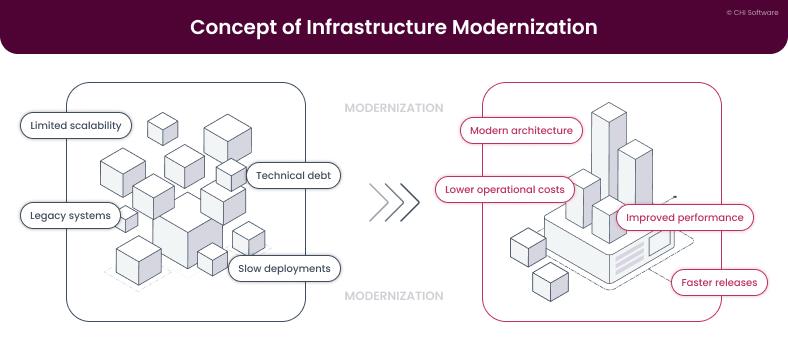
Infrastructure modernization transforms legacy systems and on-premises infrastructure into automated, scalable platforms. Most organizations running on older IT systems face predictable problems:
- High maintenance costs that drain revenue
- Limited scalability and slow deployment cycles
- Increased vulnerability to security threats
- Difficulty meeting compliance and regulatory requirements
To modernize infrastructure, you do not need to replace all physical infrastructure at once. Effective infrastructure modernization solutions combine software updates with targeted hardware replacements, enabling a phased and cost-effective approach.
We recommend replacing outdated servers with cloud computing, containers, and CI/CD pipelines. This helps you deploy applications faster and supports your overall digital transformation, especially when you follow a structured app modernization roadmap from legacy to cloud-native.
Real-World Example
A US regional bank used Microsoft Azure APIs to update its IT systems. The core transactional logic stayed on premises, while customer services moved to the cloud. They launched mobile banking in months, similar to how FinTech software development services help financial institutions roll out secure digital products rapidly. This hybrid cloud setup provided reliable backup storage and improved infrastructure reliability.
Our Approach to Infrastructure Modernization
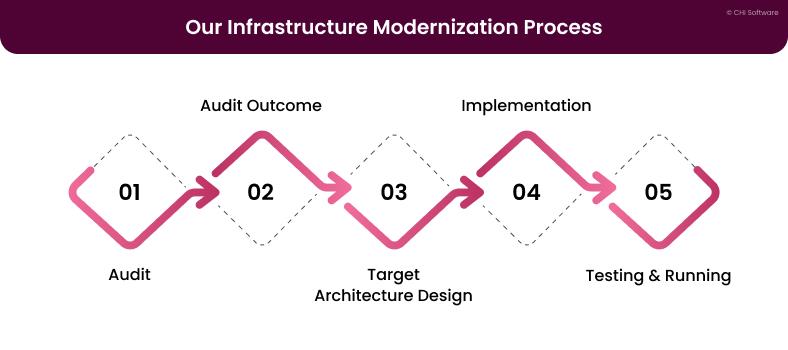
A successful transformation happens in phases. For infrastructure modernization, we begin by conducting an audit of your current systems and legacy applications. Based on the outcome of the audit, we will design a for your technology systems. This stage involves prioritizing initiatives that will significantly minimize disruptions to your organization’s operations and align with our broader legacy software modernization services. Often, the best solution involves leaving your existing legacy systems as they are and connecting them to your new technologies via APIs.
What Modernization Efforts Can Do for You
Bridging the Physical and Digital with Predictive Intelligence
- Predictive Maintenance: Installing IoT sensors in your data center allows you to track real-time data from your data center. Tracking data allows for the ability to prevent any downtime or failures in your data center when it’s supported by a strong data infrastructure built in 7 key steps.
Unlocking Limitless Elasticity via the Cloud
- Cloud Scaling: Cloud environments allow you to have on-demand resources according to your need. Additionally, the cloud providers typically offer enhanced security features and lower costs in comparison with your current data center costs.
Accelerating Business Agility
- Agility: With software-defined networking, your network can be reconfigured in minutes rather than days. This agile infrastructure allows your organization to respond quickly to business needs.
Advancing Sustainability
- Sustainability: Infrastructure technologies can be configured to require less energy to operate. This benefit allows your organization to curtail its environmental impact and align with sustainability goals.
Why Modernize Infrastructure Now?
Aging IT infrastructure can cost your organization money. The continued delay in modernizing your infrastructure can cause you to face various challenges and costs money.
Pain Points of Legacy Environments
Organizations using outdated IT systems face various challenges. For example, technologies cannot meet data processing demands from applications like artificial intelligence or data analytics. Additionally, these systems may not comply with data regulations. Finally, outdated applications are susceptible to cyber-attacks, and your organization must improve its cybersecurity.
Competitive Pressure
If your competitors have implemented new IT infrastructure, you may fall behind the competition. To remain competitive, your organization needs to invest in a new infrastructure. At CHI Software, we focus on helping organizations reduce their total cost of ownership.
Even with tight budget constraints, we can help you achieve cost savings. Nonetheless, doing nothing at all about your aging IT infrastructure is the most costly choice. Key Components of Infrastructure Modernization
Modernization can reduce operational costs through lower energy consumption, less frequent hardware maintenance, and simpler IT management. A modern IT environment relies on modular design and DevOps principles, as demonstrated in multiple real-world legacy modernization case studies.
Microservices and Modular Design
- Microservices: Monoliths fail as a single unit. We break apps into independent services.
Decoupling and Portability
- Decoupling: Tools like Docker make workloads portable. This helps you avoid vendor lock-in.
Performance and Autoscaling
- Speed: We use autoscaling to maintain high performance. Improved performance directly increases customer satisfaction.
Cloud Models
We help you choose the right technologies, including advanced AI-driven software development capabilities:
- Re-hosting: Fast lift-and-shift.
- Re-platforming: Using managed cloud technologies.
- Re-architecting: Full cloud rebuild.
- Hybrid/Multi-Cloud: Keep sensitive data in a private cloud or on-premise, while running customer apps in public clouds. These hybrid environments offer maximum flexibility.
Security and Automation
Security plays a crucial role. We focus on embedding security into every layer using zero-trust architecture. DevOps pipelines allow you to automate processes, automating tasks like testing and code deployment. This makes operations cost-effective and helps reduce costs caused by manual human errors, all in line with CHI Software’s company-wide engineering standards.
Business Benefits and Execution
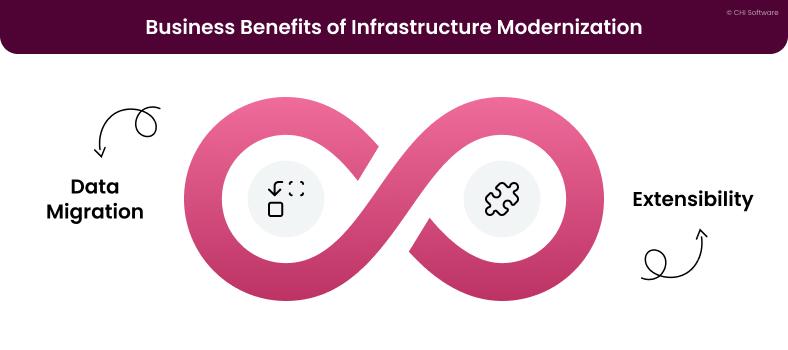
These modernization efforts drive operational efficiency and business agility. Over two to three years, companies see measurable cost savings.
- Data Migration: We manage phased migrations with validation checkpoints to guarantee business continuity and operational continuity.
- Extensibility: You must future-proof your platform. Technological advancements happen fast. Modern infrastructure provides the foundation for strategic initiatives and other strategic initiatives like IoT.
How to Build and Execute an Infrastructure Modernization Strategy
- Assess: Audit your hardware and costs.
- Engage: Align IT with business goals and specific business needs.
- Set Metrics: Define strict key performance indicators (KPIs).
- Execute: Run pilots first, then migrate core systems.
Challenges and Risks in Infrastructure Modernization
Legacy System Integration
Integrating new solutions with legacy systems can be complex and may require custom APIs or middleware.
Data Migration and Compliance
Migrating data securely while maintaining compliance with regulations is a significant challenge. Validation checkpoints and phased migrations are essential.
Skills Gaps and Change Management
Modernization often requires new skills and a cultural shift within IT teams. Training and change management are critical for success.
Budget and Business Continuity
Balancing modernization investments with ongoing business operations requires careful planning to avoid disruptions and ensure ROI.
Future Trends
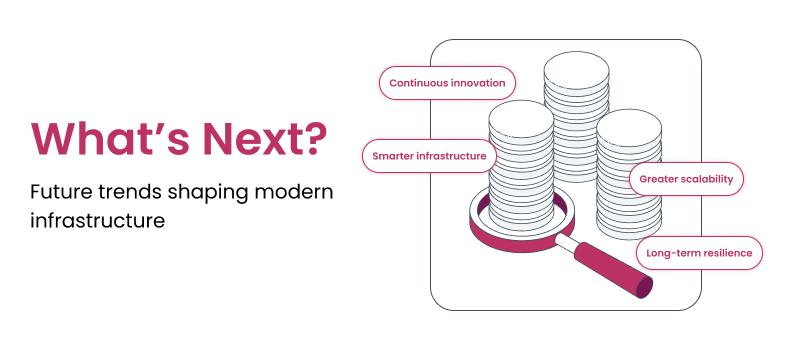
Your future growth depends on cutting-edge technologies and emerging trends. Expect edge computing to process data closer to the source for lower latency, alongside advances such as next-generation AI chatbot trends that reshape how users interact with digital systems. Build the foundation today so your systems can adapt tomorrow.
By partnering with CHI Software, CIOs, CTOs, and IT leaders can confidently navigate the complexities of infrastructure modernization, ensuring their organizations are equipped for sustainable growth, innovation, and resilience in a rapidly changing digital landscape, backed by our ongoing news and insights on innovation at CHI Software.
FAQ
How do I make my systems predictable for maintenance?
As part of Infrastructure modernization, AI and IoT (Internet of Things) sensors are deployed to make sure that maintenance becomes a predictable process. Instead of waiting for something to break, we reduce guesswork and optimize real-time data analysis.
How is infrastructure modernization applicable for mass use?
Infrastructure modernization has been enhancing public services like healthcare systems, smart traffic management, and document portals. It reduces congestion and optimizes processes to make sure that services are accessible on a whim.
How does Infrastructure modernization help bridge funding gaps?
In infrastructure projects, modernization fixes parts of the processes that aren’t working properly. It’s estimated that 80% of businesses need modernization within 5 years of creating their first piece of software or buying their first piece of hardware.
What does Infrastructure modernization do?
Infrastructure modernization enhances agility, efficiency, and security, allowing companies to adapt quickly to digital demands. Investing in smart technology and utilizing blended finance can bridge funding gaps in infrastructure projects.
Can Infrastructure modernization help with security?
IT modernization can help businesses incorporate advanced security measures, including intrusion detection systems, firewalls, and encryption, that better protect sensitive data. Digital construction management reduces human error and improves efficiency by using GPS and digital as-builting.
About the author
Ivan keeps a close eye on all engineering projects at CHI Software, making sure everything runs smoothly. The team performs at their best and always meets their deadlines under his watchful leadership. He creates a workplace where excellence and innovation thrive.
Rate this article
27 ratings, average: 4.8 out of 5