

DSD Software Modernization
Through step-by-step modernization, CHI Software transformed a legasy DSD platform into a scalable, efficient tool — achieving 97% retention and faster, smoother logistics.

Some initiatives stall not because the idea is wrong — but because nobody owns the last mile of execution. A model works in a notebook. A migration sits in a slide deck. An integration keeps slipping a quarter. Forward deployed engineering services exist to break that pattern.
Instead of handing you a report and walking away, senior engineers work inside your systems, next to your people, until the thing actually runs in production. Learn how CHI Software delivers FDE as a service, what it includes, and when it delivers the greatest value.

























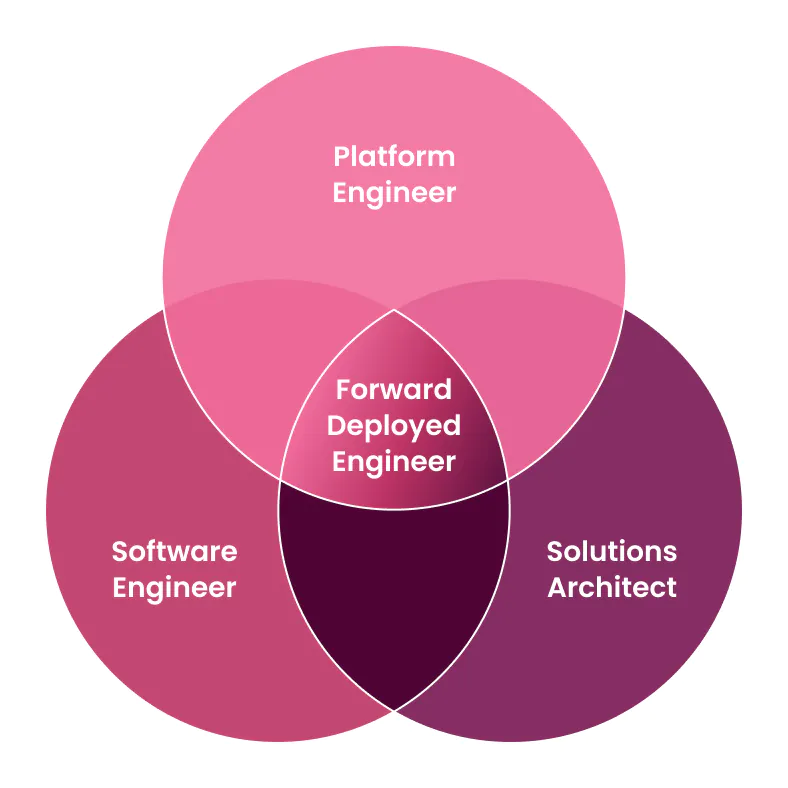
Forward deployed engineering (FDE) is a delivery model where experienced engineers embed directly in the customer’s environment to build, integrate, and deploy working software. Instead of operating from a separate delivery organization, FDE teams work alongside your stakeholders, data, and workflows, enabling faster decisions and continuous implementation.
Unlike traditional consulting, FDE does not stop at recommendations or technical roadmaps. The same team that defines the solution is responsible for building, integrating, testing, and launching it in production, ensuring accountability from strategy through execution.
This model is particularly effective for complex enterprise initiatives where success depends on working within existing environments rather than replacing them. FDE teams navigate legacy systems, fragmented integrations, incomplete documentation, and evolving business requirements while delivering measurable progress without disrupting day-to-day operations

AI projects fail in production, not in the demo. Get senior engineers embedded in your environment before the next sprint.
Talk to a Forward Deployed EngineerThe FDE model earns its place at specific moments — usually when an internal team is capable but stuck. The market shift is already visible: major AI and cloud providers are investing heavily in embedded engineering models because production deployment, not prototyping, has become the real bottleneck. McKinsey’s analysis of enterprise technology, drawn from more than 100 interviews with senior technology officers, found companies can triple the EBITDA lift from tech investment when they fix execution rather than simply spend more. Forward deployed engineering services target exactly those execution gaps. The recurring triggers look like this.
Legacy systems rarely fail loudly. They just make every new feature slower and every integration riskier. When a modernization effort keeps getting deferred, embedded engineers can carve out change safely through our legacy software modernization services, without a big-bang rewrite.
Enterprise integrations, the custom connectors between CRMs, data warehouses, and third-party APIs, quietly eat roadmaps. Systems integration is hard to scope and easy to underestimate. An embedded team that owns the custom integrations end to end removes that drag.
Your engineers may be excellent and still have never shipped a RAG application or run a model in production. AI deployment expertise is scarce and expensive to hire full time. FDE brings that specific skill in temporarily, then hands it to your team through structured knowledge transfer.
Some projects are too important to route through a slow vendor queue. When business continuity, a regulatory deadline, or a launch is on the line, embedded engineering puts senior people in the room with direct ownership of the outcome.
The transition from pilot to production is where most enterprise AI initiatives fail, because a proof of concept never had to meet real data, latency, or security requirements. Google’s DORA research found that AI acts as an amplifier — high-performing teams and platforms operate faster, while existing issues in weaker ones become more pronounced. This is where FDE delivers production-ready solutions instead of demos, strengthening the foundations needed for successful AI adoption.
Still in pilot after two quarters? A fixed-scope engagement delivers a working production increment with defined cost and timeline.
Start with a Fixed-Scope FDE PilotCHI’s FDE as a service is not a separate product bolted onto the company. It brings together our core engineering capabilities into one accountable delivery model, embedded directly in your live environment rather than from a distant backlog. Our FDE services cover the areas below, and each maps to a real CHI practice.
Engineers work on your enterprise AI use cases directly, from scoping to production deployment. The same people who prototype also take the feature the rest of the way, so nothing gets lost between a research team and a delivery team. This is applied work on production systems, not slideware.
Custom software development happens inside your repositories and pipelines, producing production-grade code your team can maintain. These are customer-specific solutions, not generic templates, and our FDE services keep that code in your stack, under your standards.
We develop and deploy AI agents that act inside real workflows, with the permissions, guardrails, and monitoring that production use demands. We wire them into your identity, logging, and rollback paths — so a failing agent degrades safely instead of taking a workflow down with it.
We connect new services to the systems that already run your business, using custom integrations and workflow integration, with data governance and security requirements handled from the start.
Reliable data pipelines and clean API contracts decide whether AI works at all. Our data engineering people build and harden the flows models depend on.
Getting to production rollout means observability, CI/CD, and MLOps that keep models healthy after launch. We build the delivery machinery, not only the model.
Every engagement opens with technical discovery and solution architecture, so scope, risks, and measurable outcomes are agreed before code is written.
Knowledge transfer runs through the whole engagement. Customer enablement is a deliverable in its own right, so your team owns the system after we step back.
Through step-by-step modernization, CHI Software transformed a legasy DSD platform into a scalable, efficient tool — achieving 97% retention and faster, smoother logistics.

By automating financial processes and modernizing architecture, CHI Software helped a fintech client grow faster, scale smarter, and report with 50% more accuracy.

With cloud migration, automation, and custom SSO, CHI Software modernized a growing oncology platform — boosting decision speed and cutting operational costs by 30%.
For a CEO or CIO, the FDE model is worth it only if it changes outcomes. This is where the value shows up. Well-run FDE services improve engineering productivity, free capacity to modernize platforms, reduce technical debt, and increase ROI — creating a compounding effect within a single initiative rather than over a five-year transformation program.

Decisions made inside your environment skip the vendor queue. That compresses the distance from idea to production, which is the lever McKinsey ties directly to higher technology ROI.
Small, validated increments cut deployment risk. Problems surface in a working system early, not during a launch weekend.
Because engineers work next to your data and users, enterprise AI adoption moves at the speed of your business rather than the speed of a statement of work.
Phased scope and fixed pilots give finance a predictable number. Executives get business outcomes tied to milestones instead of open-ended time and materials.
Cross-functional teams from CHI sit with your product, security, and operations people. Fewer handoffs, faster iteration, clearer answers.
The output is production-ready solutions running in production systems, not a proof of concept that needs a second project to become real.
One accountable team replaces a chain of advisors and subcontractors. This is where FDE services quietly save money: one contract, one team, one place to point when something breaks.
Modernization does not have to pause the business. Each phase delivers a signed-off outcome before the next one begins.
Request a Phased Engagement PlanAI projects fail in the seams: between the model and the data, the data and the systems, the systems and the users. Forward deployed engineering services work because they treat those seams as one problem. A capable FDE-as-a-service agency handles architecture, data, and integration as one effort, not three disconnected workstreams. Google’s DORA research is blunt about it — without healthy platforms and clean data, AI mostly adds instability. Applied engineering close to the workflow is how the model earns its place.
RAG applications live or die on retrieval quality and data freshness, which only reveal themselves against real data. We tune chunking, indexing, and evaluation against your documents, not a public benchmark.
AI agents require real access rights, real systems, and real safeguards. Creating them in an environment that closely mirrors production is the only honest way to test them.
Enterprise copilots are useful only if they plug into the tools people already use, which means deep workflow integration rather than a bolt-on chat box.
Automation that ignores edge cases creates new work. Engineers inside the process see the exceptions a remote team never would.
LLM integration touches security, cost, and latency at once. Getting all three right needs hands on the production systems, not a diagram.
AI governance, audit trails, and data governance are far cheaper to build in than to retrofit. We design for them from the first sprint.
We focus on sectors where systems are complex, compliance is real, and delivery crosses many teams. In each one, our forward deployed engineering services attach to modernization, AI enablement, and integration-heavy work. The pattern repeats — an experienced FDE service matters most where a mistake in production is expensive to unwind.
Patient data, HL7 and FHIR interfaces, and strict privacy rules make integration and modernization slow. Embedded engineers move carefully, taking these constraints into account.
Payments and banking platforms carry decades of legacy systems and heavy operational resilience obligations. FDE helps implement changes without compromising the integrity of core systems.
Shop-floor data, ERP systems, and IoT technologies rarely “speak the same language”. Specialized integration solutions and data pipelines transform this information noise into actionable data.
Seasonal load, personalization, and a wall of point solutions define retail. System integration and AI-powered, enterprise-ready solutions matter more than just another dashboard.
Routing, tracking, and forecasting rely on continuous data streams. Embedded systems engineering ensures their reliability while integrating AI technologies.
Grid, metering, and field systems mix old and new. Modernization here is about safety and uptime, not features for their own sake.
The FDE service model is deliberately phased, so CIO and CEO stakeholders get milestones and visibility instead of a big-bang bet. Each phase produces something you can inspect — since the work is staged, you can stop, extend, or scale at any milestone without stranding what was already built.

Discovery and Business Challenge Assessment We start with the business problem, not the tech. Technical discovery names the outcome and the constraints before anything else.
Technical and Data Environment Assessment Next, we map your systems, data, and security requirements, including any legacy systems sitting in the path of the work.
Team Deployment and On-Site or Remote Integration Engineers embed into the customer environment, on-site or remote, and join your standups, boards, and repositories from week one.
Iterative Development and Validation Short cycles with rapid iteration and validation help keep the scope of work realistic and risks in view. You see working software at the end of each sprint.
Production Rollout and Scaling Once validated, we handle production rollout and scaling, with the observability needed to keep it healthy under load.
Knowledge Transfer and Team Enablement Throughout, knowledge transfer and customer enablement make sure your team can run and extend the system on its own.
Fixed-Scope Pilot and Risk Assessment For an initial engagement, a pilot with a fixed scope and a written risk assessment limits risk and demonstrates value before you commit further.
Plenty of FDE-as-a-service providers can send bodies. Fewer send senior engineers who own outcomes and then hand control back. As an FDE-as-a-service company, CHI Software is built around end-to-end ownership without lock-in, which is what separates serious FDE-as-a-service providers from staffing shops. Our forward deployed engineering services are scoped around a result you can measure, not a headcount you rent.
Our forward deployed engineers are seniors who have shipped production systems in regulated enterprises, not juniors learning on your budget. Enterprise execution, not enthusiasm, is what carries a project through security review and into production.
We cover AI and generative AI, cloud engineering, data engineering, and DevOps under one roof, including our agentic AI development services for teams building autonomous workflows. As an FDE-as-a-service company, we bring it all under one accountable roof rather than stitching four vendors together.
We stay vendor-neutral across AWS, Azure, GCP, and open-source tools, so you are not locked into one stack or one supplier. Unlike lock-in-prone FDE-as-a-service providers, we document everything in your repositories, where it stays yours.
Cross-functional teams combine deep engineering expertise with specialized knowledge in data management, security, and product management, precisely what is needed for full-scale technical implementation.
CHI Software holds ISO 9001 and ISO 27001 certifications and works under NDAs and data processing agreements, with least-privilege access to your environment. As an FDE-as-a-service company that operates inside regulated systems, we treat your environment as production from day one.
We build on open standards, document in your repositories, and treat knowledge transfer as a contractual deliverable, so future control stays with your team. A disciplined FDE-as-a-service agency writes down what it learns — so nothing walks out the door when the engagement ends.
LLM:
Frameworks:
AI Agents:
Backend:
Frontend:
Python Frameworks:










The difference between forward deployed engineering and traditional consulting is simple: advice versus accountable execution. Traditional consulting often stops at a plan. FDE-as-a-service providers who do it well stay until the system runs. Professional services that only produce recommendations leave the hardest part, delivery, to you.
| Dimension | Forward Deployed Engineering | Traditional Consulting |
|---|---|---|
| Primary output | Running, production-grade code | Reports, strategy, recommendations |
| Engagement depth | Embedded in your live environment | Advisory, outside the system |
| Ownership of production | Shared, with direct engineer ownership | Left to the client or a third party |
| Speed to value | Faster, decisions made in the room | Slowed by handoffs and approvals |
| Knowledge transfer | Continuous enablement of your team | A final document, then exit |
| Risk model | Phased pilots, validated increments | Risk stays with the client |
| Team | Senior cross-functional engineers | Analysts and generalists |
None of this makes consulting worthless. Strategy has its place, and a good roadmap is worth paying for. But when the goal is a working system, the best FDE-as-a-service providers close the gap that advice leaves open, and a strong FDE-as-a-service agency turns a modernization plan into shipped software. Compared with traditional professional services, the accountability simply sits somewhere else — on the team that writes and ships the code. FDE as a service is what that shift looks like once you stop separating the thinking from the building.

I am very pleased with the exceptional work delivered by the CHI Software team on our Workspace customer portal project. Their business analysis, insights and technical implementation expertise has been instrumental in developing a sophisticated platform, that serves our 70+ London locations and enhances the overall experience of our customers.
Their ability to translate complex business needs into practical solutions was particularly impressive, alongside event management, community engagement features, and building access system integrations.

Head of Technology at Workspace
CHI Software played a crucial role in optimizing our mobile application, ensuring seamless functionality across iOS and Android platforms. Initially brought in for a short-term fix, their expertise quickly became indispensable as they resolved critical publishing issues, modernized outdated libraries, and enhanced navigation. Their proactive approach in identifying and fixing hidden flaws significantly improved app stability and usability. CHI Software’s adaptability, deep technical knowledge, and ability to streamline a previously fragmented system have made them a trusted technology partner in this project’s success.

Lead Data Engineer at Cefetra Group B.V.
Media Markt worked with CHI Software for over 4 years. During this time the CHI team made important contributions to our e-commerce projects and to one of our core proprietary technologies in the area of distributed data synchronization. Alongside outstanding technical skills, these engineers have always been highly reliable in terms of quality and deadlines. Taking into consideration my experience, I would highly recommend working with the CHISW engineering team.

Solution Manager at Media Markt
Not sure if FDE fits your situation? A discovery session maps your constraints and shows what a scoped engagement would cover and cost.
Book a Discovery Session
Forward deployed engineering is a model where senior engineers embed in your environment to build, integrate, and ship software to production, rather than advising from the outside. It grew out of teams that measured success by working systems, not deliverable documents.
A forward deployed engineer works inside your systems and workflows, handling technical discovery, integration, custom software development, deployment, and knowledge transfer. The role blends solution architecture with hands-on implementation and direct contact with your business and technical teams.
Consulting usually ends with a recommendation. An FDE service ends with a running system. Where traditional consulting hands over a plan, an FDE-as-a-service agency owns the delivery, the integrations, and the production readiness. Unlike advisory firms, FDE-as-a-service providers stay accountable straight through deployment. That is the whole point of choosing an FDE-as-a-service agency over a firm that only advises.
Yes. While the FDE model shines on enterprise AI, the same embedded approach fits modernization, systems integration, cloud migration, and custom software development. Any project blocked by legacy systems or integration complexity is a fit, and a good FDE-a-a-service agency will scope it the same disciplined way.
That is the point. FDE as a service is designed for exactly this kind of partnership. Our FDE services work alongside your developers, share your backlog and repositories, and leave your team stronger through knowledge transfer. As an FDE-as-a-service company, CHI plans for handoff from day one, so this FDE service never becomes a dependency.

About cookies on this site