

AI Assistant Integration for an ERP System
We kicked off a project to create an AI assistant to make the client's ERP system even better. Our goal was to develop a text-based Q&A AI assistant that users

Most companies do not actually have a problem with artificial intelligence itself. Instead, they face challenges with prioritization, data management, and responsibility allocation — issues that only begin to look like an "AI problem" when a pilot project hits a dead end.
CHI Software’s AI advisory services help untangle these issues before you spend your budget developing yet another proof of concept that was never designed for full-scale production deployment from the start.
We work with CEOs, COOs, and CIOs who need a defensible answer to critical questions: where will AI create measurable business value, and what conditions must be in place to realize it? As an AI advisory services provider with delivery engineers behind the advice, we tie AI strategy to the data, systems, and governance that decide whether a model ever leaves the lab. The right AI advisory partner does both, and that combination of strategic guidance with people who have deployed AI systems into production is what separates real artificial intelligence advisory services from a slide deck.

AI investment should start with a defensible decision, not another proof of concept. Get a clear view of which use cases can create measurable value, what must change in your data and technology environment, and what it will take to move from pilot to production.
Get an AI ROI and Readiness Assessment
























Most teams do not need convincing that AI matters. They need help turning intent into outcomes. Well-run artificial intelligence advisory services do exactly that. If any of the situations below sound familiar, an AI advisory service engagement is usually the fastest way to get unstuck.
Every function has a wish list. Marketing wants faster content creation, support wants to reduce ticket volume, and finance wants more accurate forecasting. Without a shared method for scoring these ideas against business goals, budget scatters across pilots that each look reasonable in isolation and add up to very little. Sound AI strategy starts by ranking opportunities on value and feasibility, not on which department asked loudest. We bring ROI analysis and a straightforward cost-benefit analysis to that conversation, so the first funded use cases are the ones most likely to pay back.
A proof of concept that dazzles in a demo and then dies before production is the single most common pattern we see. The reasons are rarely mysterious. The data pipeline was never built for production readiness, nobody defined success metrics up front, or the pilot lived on infrastructure no one wanted to depend on. The difference between a successful AI initiative and an abandoned pilot is often not the technology itself, but the discipline to design for scale from the beginning. Pilot validation should answer one blunt question early — whether this is worth scaling. When the answer is no, killing it fast is a win, not a failure.
Models are only as good as what feeds them. Poor data quality, siloed data infrastructure, and legacy systems with no clean way to expose data are the quiet reasons most AI programs stall. An honest AI readiness assessment tells you where your data and existing systems sit today and what has to change before any serious AI deployment. Without this foundation, even the most advanced AI tools will struggle to deliver reliable insights, automate processes, or create measurable business value. Sometimes the right first project is not an AI project at all. It is improving the underlying data and technology foundation that makes AI possible.
When AI is everyone’s side project, it is no one’s responsibility. Fragmented ownership shows up as duplicated AI tools, conflicting priorities, and a team that has adopted tools with no shared AI operating model behind them. Strategic guidance here is less about technology and more about people — who owns AI outcomes, which internal capabilities you build versus buy, and how leadership alignment holds as the work scales. Gartner expects more than 40 percent of agentic AI projects to be canceled by the end of 2027, mostly because of unclear value and weak controls, not because the technology fails. Ownership is usually the difference.
Which model, which vendor, which cloud, and who signs off when an AI system gets something wrong? When those answers are vague, projects either stall in committee or ship without the guardrails a regulated business needs. Clear AI governance covers responsible AI and ethical AI practices, data privacy, security, transparency, accountability, and human oversight over automated decisions, along with guarding against algorithmic bias. It also covers regulatory compliance, which for European clients increasingly means designing against the EU AI Act from day one rather than retrofitting later. A recent Mayfield CXO Survey found that AI governance now outranks cybersecurity as an emerging board-level priority. Boards are demanding visibility and accountability over agentic systems — a structured governance framework is what lets a CIO answer.
Most enterprise AI pilots stall not because the model fails, but because the data infrastructure, governance model, and operating model were never designed to carry it to production. An advisory engagement diagnoses exactly where that gap sits before another sprint begins.
Book an AI Advisory ConsultationOur AI advisory services sit as the strategic layer between your business goals and the technology that has to deliver them. Each engagement draws on the same teams that handle CHI Software’s IT consulting, AI and generative AI development, software modernization, cloud engineering, data engineering, and DevOps and MLOps work. That matters, because advice you cannot build is just opinion.

We assess where you stand across data, architecture, skills, and AI maturity. The output is a plain-language read on data quality, data infrastructure, and the state of your existing systems, plus a short list of what has to change before AI can run reliably in production.
We run structured workshops to surface candidate use cases across generative AI, machine learning, predictive analytics, workflow automation, and decision support, then score each one on business value and technical feasibility. You leave with a ranked shortlist rather than a long menu.
We turn that shortlist into an AI strategy with a costed business case and a phased implementation roadmap. This is where measurable business outcomes get attached to specific initiatives, and where success metrics are defined before any code is written. For boards and PE-backed leadership teams, the same roadmap doubles as due-diligence material: costed initiatives, named owners, and ROI you can defend in an EBITDA conversation.
We define a governance framework covering responsible AI, risk management, and risk mitigation, along with the regulatory compliance obligations specific to your market. The EU AI Act’s high-risk obligations have been deferred to December 2027 — which makes now the window to build governance properly instead of retrofitting it under deadline pressure. Transparency obligations are already in force as of August 2026. We design against both from day one: risk-tier mapping, technical documentation, logging, human oversight, and artifacts you can hand to an auditor.
We recommend an AI architecture and support technology selection across AI platforms and AI tools, with honest vendor evaluation and vendor selection based on fit and total cost of ownership rather than the loudest sales pitch. Because we stay vendor-neutral, the recommendation follows your requirements, not a reseller agreement.
We build a proof of concept against clear acceptance criteria and run pilot validation on real data, so the go or no-go decision rests on evidence of technical feasibility and business value — not subjective enthusiasm. This approach helps identify potential risks early, refine the solution before larger investments are made, and ensure that only the most viable AI initiatives move forward.
We help design the AI operating model that carries a validated pilot into production: the AI integration work, the change management, the stakeholder alignment and leadership alignment across teams, and the implementation support your people need to own it. This is also where scalable AI solutions and continuous monitoring get built in from the start.
A prioritized AI roadmap with a documented business case, phased cost model, and go/no-go criteria at each milestone gives the board a defensible investment decision rather than a slide deck about potential.
Request a Board-Ready AI Investment RoadmapEvery AI advisory service we deliver produces artifacts an executive can act on and an engineering team can build from. That is what separates practical AI advisory services from a strategy deck that ends up sitting unread in a shared drive.

A written AI readiness assessment covering data, architecture, and AI maturity, paired with a prioritized list of opportunities scored on value and feasibility.
A costed business case with ROI analysis and cost-benefit analysis, plus a phased implementation roadmap tied to success metrics and clear milestones.
A target AI architecture, a technology selection view across AI platforms and AI tools, and an AI integration plan for your existing systems, including any legacy systems that need attention first.
A governance model covering responsible AI, ethical AI, data privacy, and accountability, together with a value measurement approach so you can prove measurable business outcomes over time rather than assume them.
Our process is built to reduce uncertainty before you commit real money. A disciplined AI advisory service moves through five phases, and each one ends in a decision point. The guiding principle: AI should strengthen your technology organization, not paper over weaknesses already in it.
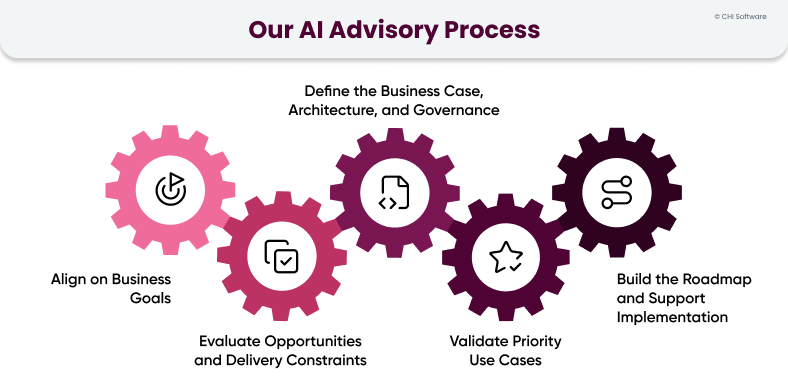

Align on Business Goals We start with your objectives, not our tooling. What does the business need to achieve in the next year, and where could AI move that number? Everything downstream is judged against these business goals, and if AI cannot plausibly move a metric your leadership already tracks, we will tell you that too.
Evaluate Opportunities and Delivery Constraints We run the AI readiness assessment and opportunity discovery in parallel, mapping data quality and data infrastructure against the use cases with the strongest business value.
Define the Business Case, Architecture, and Governance We define the business case, target AI architecture, and governance model together, because a use case is only real once you know what it costs, how it is built, and how it stays compliant with your regulatory compliance duties.
Validate Priority Use Cases We prove the top priorities with a proof of concept and pilot validation, confirming technical feasibility and production readiness before anything scales. During this phase, we evaluate model performance, integration requirements, data dependencies, operational workflows, and user adoption factors to determine whether the solution is ready for enterprise deployment. The result is a clear decision on what to scale, refine, or stop.
Build the Roadmap and Support Implementation We finalize the implementation roadmap and, when you want it, provide implementation support to execute, from AI deployment through continuous monitoring and performance optimization.
CEOs have committed more than 30% of their 2026 AI investment to agentic AI, and about 90% expect agents to deliver measurable ROI this year (BCG AI Radar 2026). Governance maturity rarely keeps pace with that spending — and that gap is exactly what advisory closes. The point of all this is not a more polished strategy. A good AI advisory services provider is judged on outcomes the CEO, COO, and CIO can defend, not by the perfection of the deck.
By funding the use cases with the clearest value first, you stop spreading budget thin and start seeing return where it actually counts.
A defined path from idea to AI deployment shortens the distance between a promising concept and something running in production, with far fewer restarts. By connecting business priorities, technical requirements, data readiness, governance, and implementation planning from the beginning — organizations can move through each stage with greater clarity and confidence.
Governance, risk management, and regulatory compliance built in early mean fewer nasty surprises in audit and fewer outages in operations. By addressing security, data governance, model oversight, and compliance requirements from the beginning, organizations create AI solutions that are more reliable, transparent, and easier to manage at scale.
Because we build your AI operating model and internal capabilities alongside the technology, AI adoption sticks after we step back, supported by cross-functional collaboration rather than a single hero team. Your team gains the confidence and capability to manage AI as an ongoing business capability. That durability is the real payoff of an AI advisory service.
We kicked off a project to create an AI assistant to make the client's ERP system even better. Our goal was to develop a text-based Q&A AI assistant that users

Our client is one of the leading providers of AI-driven automotive solutions in Tel Aviv, Israel.

This project is an in-house initiative by CHI Software, designed in response to the company's objective of enhancing the visitor experience on the corporate website through the integration of an
You do not have to buy the whole program on day one. We structure the work so you can start small, prove value, and expand when the confidence is there. This is one reason clients treat us as a long-term AI advisory partner rather than a one-time vendor.
A fixed-scope, lower-risk entry point. In a few weeks, you get an AI readiness assessment, a ranked opportunity list, and a clear recommendation. Many clients start here because it is cheap certainty before an expensive decision.
A deeper engagement that produces the full AI strategy, business case, and implementation roadmap. This is the board-ready package: which AI initiatives to prioritize, in what order to execute them, what investment they require, and what business value they are expected to deliver.
Continued advisory plus the engineering to execute, for when you need CHI Software’s teams to deliver the roadmap. This is where an AI advisory service turns into working software, backed by our agentic AI development services and full delivery capability.
Plenty of firms will write you a strategy. Fewer can build it. The reason to choose CHI Software as your AI advisory partner is that the same company does both, which removes the handoff where most transformation programs quietly lose momentum.
We start from your business goals and stay vendor-neutral, so technology selection and vendor selection serve you, not a partnership quota. As an independent AI advisory services provider, our advice is not tied to any single platform.
Our recommendations come from people who ship production systems, not from analysts who have never owned an on-call rotation. That is what makes CHI Software a credible AI advisory services provider: strategy that survives contact with real engineering.
AI rarely lives in one team. Our people span AI and data engineering, cloud, security, and legacy software modernization, so the recommendation accounts for the whole system, not just the model. That breadth also means we can spot where AI integration will collide with your existing systems before it becomes an expensive surprise.
From the first AI readiness assessment to production deployment, one accountable team carries the work. When you need to scale delivery quickly, you can add senior engineers through models like FDE as a service and Hire forward deployed engineers who embed with your team instead of throwing work over a wall.








I am very pleased with the exceptional work delivered by the CHI Software team on our Workspace customer portal project. Their business analysis, insights and technical implementation expertise has been instrumental in developing a sophisticated platform, that serves our 70+ London locations and enhances the overall experience of our customers.
Their ability to translate complex business needs into practical solutions was particularly impressive, alongside event management, community engagement features, and building access system integrations.

Head of Technology at Workspace
CHI Software played a crucial role in optimizing our mobile application, ensuring seamless functionality across iOS and Android platforms. Initially brought in for a short-term fix, their expertise quickly became indispensable as they resolved critical publishing issues, modernized outdated libraries, and enhanced navigation. Their proactive approach in identifying and fixing hidden flaws significantly improved app stability and usability. CHI Software’s adaptability, deep technical knowledge, and ability to streamline a previously fragmented system have made them a trusted technology partner in this project’s success.

Lead Data Engineer at Cefetra Group B.V.
Media Markt worked with CHI Software for over 4 years. During this time the CHI team made important contributions to our e-commerce projects and to one of our core proprietary technologies in the area of distributed data synchronization. Alongside outstanding technical skills, these engineers have always been highly reliable in terms of quality and deadlines. Taking into consideration my experience, I would highly recommend working with the CHISW engineering team.

Solution Manager at Media Markt
The CHI Software team successfully developed upgraded versions of the company's products with new functionalities and features. Thanks to these contributions, the company was able to increase its number of platform users and deepen the level of their engagement.

Founder at Albert AB

At Imagine Learning, we highly value our collaboration with CHI Software. Their skilled AI and generative AI engineers have significantly enhanced our K–12 education solutions.
With CHI Software’s help, we have developed tools for providing feedback on student writing, mechanisms to create learning content based on reading education strategies, and a series of chatbots that provide efficient and accurate information access for our teams. Their ability to deliver specialized applications swiftly demonstrates their agility.

VP, Product Management, AI Initiatives at Imagine Learning
AI advisory programs that arrive without governance documentation and a single accountable delivery structure rarely survive enterprise procurement review. One partner covering the full scope passes that review before the first sprint starts.
Talk to an Advisory Lead
AI advisory services are strategic guidance engagements that help an organization decide where and how to use AI, then plan the data, architecture, governance, and operating model to do it well. Good artificial intelligence advisory services connect business goals to a practical implementation roadmap rather than stopping at a high-level vision.
The terms overlap, but there is a useful distinction. AI consulting often focuses on a specific technical problem or build. Artificial intelligence advisory services operate one level up, at the executive layer: which investments to make, how to govern them, and how to sequence them for value. In practice, a strong AI advisory partner does both, because strategy without delivery is just talk.
No. Many clients come to us with nothing more than a legacy stack and a mandate to figure AI out. The first step is usually an AI readiness assessment of your data quality and data infrastructure, which tells us what has to happen before any model is trained.
A focused AI advisory service engagement covering readiness and opportunities typically runs a few weeks. A full AI strategy and roadmap engagement takes longer, usually a couple of months, depending on how many use cases are in scope and how ready your data is. We scope it with you up front, so there are no open-ended bills.
It depends on scope. A fixed-scope readiness assessment is the entry point — a flat fee over a few weeks. Strategy and roadmap engagements are scoped and priced up front, so there are no open-ended bills. You get the number before you commit.
Yes, and this is a large part of why clients choose us. Once the roadmap is set, the same AI advisory services provider can move into build, offering the implementation support and engineering to ship, including agentic AI development for use cases that call for autonomous workflows.
Almost always. We stay vendor-neutral and design AI integration to fit your existing systems and current AI platforms rather than forcing a rip-and-replace approach. Where a change genuinely serves you, we say so and back it with a total cost of ownership comparison.
We define success metrics before building, run ROI and cost-benefit analyses against your business goals, and track value through continuous monitoring after launch. If a use case cannot be measured, we identify that before investment decisions are made.
We organize our work in stages, making decisions at each step regarding the project’s continued viability, validating assumptions through pilot testing, and establishing a management system from the outset that ensures human oversight, risk minimization, and regulatory compliance. Smaller bets, checked often, beat one large leap, and the right AI advisory partner keeps decisions disciplined at every gate rather than only at the finish.
Yes. We map your AI systems against the Act’s risk tiers, define the documentation, logging, and human-oversight controls each tier requires, and build the audit-ready artifacts in advance. Transparency rules already apply; high-risk requirements arrive in December 2027 — enough time to do it properly, not enough to ignore.

About cookies on this site