
AI Assistant Integration for an ERP System
We kicked off a project to create an AI assistant to make the client's ERP system even better. Our goal was to develop a text-based Q&A AI assistant that users
AI writes code faster than most teams can review, test, and ship it safely. That speed is where the trouble starts — rework climbs, change stability drops, and technical debt quietly compounds.
CHI Software builds AI-powered SDLC services that keep pace with AI-generated code, from comprehensive analysis of your engineering environment to the implementation of secure, production-ready workflows. We pair AI-assisted development with the review, testing, CI/CD, and governance controls — that turn raw speed into predictable software delivery.

























AI coding tools increase output, but output is not delivery. In the DORA study, about 90% of developers already use AI daily, yet AI amplifies whatever your engineering practices already are. Strong teams get faster. Weak pipelines get faster problems.
A higher volume of generated code does not, in itself, shorten the development cycle. Code review backlogs arise, integration is disrupted, and the same functions have to be reworked. The DORA research showed that AI increases delivery throughput only when a version control system, small-batch change practices, and a reliable platform are in place. Without this foundation, the software development lifecycle remains slow — even if the speed of code writing increases.
When AI generates code faster than humans can review it, the review stage becomes a bottleneck. A 2025 analysis by GitClear of 211 million changed lines of code found that the prevalence of duplicated code blocks increased approximately eightfold between 2020 and 2024, while the share of refactoring within total changes fell below 10%. The burden of tidying up the code falls on the reviewers, and the quality assurance process begins to lag behind. Recent DORA and some independent telemetry analyses (e.g., Faros AI) found that the median PR review time rises 91% with AI adoption; generated code is faster to write but not faster to review without structured AI-assisted code review.
Context lives in scattered tickets, internal knowledge bases, messaging threads, and the heads of a few senior engineers. AI agents that lack access to this context generate plausible but incorrect code. As a result, fragmented knowledge slows down the adaptation process and complicates the verification of suggestions generated by AI.
Many teams add AI coding assistants with no policy for what data models can see, how output is checked, or who signs off before release. That gap is a security and governance risk — proprietary code leaks, unreviewed dependencies, and no audit trail. According to developer productivity benchmarks for 2026, agentic tools cost $200 to $2,000+ per engineer per month in token spend; governance includes defining usage budgets, model routing policies, and cost attribution per team. Controls have to be designed in, not added later.
A tangled legacy application resists AI-assisted development. Undocumented dependencies, shared data access, and missing tests make AI-generated changes harder to validate and more likely to create rework. Before AI can help here, the codebase usually needs targeted legacy software modernization to expose interfaces and improve test coverage.
Make the DORA warning more specific — AI may improve throughput while weakening delivery stability when teams lack strong testing, review, platform, and rollback controls. This distinction matters to CTO DevOps readers because deployment speed alone does not prove that modernization is working.

Legacy pipelines and manual review cycles become the bottleneck the moment AI generates code faster than your team can validate it. A structured SDLC analysis maps exactly where the gaps are.
Request an AI SDLC AnalysisOur AI-powered SDLC services cover the supported CHI Software scope: AI and generative AI development, software modernization, custom software development, QA, DevOps and MLOps, cloud engineering, data engineering, IT consulting, and staff augmentation. They connect as one path, from AI SDLC analysis services that assess your baseline to AI SDLC implementation services that put secure workflows into production.
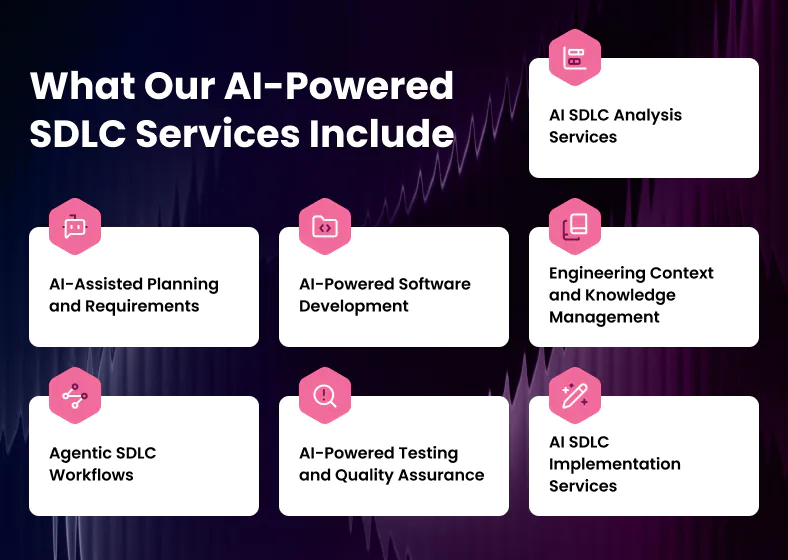
Our AI SDLC analysis services start with an AI readiness assessment of your codebase, pipelines, and team practices. We map where generated code helps, where it adds risk, and which stages need stronger controls first. You get a baseline, prioritized use cases, and a plain business case — not a tool wish list. This is where our AI advisory services shape the plan.
AI-driven tools turn rough ideas into structured user stories, clear acceptance criteria, and realistic effort estimates, with engineers reviewing every output. As a result, this tightens the early development cycle and keeps requirements traceable to code, and planning stops being the step everyone skips.
Here, code generation does the heavy lifting on boilerplate, tests, and repetitive patterns, while developers stay in control of architecture and design. We wire AI assistants into your CI/CD so every generated change runs through the same build, test, and review gates as human-written code.
We connect AI to the context it needs: architecture decisions, coding standards, and service documentation. Grounding models in your real engineering knowledge cuts hallucinated code and makes suggestions reviewable. Shared context also shortens onboarding. Therefore, new developers and AI agents both work from the same source of truth.
For well-scoped tasks, AI agents can chain steps — such as draft code, automated tests, open a structured pull request, and flag failures. Scenario-based tests and automated evaluation suites catch hallucinations and regressions before they reach code review, keeping AI-generated PRs reviewable rather than requiring manual line-by-line auditing. We keep these agentic workflows inside strict limits, with human approval gates, security checks, and rollback paths, so autonomy never outruns accountability across the software development lifecycle.
AI generates test scenarios, expands test coverage, and detects regressions earlier, thereby shortening verification cycles. This does not replace the professional judgment of quality specialists. It is the engineers who define correctness criteria and assume the associated risks. The result is faster feedback without compromising quality standards.
Our AI SDLC implementation services take the approved plan and put it to work: integrating AI into your pipelines, standing up governance and security controls, and rolling out stage by stage. We hard-wire measurement from day one, so you can prove the effect on rework, lead time, and change stability rather than guess at it.
We kicked off a project to create an AI assistant to make the client's ERP system even better. Our goal was to develop a text-based Q&A AI assistant that users

Our client is one of the leading providers of AI-driven automotive solutions in Tel Aviv, Israel.

This project is an in-house initiative by CHI Software, designed in response to the company's objective of enhancing the visitor experience on the corporate website through the integration of an
When properly implemented, AI-driven SDLC services reduce risks rather than creating new ones. This outcome is achieved only through a robust platform, structured feedback mechanisms, and adherence to quality engineering practices. Here is where the effect shows up.

With review, testing, and CI/CD keeping pace, generated code actually reaches production faster. DORA links real throughput gains to teams that pair AI with strong delivery practices, turning accelerated code creation into faster, safer software delivery — rather than a backlog of unmerged work.
When AI handles boilerplate and tests, engineers spend more time on design and hard problems. McKinsey reports that active management of technical debt to engineers reclaiming up to 50% more time for work that moves the business, and AI-assisted development pushes in the same direction when the debt is controlled.
AI-generated tests and pre-verified pull requests give reviewers a head start. Instead of examining every line from scratch, engineers focus on risk and architectural issues. The review process no longer delays every release by several days.
Unified pipelines, automated checks, and measurable execution times make determining release dates less of a guessing game. When every change to an AI system undergoes the same validation stages, the stability of changes increases, and operational surprises become the exception.
Security scans, dependency checks, and policy validations are triggered for every change, whether made by a human or an AI. Governance is built into the pipeline rather than added after an incident. This reduces the likelihood of secret leaks and hidden defects — issues that duplicated code tends to conceal.
With clean interfaces and test coverage in place, AI can help refactor and document a legacy application far faster than a manual rewrite. Paired with phased legacy modernization, it cuts big-bang migration risk while retiring the parts that block new work.
AI shows up differently at each stage of the software development lifecycle. The table below separates assistive and agentic help from the human approvals, security checks, and rollback controls that stay mandatory. AI speeds the work, but people still own the decisions.
| SDLC Stage | AI Capabilities |
|---|---|
| Planning | Drafts user stories, estimates, and risk notes; product and engineering leads approve scope. |
| Requirements | Turns notes into structured, traceable requirements; humans confirm intent and edge cases. |
| Coding | Code generation for boilerplate, patterns, and tests; developers own architecture and final commits. |
| Code Review | Pre-screens pull requests and flags risks; a human reviewer signs off before merge. |
| Testing | Generates and expands test cases and spots regressions; QA defines pass criteria and accepts risk. |
| Deployment | Prepares release notes and pipeline steps; CI/CD gates and human approval trigger production. |
| Monitoring | Detects anomalies and surfaces likely causes; on-call engineers decide and act. |
| Maintenance | Suggests refactors and documents legacy code; changes pass the same review and rollback controls. |
We move AI into your delivery in stages, with baseline metrics, clear pilot exit criteria, and vendor-neutral technology choices. Knowledge transfer and phased rollout replace the high-risk big-bang transformation, allowing you to maintain control and either halt the process or scale it up at each validation stage. Where deep involvement helps, our FDE as a service model puts a forward-deployed engineer inside your team.
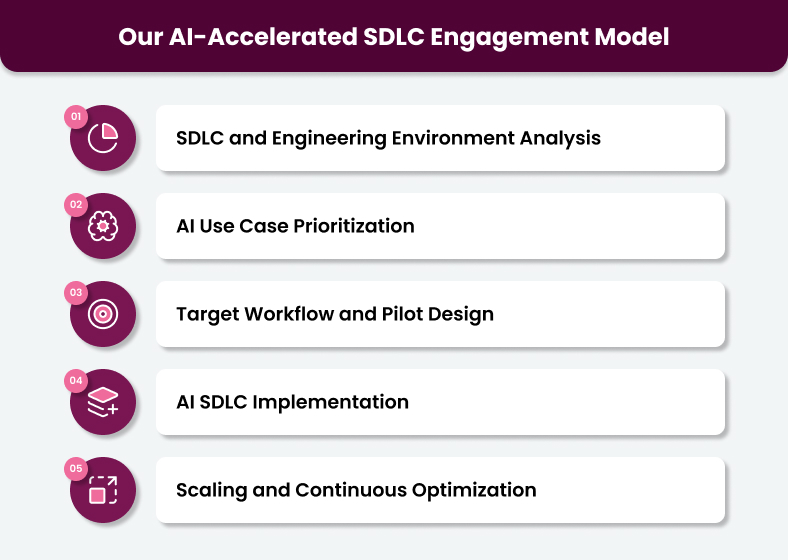

SDLC and Engineering Environment Analysis We baseline your current development cycle: delivery frequency, lead time, change fail rate, and rework, and where they hurt most. This stage, part of our AI SDLC analysis services, tells us which problems AI can realistically move and which need engineering fixes first.
AI Use Case Prioritization Not every stage benefits equally. We rank candidate use cases by effect and effort, then pick a first target — where AI-assisted work is low-risk and easy to measure, such as test generation or documentation, before touching critical paths.
Target Workflow and Pilot Design The target workflow, its guardrails, and the exit criteria are designed upfront to determine whether the pilot proceeds. Success is defined up front in numbers, so nobody argues about whether the experiment worked once it is done.
AI SDLC Implementation We are launching a pilot project on live pipelines, integrating artificial intelligence into the CI/CD architecture with security and governance controls active from the outset. These are micro-scale AI implementation services within the SDLC — measurable, reversible, and limited in scope — so a failed test costs a sprint rather than the entire system.
Scaling and Continuous Optimization Once the pilot project meets the completion criteria, we scale the workflow to additional teams and stages while continuing to track critical and measurable metrics in real time. Continuous optimization involves adjusting prompts, control mechanisms, and scope — as the codebase and engineering practices evolve.
A phased engagement with clear pilot exit criteria moves AI tooling from experiment to production workflow, without locking your team into a single vendor or requiring a big-bang migration.
Design Your AI SDLC PilotOur AI-powered SDLC services bring AI development, software modernization, DevOps and MLOps, cloud, data engineering, QA, and consulting under one roof, so AI sits inside real delivery instead of beside it.
We cover the whole software development lifecycle, not just the coding step. The team introducing AI also owns testing, deployment, and operations, so a gain at one stage does not quietly break another. For extra capacity, you can hire forward-deployed engineers to embed directly with your team.
Real products carry history, such as legacy applications, half-finished migrations, and undocumented edge cases. We have shipped inside that reality for years, and we treat legacy modernization as a controlled, staged effort rather than a rewrite-and-pray gamble.
Consolidating AI, cloud technologies, DevOps, MLOps, and QA within a single structure reduces integration risks. It eliminates the issue of finger-pointing between different vendors when the model, pipeline, and test suite need to function as a cohesive whole. One team, one area of responsibility.
We are not tied to any specific model provider or cloud platform. We select tools that align with your technology stack and risk profile and define everything as code. As a result, this ensures you retain ownership and can change direction in the future without the pain of abandoning a solution.
Proprietary code stays protected. We define data usage boundaries for AI tools, maintain audit logs, and implement security and control measures within the pipeline starting from the first sprint. This policy is established before any model gains access to your repositories.
LLM:
Frameworks:
Backend:
Frontend:
Python Frameworks:








Conventional software delivery is not wrong. For stable, well-understood systems, it can be the right call. The table shows where AI acceleration pulls ahead, and it only pulls ahead where platform engineering and delivery controls are strong.
| Dimension | AI-Accelerated SDLC | Conventional SDLC |
|---|---|---|
| Delivery speed | High once controls keep pace with generated code | Steady and predictable, limited by manual authoring |
| Review depth | AI pre-screens, humans focus on risk and intent | Full manual review, thorough but slower |
| Test automation | Broad AI-generated coverage with fast feedback | Coverage depends on team time and discipline |
| Governance | Policy and audit built into the pipeline | Governance often manual and applied late |
| Rework risk | Lower when review and tests catch AI errors early | Lower churn, but slower to surface some defects |
| Change stability | Improves with a strong platform and measurement | Stable in mature teams, harder to accelerate |
| Modernization readiness | Faster, phased refactoring of legacy code | Slower, but lower coordination overhead |
I am very pleased with the exceptional work delivered by the CHI Software team on our Workspace customer portal project. Their business analysis, insights and technical implementation expertise has been instrumental in developing a sophisticated platform, that serves our 70+ London locations and enhances the overall experience of our customers.
Their ability to translate complex business needs into practical solutions was particularly impressive, alongside event management, community engagement features, and building access system integrations.

Head of Technology at Workspace

CHI Software played a crucial role in optimizing our mobile application, ensuring seamless functionality across iOS and Android platforms. Initially brought in for a short-term fix, their expertise quickly became indispensable as they resolved critical publishing issues, modernized outdated libraries, and enhanced navigation. Their proactive approach in identifying and fixing hidden flaws significantly improved app stability and usability. CHI Software’s adaptability, deep technical knowledge, and ability to streamline a previously fragmented system have made them a trusted technology partner in this project’s success.

Lead Data Engineer at Cefetra Group B.V.
Media Markt worked with CHI Software for over 4 years. During this time the CHI team made important contributions to our e-commerce projects and to one of our core proprietary technologies in the area of distributed data synchronization. Alongside outstanding technical skills, these engineers have always been highly reliable in terms of quality and deadlines. Taking into consideration my experience, I would highly recommend working with the CHISW engineering team.

Solution Manager at Media Markt
Not sure how AI SDLC implementation fits your existing toolchain or code security requirements? A scoping session maps compatibility before any integration begins.
Book an AI SDLC Scoping Session
An AI-accelerated SDLC uses AI across the software development lifecycle, including planning, coding, review, testing, deployment, and maintenance — while people keep approval over risk and release. The point is not full autonomy. It is faster, safer software delivery backed by review, testing, and governance.
Our AI SDLC analysis services include an AI readiness assessment of your code, pipelines, and team, a map of high-value use cases, a risk review, and a baseline of delivery metrics. You leave with a prioritized plan and a business case, not a generic tool recommendation.
Our AI SDLC implementation services run in stages — a scoped pilot with clear exit criteria, then scaling once it proves out. We integrate AI into your CI/CD, turn on security and governance controls, transfer knowledge, and keep measuring effect on rework and lead time throughout.
Usually, yes. We take a vendor-neutral approach and fit AI into your current stack, repositories, and CI/CD rather than forcing a switch. A short scoping session confirms compatibility with your engineering tools before any integration starts.
We define strict data boundaries for AI tools, prefer options that keep code in your environment, and keep comprehensive audit trails on AI-driven changes. Effective security and governance controls are set before any model reads your repositories, and our AI-powered SDLC services treat code protection as a design requirement, not an afterthought.

About cookies on this site