case-banner

Forward Deployed Engineering for Healthcare Data Modernization

A private healthcare provider had 30 million clinical records but no practical way to use them for AI, research, or analytics. A CHI Software Forward Deployed Engineer turned this data modernization in healthcare challenge into priority use cases, a FHIR-based architecture, and an implementation roadmap.

Quick Project Facts and Key Achievements

Quick Project Facts

Client Industry

Private Healthcare

Client Location

Ukraine

Challenge

The client had 30M clinical documents and several data and AI opportunities, but no clear technical path for making this information accessible.

Solution

A Forward Deployed Engineer turned the client’s business needs into prioritized use cases, a target architecture, and an implementation roadmap integrated with the existing MIS.

Team Size

1 Forward Deployed Engineer

Project Stage

Discovery and Solution Design

Project Key Achievements

30M

clinical documents covered

2+ hours

potentially saved per physician weekly

40-50%

projected faster trial recruitment

1 FHIR layer

connecting the existing MIS with AI and analytics

Story Behind the Numbers

CHALLENGE

The client came to CHI Software with a broad business problem rather than a ready technical specification. Around 30 million clinical documents had accumulated over ten years, but much of this information was difficult to use outside everyday patient workflows.

Clinical records were largely stored as unstructured free text. External laboratory PDFs were not parsed, and cohort search by clinical criteria was unavailable. At the same time, the client saw opportunities in physician support, management reporting, clinical research, trial recruitment, and better use of clinical data.

The data modernization in healthcare engagement started by looking at these needs within the client’s real workflows and existing IT environment. The first task was to understand what should be built, which use cases had the most value, and how new capabilities could work with the existing MIS rather than replace it. These limitations match the findings documented during the assessment.

ENGAGEMENT STAGE

A CHI Software Forward Deployed Engineer worked directly with the client’s existing workflows, clinical data, and IT environment. The engagement started with a broad business problem rather than a predefined technical specification.

The FDE assessed how clinical information was stored and used, identified the main technical constraints, and translated business needs into concrete use cases. Physician support, management reporting, research, trial recruitment, and strategy became the main priorities.

This gave the health data modernization initiative a clear direction. Instead of treating every opportunity as a separate project, the FDE connected them through one clinical data foundation and carried the same context from discovery into solution design.

TRANSFORMATION

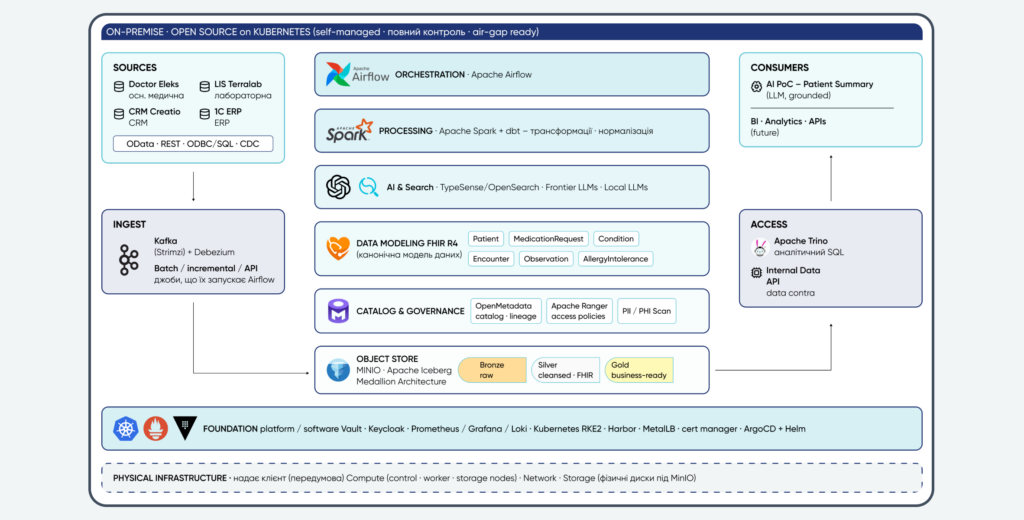
The next step was to turn the discovery findings into an architecture that could work within the client’s existing environment. The FDE designed MedStore as a de-identified FHIR R4 layer over the existing MIS. The proposed architecture brings together clinical data standardization, OCR, entity extraction, cohort and semantic search, analytics, and AI Patient Summary within one platform.

Each part of the architecture was tied to a use case identified during discovery. AI Patient Summary supports physicians. Complex reporting serves management. Cohort search supports research and clinical trials. De-identified FHIR data creates a foundation for Real World Evidence and future data products.

The data modernization for healthcare engagement resulted in an implementation-ready architecture and roadmap. The same FDE can carry the context established during discovery into the next engineering stage, keeping business needs, architecture, and implementation connected. This continuity reflects CHI’s FDE model of one technical owner across business context, architecture, engineering, deployment, and business impact.

SERVICES PROVIDED

  • Forward Deployed Engineering
  • Healthcare Modernization
  • Discovery and Solution Design
  • Solution Architecture
  • FHIR Data Standardization
  • Data Integration Design
  • AI Solution Design
  • Clinical Search Design
  • Security and Governance

DEVELOPMENT TEAM

  • 1 Forward Deployed Engineer

Key Areas for Improvement

UNSTRUCTURED CLINICAL RECORDS

Years of clinical information were stored largely as free text. The data existed, but its fragmented structure limited how easily it could be searched, analyzed, or reused. The healthcare data modernization roadmap therefore needed a standardized clinical data foundation that could serve several use cases without changing the operational MIS.

CLINICAL DATA SEARCH AND ACCESSIBILITY

The existing environment did not support cohort search across ten years of records using clinical criteria. The FDE proposed a search layer combining clinical filters, cohort search, and semantic search, giving physicians and researchers different ways to work with the same patient data.

PROCESSING OF EXTERNAL LAB DOCUMENTS

External laboratory PDFs contained useful clinical information but were not automatically parsed. The proposed architecture includes OCR and clinical entity extraction to identify diagnoses, medications, laboratory values, procedures, and other relevant information and bring it into the standardized data flow.

HEALTHCARE DATA INTEROPERABILITY

The existing MIS remains the operational source and does not need to be replaced. The FDE designed a FHIR-based MedStore layer that provides a common clinical structure for search, analytics, AI, and future integration scenarios while allowing the existing healthcare infrastructure to remain in place.

SECURITY AND PATIENT PRIVACY

Patient privacy shaped the architecture from the discovery stage. MedStore was designed as a de-identified environment, with patient names remaining inside the existing MIS. This allows new data and AI workloads to use clinical information without unnecessarily moving direct patient identifiers into the new platform.

CLINICAL DATA REUSE

The same clinical foundation can support more than internal workflows. Standardized and de-identified FHIR data creates opportunities for clinical research, trial recruitment, Real World Evidence, analytics, and approved licensing scenarios, turning health data modernization into a potential long-term data asset.

Our Implementation Approach

STRATEGY

The FDE started with the client’s business context, workflows, data, and legacy systems rather than a predefined product.

The goal was to move from a broad data modernization in healthcare problem to a solution that could realistically work within the existing environment. Discovery, architecture, integration, security, and implementation planning therefore remained connected throughout the engagement.

DEVELOPMENT PHASES

01
Discovery and Use Case Prioritization

The FDE first assessed the existing data environment and the workflows affected by its limitations. The findings were mapped to five priority areas: physician support, management reporting, clinical research, trial recruitment, and strategy. This defined what the architecture needed to support before implementation planning began.

02
FHIR R4 Data Standardization

The existing MIS remains the operational source, while MedStore was designed as a separate data layer. Clinical information would be normalized into a FHIR R4-based model, providing one structure for search, analytics, AI, and integration use cases. This standardization is the foundation of the proposed data modernization for healthcare architecture.

03
OCR and Entity Extraction

The proposed solution accounts for the unstructured information already present in the client’s environment. OCR would process external medical documents, while entity extraction would identify diagnoses, medications, laboratory values, procedures, and other clinical information. The extracted data could then become part of the same standardized model.

04
De-Identification and Patient Privacy

Patient identity remains within the existing MIS. MedStore was designed to work with de-identified clinical information, reducing unnecessary exposure of identifiable patient data while still supporting downstream search, analytics, research, and AI scenarios.

05
Ukrainian Language Clinical Search

The proposed search architecture combines filters, cohort search, semantic search, and support for Ukrainian clinical terminology. This allows structured and unstructured information to be searched within the same environment and makes historical clinical data more accessible for physician and research workflows.

06
AI and Analytics Design

AI Patient Summary and Power BI reporting were designed on top of the shared clinical foundation. Rather than building isolated applications with separate data pipelines, the FDE connected AI, analytics, and search to the same standardized architecture. MedStore is intended to support these services from one clinical data platform.

07
Proposed Implementation Roadmap

The engagement moved beyond architecture diagrams into practical implementation planning. The proposed delivery approach uses short end-to-end iterations, requirement clarification before each stage, regular validation with client experts, milestone testing, UAT, and progress reporting. This provides a controlled path from solution design into implementation while keeping medical data flows and requirements under regular review.

Technology Stack

  • Clinical Data Standard: FHIR R4
  • Clinical Platform: MedStore
  • Operational System: Existing Medical Information System
  • Data Processing: ETL, OCR, Clinical Entity Extraction
  • Search: Clinical Search, Cohort Search, Semantic Search, Ukrainian Language Search
  • Analytics: Power BI
  • AI: AI Patient Summary

Product Features

01
AI Patient Summaries at the Point of Care

Physician support was identified as one of the priority use cases during discovery. The proposed AI Patient Summary uses standardized clinical information to give physicians relevant patient context at the point of care and reduce time spent working through documentation.

02
Complex Clinical Reporting

The same clinical data foundation can support complex reports for surgeons and management. Instead of creating a separate reporting pipeline, structured data in MedStore can serve analytics and reporting alongside other clinical use cases.

03
Clinical Cohort Search

The proposed platform allows clinical criteria to be applied across ten years of historical records. This capability addresses the accessibility gap identified during discovery and creates a foundation for research and other cohort-based workflows.

04
Clinical Trial Patient Recruitment

Cohort search can also support patient identification for Phase II and III studies. The use case reuses the same standardized data rather than requiring a separate clinical trial data platform.

05
De-Identified Real World Data for Research and Analytics

FHIR standardization and de-identification create a potential foundation for Real World Evidence, research, analytics, and approved B2B scenarios. This allows the same healthcare data modernization foundation to support both internal workflows and future business models.

Measurable Improvements

The figures below are projected outcomes defined during the FDE-led discovery and solution design stage. They are based on the client’s data volumes and the business case prepared during the proposal stage and must be validated against measured baselines during implementation.

2+ HOURS POTENTIALLY RELEASED PER PHYSICIAN PER WEEK

AI Patient Summary is projected to reduce time spent working through clinical documentation, potentially releasing more than 2 hours per physician each week.

40-50% FASTER CLINICAL TRIAL RECRUITMENT

Clinical cohort search is projected to support 40–50% faster patient recruitment by making it easier to identify patients against defined clinical criteria.

$150-500K IN POTENTIAL ANNUAL DATA LICENSING REVENUE

Standardized and de-identified FHIR datasets could support approved Real World Evidence and B2B licensing scenarios, creating an estimated $150–500K+ in potential annual revenue.

UNDER 30 SECONDS FOR COHORT QUERIES ACROSS 30M CLINICAL DOCUMENTS

The proposed architecture targets under 30 seconds for cohort queries across approximately 30 million clinical documents, with around 300 concurrent users.

Interested in AdTech Data Management Platform Modernization?

Complex healthcare data modernization often begins before there is a complete technical specification. Forward Deployed Engineering keeps discovery, architecture, engineering, integration, and business context with one technical owner as the solution moves toward implementation.

CHI Software provides FDE as a service for companies that need to turn complex business problems into practical technical solutions. One Forward Deployed Engineer stays close to the client’s context from discovery and architecture through implementation, keeping business needs and technical decisions connected.

Unlike traditional consulting models that hand off after discovery, CHI Software can carry the same technical ownership into implementation. Organizations can also hire forward-deployed engineers for complex initiatives that require continuous ownership from problem definition to delivery.

Our data modernization services help organizations make fragmented data accessible and ready for analytics and AI, while legacy software modernization services help extend existing systems without unnecessary replacement.

What We Specialize In

  • Forward Deployed Engineering
  • Healthcare Data Modernization
  • FHIR R4 Data Standardization
  • Clinical Data Architecture
  • Healthcare Data Integration
  • Clinical and Semantic Search
  • AI Solution Design
  • Security and Governance
  • Implementation Planning

Who We Work With

  • Private Healthcare Providers
  • Hospital Networks
  • Digital Health Companies
  • Clinical Research Organizations
  • Healthcare Data Platforms
  • Pharmaceutical and Life Sciences Companies

Let’s bring your idea to
life together!

    Successfully applied!