

Remote Monitoring Software: Connected Nursery
Our client is a US-based healthcare company specializing in remote monitoring systems for newborns and babies up to 4 years and those requiring constant supervision due to health problems or
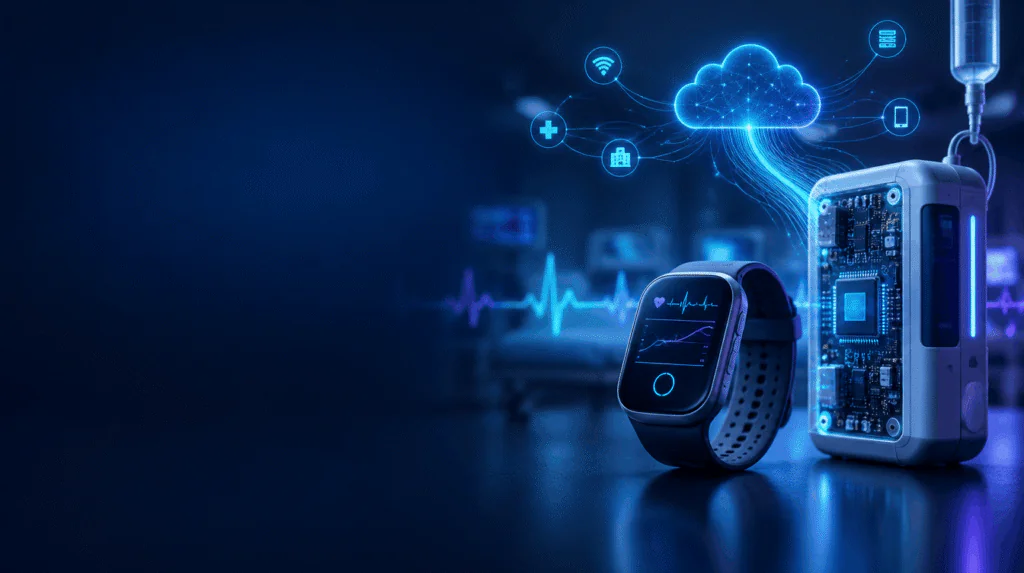
In medical devices, software reliability is a matter of patient safety. CHI Software builds and maintains device software from firmware to the cloud, with traceable requirements, documented design decisions, and recorded testing that support your audits and submissions.
Developing software for a medical device is much more significant than creating a typical app. Since it sits right on top of the hardware, its reliability becomes a matter of patient safety. Every change must be fully tested and documented, and this responsibility does not end at launch. Manufacturers keep running into the same gap. The hardware team is solid, but the firmware team is weak. Quality problems then surface late, causing the release date to slip.
CHI Software is a medical device software development company and long-term engineering partner for MedTech manufacturers that need to extend their R&D capacity without handing over product ownership. We cover the full span of software development for medical devices, from embedded firmware and device control logic to connected apps, cloud backends, and applied AI. Our job is to strengthen your engineering output and documentation trail. Your team keeps ownership of the product, the quality management system, and regulatory accountability.


























FDA QMSR is now the live audit standard, it is time to close remaining gaps in your design controls and software documentation. We can run a focused review and show you exactly where your current process stands.
Talk to Our Medical Device TeamOur medical device software development services are available for the entire process or for a single phase. Some clients bring us in for discovery and architecture. Others hand us a firmware backlog, a connectivity layer, or a modernization project with a fixed deadline. We adapt to the area in which assistance is needed.
We use the same engineering principles for all our work. Requirements are traceable, design decisions are documented, and testing and changes are recorded. Prepare submissions with the help of this documentation by your quality and regulatory teams. We aim to help you maintain compliance. But remember, we don’t certify products or act as an independent conformity assessment body.
Making good decisions early on can save you from having to make expensive corrections later. Before writing any code, we help you establish clear device requirements, compare architectural approaches, evaluate risks, and define the project scope. Our product discovery services transform your initial idea into a concrete plan with technical recommendations, effort estimates, and a risk assessment. Thinking about SaMD classification? We can help you determine which features are likely to be regulated before they affect your design.
Off-the-shelf solutions rarely fit regulated products with specific hardware and clinical workflows. We design and build custom software around your device, constraints, and users. As a medical device software design company, we prioritize architecture, usability, and maintainability because a device often remains in use for a decade or more, and the software must be serviceable throughout that time.
This is where many manufacturers feel the skills shortage most. Our engineers write embedded medical software and device firmware that runs on constrained hardware with hard real-time requirements. We handle board bring-up, RTOS and bare-metal work, device drivers, secure boot, and over-the-air update mechanisms. If you need to scale this capability, our embedded software development services and dedicated firmware development services give you experienced engineers without a long hiring cycle.
Modern devices rarely work alone. They communicate with phones, gateways, and the cloud. We develop connectivity solutions for connected medical devices and the Internet of Medical Things (IoMT): This includes BLE and other short-range links, companion mobile apps, device-cloud protocols, and the data pipelines behind them. The most challenging aspects are ensuring reliability under poor connectivity and maintaining the security of device data in transit and at rest. That is where we focus.
Hospitals and clinics run on existing systems, and your device has to fit in. We handle medical device integration with EHR and EMR platforms, HL7 and FHIR interfaces, DICOM where imaging is involved, and third-party clinical or analytics tools. Clean device data integration is what makes the difference between a device that gets adopted and one that creates manual work for clinical staff.
Legacy firmware and outdated application stacks can become liabilities due to unsupported toolchains, security gaps, and engineers unfamiliar with the code. We modernize this software while preserving validated behavior. Stack migration, re-architecture, and cybersecurity hardening are included in our software product modernization services. We provide a documented change trail so that you do not need to reopen your entire validation effort for modernization.
Testing a medical product is an ongoing process throughout its entire lifecycle. We develop automated test suites, support software verification and validation activities, and generate the test documentation required for your submission. After the product is released, we provide maintenance, monitoring, security patching, and over-the-air (OTA) updates to ensure the device continues to operate safely throughout its lifespan.
A compliance gap or a missed delivery deadline can block an enterprise contract before procurement ever evaluates your product on merit. Tell us where your current development setup is creating friction and we will show you how to fix it.
Book a 2-Week Software Gap Review
This firmware controls pumps, monitors, analyzers, and therapeutic devices. It reads sensors, drives actuators, and enforces safety interlocks. It must also behave deterministically every time. We design it with testability and long-term maintenance in mind because control software is the most difficult aspect of a device to change after validation and shipment.

This layer connects devices to users and the cloud. It includes companion mobile apps for patients and clinicians, device management backends, and infrastructure to handle large-scale provisioning, telemetry, and updates. From the first sprint, medical device software and app development must account for authentication, consent, and data protection.

When the software itself is the medical device, with no dedicated hardware, the priorities shift to clinical functionality, software quality, and controlled change. We build SaMD with those constraints in mind. The IMDRF clinical evaluation framework draws a useful distinction between analytical validity, clinical validity, and clinical association, and we design the software and its data flows so your clinical evaluation has something solid to stand on (IMDRF SaMD clinical evaluation).

Both remote patient monitoring and real-time health monitoring depend on the reliable extraction of device data and its transformation into clinically useful information. We develop ingestion pipelines, time-series storage, alerting logic, and dashboards for cloud-based medical platforms with an emphasis on data integrity and uptime.

As an AI medical device software development company, we incorporate machine learning where it is warranted: signal processing, anomaly detection, imaging support, and clinical analytics. We don’t just add AI to a device for its own sake. First, we identify the clinical or operational outcome that the model is intended to improve. Then, we develop the necessary data, validation, and monitoring processes. For a broader strategy on applying AI in this field, our healthcare AI consulting practice collaborates with device teams. For SaMD with a medical purpose, new regulations treat these solutions as high risk and require strong transparency and compliance measures. We help you organize your development process so your roadmap meets regulatory expectations.
Makers of physical medical equipment usually care most about embedded reliability, tight hardware integration, and maintenance over a long product life. For these clients we act as embedded and firmware specialists, extending internal R&D without taking over the product roadmap.
The success of connected MedTech companies hinges on secure device-cloud connectivity and reliable companion applications. Here, we combine Internet of Medical Things (IoMT) engineering, mobile development, and cloud backend work with built-in security rather than patched-on security.
When it comes to SaMD and digital health developers, the focus is on three key areas: clinical functionality, software quality, and controlled updates. We focus on disciplined development, strong testing, and documentation that supports clinical evaluations. In each case, we increase your capacity. You retain ownership of the product, as well as responsibility for quality management and regulatory compliance.
Whether you answer to the FDA, the EU, or both, software engineering is woven into your regulatory obligations. Our work is designed to support your quality function, not replace it. We cannot and do not certify your product. However, we can produce the engineering artifacts and follow the lifecycle processes that will make your audits and submissions easier.
The regulatory baseline has recently changed. The Quality Management System Regulation was implemented in the United States on February 2, 2026. Manufacturers must now align their QMS with ISO 13485:2016 under the revised 21 CFR Part 820 framework (FDA QMSR). For teams still mid-transition, it is the time to close those gaps before audits follow. We align our deliverables with that framework and the standards your quality team adheres to.
SaMD with a medical purpose is now high-risk AI under the EU AI Act Omnibus. We can help you map your current AI integration against both FDA and EU requirements.
Assess Your SaMD AI ComplianceWe follow the software lifecycle processes described in IEC 62304 and incorporate them into your ISO 14971 risk management initiatives. This includes software requirements tied to risk controls, documented architecture, and a clear link between hazards, their associated controls, and the code that implements them. If the software has a user interface that affects safety, we also incorporate usability engineering under IEC 62366-1.
The quality of verification and validation depends on the evidence behind them. We produce requirements traceability, test protocols, test results, and the documentation set by your design controls. Our goal is to provide you with a clear and complete record that can withstand scrutiny from reviewers and auditors.
Device security is now a core safety issue, not an afterthought of the IT department. Healthcare is the most expensive industry for breaches; IBM’s research data puts the average cost of a healthcare security incident at $6.64 million, a number that lands differently when software security is built in from sprint one rather than patched later (IBM Cost of a Data Breach Report). We use threat modeling, secure boot, and signed over-the-air (OTA) updates. We also build a software bill of materials and data protection into connected components from the start. These measures support your response to current FDA premarket cybersecurity expectations and data protection rules in your target markets. In the EU, the picture spans more than one rulebook: the device itself sits under MDR, where ENISA guidance shapes how cybersecurity requirements are read, while connected companion software and other digital elements around it can fall under the Cyber Resilience Act (CRA). We help you map which part of a connected product answers to which regime, so nothing slips through the gap between them.
Here, engineering quality is not an abstract virtue. Fewer field issues, more predictable releases, and lower cost to keep a device running are some of the ways it is showing up. The market is moving in the same direction. In Deloitte’s recent Life Sciences Executive Outlook, 47% of MedTech respondents identified AI implementation as their primary cost-containment strategy, and 49% cited AI-driven diagnostics as a product development priority. Most of those priorities are built using custom software.
Software that has been better-engineered will result in fewer defects reaching the field and steadier performance under load. Track this with defect escape rate and requirements coverage to see the trend over time.
A disciplined pipeline shortens the lead time for software changes and reduces the need for rework when releasing products. This is possible without the controls required for regulated products. With the documentation already in place, you can ship sooner.
Reliable connectivity and clean data pipelines increase device availability and provide real-time operational visibility into a fleet of devices in the field. This information is useful for support teams, clinical teams, and the development of future products.
Software you can maintain over a ten-year device life is worth more than software that is merely clever. We build for scale and for the engineers who will inherit the code, which keeps long-term support costs down.
We start with establishing the device requirements and intended use, and conducting an initial risk assessment. In this step, we distinguish between medical functionality and supporting software, and we determine what the software must and must not do.
Finally, we define the architecture, including how the firmware, applications, and cloud fit together, where the safety-critical boundaries are located, and which technology choices are allowed by the hardware and real-time needs. Our software architecture consulting services document these decisions, ensuring they survive staff turnover and audits.
The engineering process involves continuous integration and testing in iterations. The firmware, apps, and backend are integrated, and we test against the requirements throughout the process rather than waiting until the end. Test evidence accumulates instead of having to be reconstructed later.
We provide support for validation activities, help prepare the software component of your submission package, and deploy it. Then, we provide maintenance, monitoring, security updates, and change records to ensure the product continues to meet its obligations throughout its lifespan.
Our client is a US-based healthcare company specializing in remote monitoring systems for newborns and babies up to 4 years and those requiring constant supervision due to health problems or

Our client is an American multinational social technology company. It builds applications and technologies that help people connect, find communities of interest, and also grow businesses.
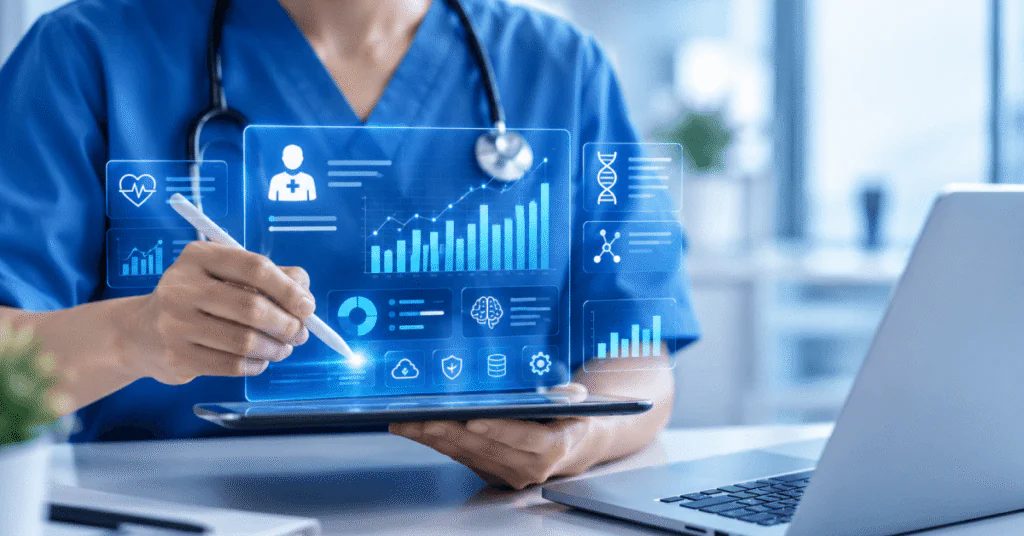
A Forward Deployed Engineer turned a complex healthcare data challenge into prioritized use cases, a FHIR-based architecture, and an implementation roadmap for 30M clinical records without replacing the existing MIS.
Technology choices follow the device, not the other way around. The technology that runs on constrained hardware with real-time limits differs from the technology that serves a cloud analytics platform. We select the stack based on the following: hardware, real-time requirements, connectivity constraints, cybersecurity needs, maintainability, and the environment in which your team already works.
Our teams work with embedded systems and real-time operating systems (RTOS) using C and C++ for firmware. We also work with Bluetooth Low Energy (BLE) and Internet of Medical Things (IoMT) connectivity stacks, as well as mobile development for iOS and Android companion apps. Additionally, we work with web applications, cloud infrastructure, and databases, including time-series stores for device telemetry. We also work with AI and machine learning frameworks for clinical analytics. Proven expertise and project-specific choices are not the same, and we will clarify this with you before you commit.








Most device problems cross disciplines. For example, a connectivity bug could be in the firmware, mobile app, or cloud. Having embedded, cloud, data, and AI engineers in the same partnership means there are no handoffs and one team owns the entire process.

We have experience building connected devices and healthcare software in regulated and adjacent domains. This experience is evident in the early questions we ask, the risks we flag, and the documentation habits we implement. As a medical device software developer, each of our engineers brings these habits by default rather than picking them up on your project.

You can hire us as a full product team, a dedicated squad, or individual specialists to join your group. If you need to quickly expand your in-house team, you can hire embedded software engineers through us on flexible terms. Our model adapts to your situation, not the other way around.
If your platform is losing enterprise deals because it cannot pass security due diligence or lacks a clean FHIR integration layer, modernization is a revenue issue, not just a technical one. Start with an architecture review and a concrete plan.
Request a Platform Modernization Review

Medical device software engineering involves the development of software that runs on, controls, or qualifies as a medical device. This includes embedded firmware in equipment, as well as companion and connectivity software and standalone software that performs a medical function independently. Unlike general healthcare application development, patient safety, risk controls, and regulatory documentation are built into the work from the initial requirements.
Software as a Medical Device (SaMD) performs a medical function without being tied to specific hardware, for example an algorithm that analyzes images to support a diagnosis. Embedded medical device software, sometimes called software in a medical device (SiMD), runs inside a physical device and controls how it operates. SaMD work centers on clinical functionality and controlled change. Embedded work centers on real-time behavior, hardware integration, and reliability.
Yes. We integrate devices and their software with EHR and EMR platforms and clinical systems using standards such as HL7, FHIR, and DICOM, plus secure APIs for third-party tools. The aim is for device data to flow into clinical workflows without creating manual steps for staff.
Instead of testing at the end, we test throughout the entire lifecycle. Our process includes automated verification against requirements, integration testing across firmware, apps, and the cloud, as well as support for validation activities managed by your quality team. Each step generates traceable evidence to inform your design controls and submission preparation.
The main drivers are device complexity, real-time and safety requirements, connectivity and integration scope, cybersecurity needs, regulatory class and documentation requirements, and the amount of validation evidence required for the product. The discovery phase is the most cost-effective way to transform these variables into a realistic estimate before committing a budget.
Experienced software developers for medical devices possess a combination of skills, including embedded engineering, connectivity, and applied AI, as well as a working knowledge of medical software standards and risk management. CHI Software provides this expertise as a medical device software development service, supporting manufacturers while they retain product ownership and regulatory accountability.
Yes, often, though it depends on the device and its constraints. AI can run on the device itself, in a companion app, or in the cloud. The optimal location depends on latency, data needs, and safety requirements. Our custom AI medical device software development services begin with the desired outcome of the model, then address the data, validation, and monitoring required for regulated use. The feasibility of a project is shaped by existing hardware limits and the change-control impact on an already validated product.

About cookies on this site