Legacy systems rarely fail overnight. More often, they continue running and gradually slow growth, increasing operational effort over time. The legacy modernization examples in this article show how business-critical systems reach a point where their structure no longer supports how companies work or scale.
We’ve seen these outcomes in our own delivery. In one healthcare modernization project, automation and analytics helped oncologists make clinical decisions 40% faster. On an EdTech assessment platform, improvements to the assessment workflow and data processing reduced grading time by 70% — significantly easing educators’ day-to-day workload.
The following seven projects show how modernization takes shape in real business environments. Each one began with a different challenge, followed a different technical approach, and delivered its own outcomes. Together, they demonstrate how legacy software modernization enables businesses to strengthen existing platforms while keeping day-to-day operations running smoothly.
What Counts as a Legacy Modernization Example?
An example of legacy modernization is any project that changes how an existing, business-critical system is built so it can keep serving the business, without throwing it away and starting over. The trigger isn’t the system’s age — it’s friction. Releases that feel risky. Integrations that break. Data that shows up late. A codebase where one small change quietly forces three others.
When someone asks which of the following is an example of legacy modernization: a cloud migration, an API rebuild, splitting a monolith into services, or automating a manual reporting pipeline, the honest answer is: all of them, as long as the system underneath is one the business already depends on.
10 Key Legacy System Modernization Trends for 2026
Read more
Real Results from Our Legacy Modernization Projects
The through-line across every legacy modernization case study below is the same. The system works, but its structure now costs more than it returns in engineering hours, IT operations overhead, and business outcomes that slip away. Modernization changes that math.
All seven examples follow a run-vs-change discipline: the business keeps running on the legacy system while the new platform is built, tested, and gradually switched on. Parallel environments, incremental cutovers, and tested rollback paths allow teams to deliver change without downtime.
Choosing the right strategy and sequencing it so the business never pauses is where software architecture consulting and application modernization services earn their keep.
Each of the seven projects below is a legacy modernization case study with a measured outcome. Here’s the shortlist:
| Project |
Industry |
Key Results |
Case Study |
| Financial Management Platform |
FinTech |
- 35% faster operations through unified data consolidation;
- 60% automation of financial workflows, reducing manual effort;
- 50% higher reporting accuracy across all portfolios.
|
View case study |
| Oncology Decision Support Platform |
Healthcare |
- 40% faster decision-making for oncologists;
- 30% fewer redundant lab tests, improving efficiency for hospitals and insurers;
- 25% scalability improvement after complete migration to cloud and microservices.
|
View case study |
| Direct Store Delivery Platform |
Retail / Logistics |
- 30% faster performance during high-load operations;
- 97% customer retention rate post-modernization;
- 40% increase in user satisfaction.
|
View case study |
| Internal Trading Platform |
FinTech |
- +60% faster operations and system response time;
- ×5 scalability growth through AWS infrastructure;
- +30% improvement in compliance and data security.
|
View case study |
| Multi-Market Leasing Platform |
Real Estate / Leasing |
- +40% faster expansion through leasing platform modernization;
- ×3 quicker releases after automation replaced manual work;
- +35% stronger performance from optimized architecture and stability.
|
View case study |
| EdTech Assessment Platform |
Education |
- 70% faster grading thanks to the new student assessment software upgrade;
- 30% more accurate plagiarism detection;
- 45% earlier identification of students at risk through assessment system modernization.
|
View case study |
| K-12 Digital Learning Platform |
Education |
- +30% faster lesson delivery and assessment processing;
- +40% improvement in development velocity;
- 99.95% uptime for all learning products.
|
View case study |
Explore the next section, where we take a detailed look at each case study, covering the business context, modernization approach, results, and lessons learned. Each case demonstrates how strategic decisions and modern transformation approaches help address business challenges and create long-term value.
Companies in the bottom 20% by technical debt level are 40% more likely to have failed or abandoned IT modernization projects before seeing results — a technical audit maps where your estate sits before that statistic becomes yours.
Get a Free Legacy Architecture Assessment
7 Legacy Modernization Examples and Case Studies
Modernization rarely follows one pattern. Across these seven projects, systems hit their limits for different reasons: growth, operational pressure, regulatory demands, or the workflows people actually use. Each is a legacy modernization case study in its own right, showing what changes when a company evolves a platform step by step rather than starting from scratch.
Example 1: Scaling a Financial Platform Without Disrupting Operations
We helped update a financial management platform supporting investment operations for a growing fintech organization. The system was stable and business-critical, which ruled out a full rebuild.

This infographic illustrates one of the legacy modernization examples, with a focus on system scalability, automation, cloud infrastructure, and security improvements.
Business Context
As the platform scaled, financial processes required increasing manual effort. Reporting depended on fragmented data sources, integrations were difficult to extend, and business logic did not support complex investment scenarios or evolving compliance needs. This setup represents a typical example of legacy modernization, where structural limitations begin to slow down growth.
Modernization Approach
The financial management system modernization focused on strategic incremental changes, such as:
- Restructuring the key and foundational financial logic to support complex calculations and flexible reporting;
- Introducing a unified integration layer instead of one-off connections;
- Automating reporting and data validation processes;
- A cloud migration onto AWS and Azure, backed by Azure application modernization services;
- Implementing role-based access control and enterprise-grade security aligned with SOC 2 requirements.
The platform was built using Java and Spring Boot on the backend, Vue.js on the frontend, and PostgreSQL as the primary database.
Results
Thanks to automation, the volume of manual work in financial workflows was reduced by more than 60%. Financial operations were executed 35% faster, and reporting accuracy increased by 30%. The platform ensured 99.9% reliability even under high loads — a necessary requirement for enterprise use.
Lessons Learned
- We underestimated how quickly complex business logic turns into a constraint: Proactively refactoring financial models helped avoid future scalability issues.
- Integrations created more complexity than the core and essential functionality: A unified integration layer was required to ensure consistency and scalability.
- Automation has increased both efficiency and trust in the data: Moving away from manual checks has bolstered confidence in the reporting.
- Security had a greater impact on adoption than expected: An architecture compliant with regulatory requirements was crucial for enterprise clients.
Example 2: Architecture Behind Faster Clinical Decisions
In this project, the system directly influenced how quickly doctors could respond. The oncology decision-support platform was already deeply embedded in established clinical workflows — helping medical specialists select lab tests and treatment plans. As usage increased, even minor delays in data processing began to affect the speed and quality of critical clinical decisions.
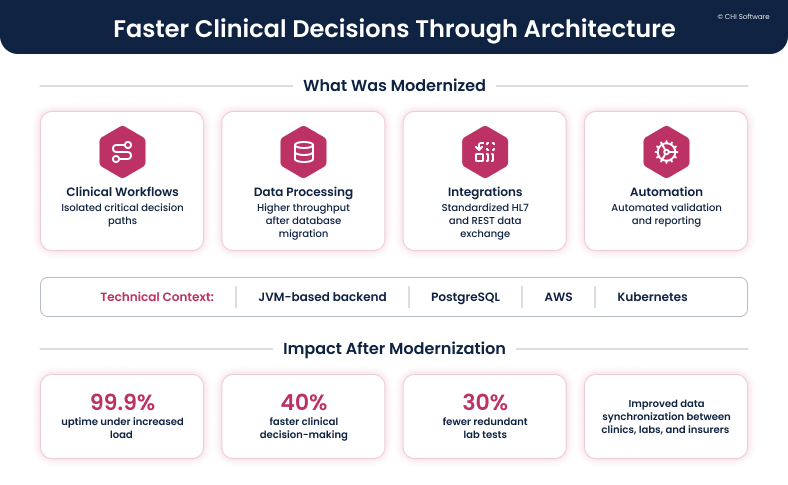
This legacy modernization example shows how architectural changes helped a healthcare platform support faster clinical decisions under growing load.
Business Context
The platform was processing ever-increasing volumes of data from laboratories, insurance companies, and clinical systems. Each new integration added complexity, and the initial monolithic architecture was struggling to handle the load.
Performance dropped during peak hours, while data verification was still being performed manually. The system had become a classic example of a legacy solution in a clinical setting — reliable, yet no longer capable of keeping pace with the speed and scale of daily clinical operations.
Modernization Approach
We adapted the platform to better support real-world operations:
- Break down the monolith into microservices to isolate critical clinical workflows;
- Migrated the database to PostgreSQL to support higher throughput;
- Standardized scalable and reliable integrations with HL7 and REST APIs based on API modernization services;
- Automated verification, reporting, and notification pipelines;
- Deployed on Kubernetes in AWS to hold up under load;
- Added custom SSO and encryption to meet HIPAA requirements.
Under the hood, the platform runs on a JVM-based backend with a modern web UI. This is the Strangler Fig approach in practice: a routing layer sits in front of the legacy system, new functionality is built as separate services, and traffic is gradually shifted until the monolith can be decommissioned without a big-bang cutover.
Results
After the oncology platform modernization, the platform handled a higher load without performance degradation and maintained 99.9% uptime. Clinical decision-making accelerated: oncologists reached conclusions 40% faster, and hospitals reduced redundant lab tests by 30%. More reliable data synchronization improved coordination between clinics, laboratories, and insurers using the platform.
Example 3: Direct Store Delivery Under Growing Operational Load
We stepped into a Direct Store Delivery environment, where the system was already integrated into daily distribution operations. Our task was to help teams maintain consistent task execution amidst rising volumes, without disrupting the workflows that the company’s daily operations relied upon. We focused primarily on aligning the system with how delivery operations were actually carried out in the field.
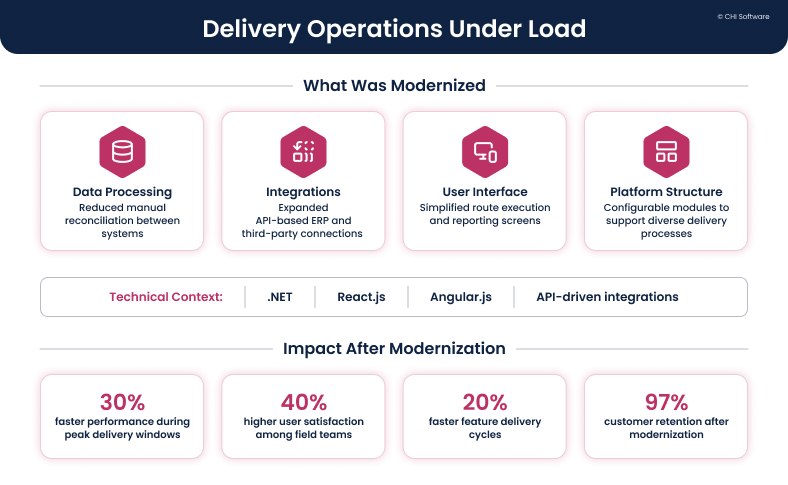
This legacy modernization example shows how delivery platforms evolve to handle increasing operational demands — through data optimization, stronger integrations, and workflow improvements.
Business Context
As daily volume increased, routine operations became more demanding. Data updates required manual reconciliation across multiple systems, ERP integrations remained fragile, and legacy platform versions slowed the delivery of new changes. The system continued to operate — but the gap between daily operations and platform capabilities kept growing. This legacy modernization effort was driven by years of continuous growth rather than outdated technology.
Modernization Approach
Our modernization process focused on gradual transformation and risk control:
- Upgrading the existing stack without changing the key and business-critical operating logic;
- Optimization of complex database queries and workflows for high-volume data operations;
- Modernizing the UI with React.js and Angular.js;
- Expanding API-based integration with ERP systems and third-party tools;
- Adding configurable modules for diverse business processes;
- Standardizing technical documentation to speed up future work.
The platform was built using .NET technologies, and the interface modernization and infrastructure upgrades were carried out with long-term support requirements in mind.
Results
Once the platform was adjusted to real delivery conditions, the operational flow became smoother. Performance during peak delivery windows improved by 30% — reducing delays in route execution and reporting. Field teams adapted quickly to updated workflows, reflected in a 40% increase in user satisfaction.
The customer retention rate remained high at 97%. This indicates that the changes strengthened trust, rather than disrupting established processes. Developers also began working faster, reducing the time required to implement new features by 20%, thanks to a reduction in technical obstacles.
Lessons Learned
- Complex compatibility constraints set the overall modernization pace: Existing versions and established workflows required gradual, сontrolled changes — rather than a rapid system replacement.
- Data processing analysis highlighted key performance bottlenecks: Database-level improvements delivered tangible results faster than changes to the user interface or application logic.
- Interfaces affect execution speed: Simpler screens reduced hesitation and task completion times for field teams.
- Written standards remain important even after the work is completed: Clear documentation helped the company maintain its pace of development following the modernization.
Example 4: Balancing Performance and Compliance in a Trading Platform
Another of our legacy system modernization examples is an internal trading platform that supports daily investment decision-making, portfolio management, and the preparation of regulatory reports. Our work focused on one key and measurable objective, maintaining stable and reliable performance and data integrity under a constant transactional load.

It is one of the legacy modernization examples — where structural changes, data processing optimization, and automated releases helped balance performance and compliance in a trading platform.
Business Context
During peak trading hours, the platform would become unresponsive. Large datasets loaded slowly, compliance checks interrupted the data flow with manual steps, and obtaining a real-time view of trading activity took extra time. Making changes was no easier because everything was consolidated into a single codebase — even minor updates required inter-departmental coordination, slowing progress as usage increased.
Modernization Approach
The project changed the structure and removed operational obstacles by:
- Decomposing the monolith into microservices for independent scaling;
- Upgrading the core backend to .NET 8 and EF Core;
- Building and developing Python-based ETL services to accelerate data processing;
- Introducing CI/CD pipelines to automate deployment and cut release risk;
- Adding a group-role access model to simplify compliance and audits.
The platform used Angular on the frontend and PostgreSQL, MySQL, and SQL Server for data storage, while infrastructure management was handled using AWS, Docker, and Terraform.
Results
After the changes, the system responded noticeably faster — response times improved by more than 60%, and the platform handled a five times higher load without degradation. CI/CD automation shortened deployment cycles by half. Security and compliance indicators also moved forward, improving by 30%, while infrastructure optimization lowered operating costs by 20%, making further growth easier to sustain.
Lessons Learned
- Compliance requirements influenced technical priorities earlier than expected: From the very beginning of the modernization process, access control and auditability played an important role in shaping architectural decisions.
- Data processing has become a key driver of productivity at scale: Optimizing ETL processes delivered the most rapid performance improvements amidst high trading volumes.
- Automation changed how the company managed releases: CI/CD pipelines, combined with loosely coupled architectures, made system updates more predictable and contributed to lower change failure rates, reducing operational uncertainty.
- The choice of infrastructure determined scalability capabilities and operational costs: Cloud architecture enabled support for higher workloads and improved cost-efficiency.
Example 5: Expanding a Leasing Platform Across Markets
CHI Software supported the next phase of growth for a paperless leasing platform operating in multiple markets. Moving into new regions highlighted how much time and coordination each launch required.
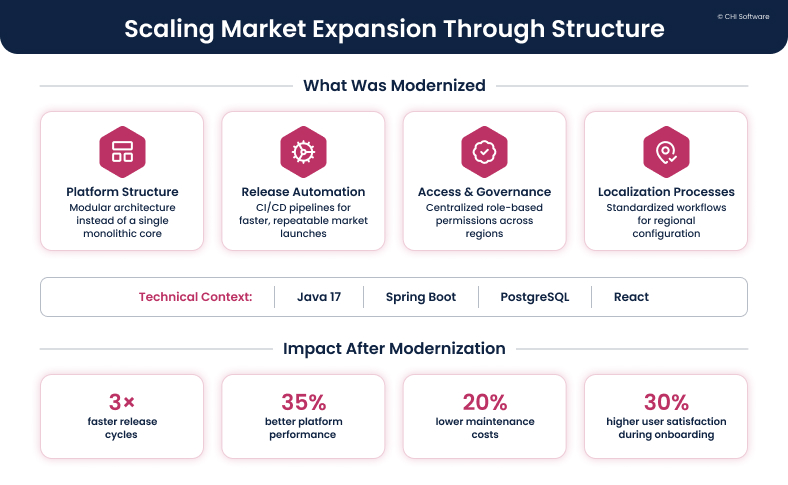
In this legacy system example, software upgrades focused on modular architecture, release automation, and standardized processes to make multi-market expansion predictable and manageable.
Business Context
Each new market rollout required a lot of manual work. Employees had to configure compliance rules, deployments, and regional settings separately, which slowed releases and increased operational risk. As usage grew, these constraints became a familiar legacy modernization example — platforms expanding faster than their internal processes.
Modernization Approach
We approached this leasing platform modernization by simplifying the system structure and removing operational friction. Our project involved:
- Refactoring the existing monolithic application into a modular Java-based architecture;
- Introducing CI/CD pipelines to automate deployments and environment setup;
- Migrating infrastructure to Kubernetes for predictable scaling — across different markets;
- Implementing centralized access management and role-based permissions;
- Adding monitoring tools to improve observability and troubleshooting;
- Standardizing localization workflows for faster market onboarding.
The platform was built using Java 17, Spring Boot, PostgreSQL, React, and Docker, with BPMN-based workflow automation supporting leasing processes.
Results
Entering new markets became possible in a matter of weeks rather than months. Release cycles accelerated threefold, and platform performance under load increased by 35%. Automation reduced operational expenses, resulting in a 20% decrease in service costs. User satisfaction rose by 30% — thanks to a faster onboarding process and fully digital contract processing.
Example 6: Assessment Platform Built for Real Classroom Workflows
We joined the project when the assessment platform was already actively used by educational organizations. Our team worked directly with teachers and administrators to understand where the system slowed them down during daily assessment and review. As a result, our role focused on aligning the system with real academic workflows while preparing it for further scale.

In examples of legacy modernization projects like this, progress starts with rethinking everyday assessment workflows, allowing platforms to deliver earlier insights and reduce manual effort.
Business Context
As assessment data grew, the platform struggled to turn results into timely insights. Teachers spent more time manually reviewing answers, and reporting focused on past results — it did not help educators identify issues early. At the same time, integration with learning management systems varied across institutions, increasing maintenance effort and slowing day-to-day work.
These conditions reflected familiar challenges seen across examples of complex legacy systems, where active use exposes structural limits long before systems actually stop functioning.
Modernization Approach
Instead of adding new features on top of existing limitations, we revisited how assessment data moved through the platform. Our experts aligned system behavior with how teachers create, review, and interpret assessments, then rebuilt the supporting layers around those flows. The assessment platform modernization involved:
- Restructuring assessment logic to reflect actual grading and review patterns;
- Introducing an AI-based system for evaluating and detecting paraphrasing to reduce the volume of manual review.
- Redesigning analytics to identify learning gaps and early risk signals;
- Strengthening integration with LMS platforms to reduce duplicated effort;
- Migrating infrastructure to a cloud-based environment that scales with usage.
The solution combined Python-based processing, Apache Spark, AWS services, and machine learning models deployed via SageMaker and Hugging Face.
Results
Grading time decreased by 70%, and plagiarism detection accuracy improved by 30%. Educators identified at-risk students 45% earlier, and student engagement increased by 50% due to adaptive assessments. The platform scaled without downtime during integration — continuing to support increasing adoption across different institutions.
Lessons Learned
- Assessment tools should reflect actual teaching workflows: Aligning them beforehand with classroom practices helped avoid complications at later stages.
- Automation is changing how educators spend their time: AI-assisted grading has allowed teachers to focus on teaching rather than on grading assignments.
- Insights matter only when they appear in a timely manner: Clear analytics enabled timely intervention rather than mere reporting.
- Integration determines the level of implementation: Seamless integration with the LMS reduced schools’ operational costs.
Example 7: Designing for Peak Load in K-12 Learning Systems
CHI Software’s team helped evolve an active K-12 online learning platform already used in daily classroom instruction. The focus was not on adding new features — but on reworking how the existing system behaves in real school conditions.
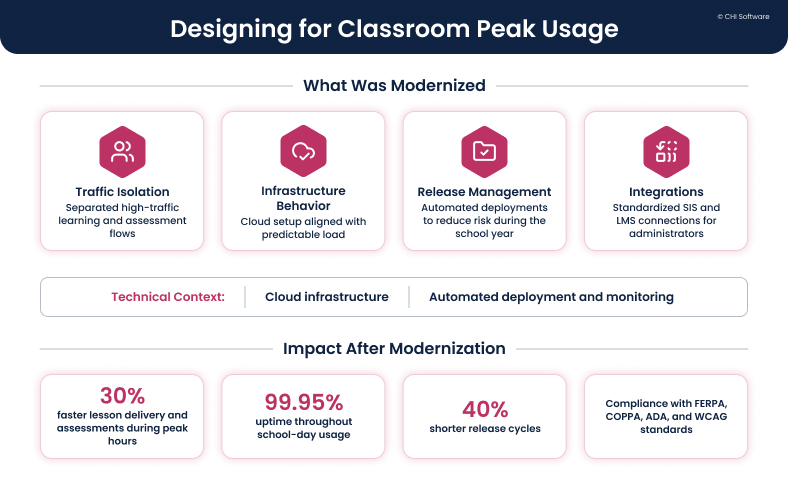
Such legacy applications often struggle during anticipated peak loads — therefore, cases like this serve as relevant legacy application modernization examples, with the modernization effort focused on isolating high-traffic flows and stabilizing system performance during training sessions.
Business Context
The greatest challenges in modernizing the outdated systems arose during predictable periods of peak load — rather than due to steady growth. When thousands of students logged in simultaneously, content delivery slowed down, and grading workflows stalled.
The company avoided releasing updates during the school term because even minor issues could disrupt classroom activities. Differences across district-level integrations created extra manual work for administrators and led to more frequent support requests.
The system kept running, but each academic cycle required more coordination and operational effort. We often see similar dynamics across large educational applications — where stability matters more than speed of change.
Modernization Approach
Instead of redesigning the platform around abstract scalability goals, we focused on how it behaved during real classroom usage. Drawing from our experience with examples of legacy modernization projects, we concentrated on evolving the existing system without interrupting learning by:
- Separating high-volume instructional and assessment workflows from support services;
- Migrating infrastructure to cloud environments supporting predictable, time-dependent workloads;
- Implementing deployment automation to reduce risks during update releases throughout the academic year.;
- Standardizing powerful integration with SIS and LMS providers to simplify administration;
- Improving monitoring to detect problems before they impact lessons;
- Updating accessibility and data processing practices in accordance with FERPA, COPPA, ADA, and WCAG requirements.
The platform combined web applications, backend services, cloud infrastructure, and automated tooling to support daily classroom use.
Results
Under peak load, lesson delivery and assessments were processed up to 30% faster. Release cycles shortened by 40%, while uptime during school hours consistently stayed above 99.95%. After this K-12 learning platform modernization, administrative effort dropped as integrations became more predictable, and engineers gained confidence to update the system without pausing academic activity.
Every example in this article started with a board decision to fund modernization before it became a continuity crisis. A fixed-scope pilot delivers a measurable first result and a validated business case before any larger commitment is required.
Request a Fixed-Scope Modernization Pilot
Common Patterns Behind Successful Legacy Modernization Examples
Step back from the seven stories, and the same threads keep reappearing. These are the patterns and best practices behind successful modernization strategies, and they hold up across industries. You probably associate legacy modernization with old systems and long-standing technical debt, but age is almost never the deciding factor. Even fast-growing startups reach a point where the system no longer supports scale, flexibility, or efficient IT operations.
For CIOs, modernization is also a governance and vendor consolidation opportunity. Rationalizing overlapping tools, clarifying ownership of each service, and reducing the number of critical vendors simplify audit, security, and cost control. A board-ready modernization case frames these benefits alongside performance and risk metrics.
Modernization Starts When Scaling Creates Friction
Systems usually trigger modernization not because they stop working, but because scaling turns inefficient. The signals are familiar:
- Every new client or feature needs manual adjustment;
- Operational load grows faster than revenue;
- A change in one part of the system disturbs unrelated components;
- Teams spend more time maintaining processes than improving the product.
At that stage, technology no longer supports growth. It gets in the way of it.
Legacy Issues Are Caused by Design Decisions
“Legacy” problems tend to come from how a system was designed, not when it was built. You’ll find a legacy system example even in young platforms if they rely on tightly coupled components, business logic scattered across layers, or integrations built as one-off solutions instead of reusable interfaces.
Incremental Change Replaces Full Rebuilds
Full rewrites are rare and risky. The stronger play is incremental: upgrade the most limiting components first, run new modules alongside the old ones, and let legacy and modern parts coexist for a while. This is the core of good legacy system migration services, and it keeps operations stable while the estate moves toward modernized systems. A cloud migration handled with the right cloud modernization services lands with far less disruption than a big-bang cutover.
Integrations and Automation Become Critical
As platforms grow, integration and workflows often fail before core functionality does. Disconnected systems, data transmission delays, and manual operations create the majority of day-to-day obstacles. This is precisely where modernization often begins — by restructuring integration layers, automating repetitive processes, and ensuring data consistency across systems. When reporting and analytics are added to the mix, data modernization services and BI modernization transform fragmented information into trustworthy insights. These changes directly impact business scalability and performance.
Security, Compliance, and Usability Become Architectural Concerns
Security and regulatory compliance cannot simply be “layered” onto a system after its core has already been developed. Access control, data management, and auditability shape the architecture from the very beginning, particularly in the corporate sector and highly regulated industries. Usability is also a crucial factor here: if accessing or reading data is difficult, decision-making slows down, and the error rate rises. Effective modernization treats these factors as design priorities, representing a key best practice for any project.
Conclusion
Modernization rarely follows a single scenario. Systems reach the limits of their capabilities for various reasons: operational complexities, integration gaps, governance challenges, vendor consolidation needs, regulatory compliance requirements, or workflows that no longer align with the underlying architecture. What matters most is not how your system started out, but where it is causing problems today — and how modernization can improve performance, governance, and security while enabling vendor consolidation.
At CHI Software, we usually start with listening — understanding how your system is used today, where it slows your business down, and what constraints shape your decisions. From there, we help create a realistic modernization roadmap that fits your processes, timelines, and technical landscape. If you want to explore what this could look like for your platform, contact us to discuss your situation with our team.
The modernization engagements that close without surprises share one trait: the partner came with a documented methodology, independent IP ownership, and a delivery structure that passed enterprise vendor review before a contract was signed.
Request the Vendor and Security Assessment Package
FAQs
-
What criteria should you use to evaluate a legacy modernization partner?

Look past the demo and check how a partner delivers. The signals that matter — a documented methodology rather than ad-hoc work, clear IP ownership that stays with you, security and compliance practices that survive an enterprise vendor review, and a delivery model that shows progress in measurable milestones. Ask for real examples of legacy modernization they've shipped, and how each client ran the system after handoff. A partner who can point to self-sufficient teams post-engagement is telling you something a slide deck can't.
-
What role does AI play in modernizing legacy systems today?
AI helps most where the work is tedious and pattern-heavy — reading undocumented code, suggesting refactors, generating test coverage, and mapping dependencies before a cloud migration. It's a strong accelerator, not a substitute for architecture decisions. Left unchecked, AI-generated code adds duplication and hidden debt faster than a team can review it. The value shows up only with structured review and clear ownership around it. In our projects, AI speeds up discovery and modernized-systems testing; humans still own the strategy.
-
Can legacy systems be integrated with modern tools instead of being replaced?
Yes, and that's usually the right strategy. Most of the case studies above kept the existing system running and wrapped it with modern interfaces, such as new API layers, an integration bus, or a service that exposes old data to new tools cleanly. Replacement is the exception, reserved for when the core can't carry the business further. Integration-first keeps operations stable and often delivers the business impact you were chasing without a full rebuild.
-
How do you decide whether modernization is needed if the system is still working?
A system rarely breaks suddenly. The signals are quieter and show up in daily work. It's worth watching a few practical indicators:
• Teams spend more time maintaining workflows than improving the product;
• Small changes need coordination across several parts of the system;
• Releases feel risky, so updates get postponed or bundled;
• Integrations or reporting still rely on manual steps.
If the system works but keeps slowing down decisions or delivery, modernization is usually already overdue.
-
What business risks should be evaluated before starting a legacy modernization initiative?
Modernization affects live operations, making business risk just as important as technical decisions. Before moving forward, it is worth considering:
• How much daily revenue or customer activity depends on the system;
• What would the business impact be if a release introduced downtime or data inconsistencies;
• How regulatory or compliance requirements influence technical decisions;
• Whether internal teams have enough knowledge and capacity to support the transition.
These considerations are not reasons to delay modernization. They help determine the right pace, scope, and rollout strategy.
-
What parts of a system usually make the biggest impact when modernized first?
The greatest improvements rarely come from rebuilding an entire system. In many cases, the biggest impact comes from focusing on a few key areas:
• Integration layers connecting the platform with external tools or partner systems;
• Data pipelines supporting reporting, analytics, and business decisions;
• Workflows that still rely on repetitive manual tasks;
• Infrastructure components that become bottlenecks during periods of peak demand.
Improving even one of these areas can increase stability and performance without requiring a full system overhaul.
-
How do modernization efforts differ for B2B platforms versus consumer-facing products?
The objectives may be similar, but the challenges are often very different.
For B2B platforms, modernization typically emphasizes:
• Predictable, auditable processes with seamless integration into client systems;
• Long-term maintainability is supported by structured change management.
For consumer-facing products, the focus usually shifts to:
• Consistent performance under changing traffic patterns;
• Faster product iteration and a smoother user experience.
Knowing who relies on the system — internal teams, business clients, or end users — helps determine the right modernization strategy and where it will deliver the greatest value.
-
How do you measure ROI when modernization is done incrementally?
The return on investment (ROI) from phased modernization is rarely expressed as a single figure. It manifests as a set of signals that emerge over time, such as less operational effort and support load, faster release cycles with fewer production issues, better performance during critical periods, and lower risk when adding new features or integrations. Each legacy modernization case study shows that incremental modernization pays off when the system becomes easier to evolve — rather than simply cheaper to maintain.
About the author
Ivan keeps a close eye on all engineering projects at CHI Software, making sure everything runs smoothly. The team performs at their best and always meets their deadlines under his watchful leadership. He creates a workplace where excellence and innovation thrive.
Yana oversees relationships between departments and defines strategies to achieve company goals. She focuses on project planning, coordinating the IT project lifecycle, and leading the development process. In their role, she ensures accurate risk assessment and management, with business analysis playing a key part in proposals and contract negotiations.
Rate this article
108 ratings, average: 4.97 out of 5