School classes and personal study sessions are progressively increasing their reliance on digital technologies, such as learning apps, quizzes, and assessment tools. And it’s no wonder why a recent OECD study showed students who used digital technologies in class scored up to 15 percent higher in math, reading, and science.
These improved student performance numbers could be an early but tell-tale sign of an upcoming paradigm shift. For an individual student, it could simply mean higher marks – but on the grander scale, an upcoming digital transformation in education could reshape how universities and EdTech approach learning for millions of teachers and students. With the emergence of EdTech apps, educators can now use smart analytics and AI-driven feedback to reap benefits that range from leveraging institutional resources more efficiently, to revolutionizing education.
Do you want to be a part of transformative changes? Check out how real business implement innovations.
In this article, we’ll explore how digital tools help businesses and institutions to improve student learning processes and operational efficiency.
Article Highlights
How we helped one of our clients transition to a platform with interactive lessons, reward systems, and unlockable achievements and see a 50% increase in user engagement as they expanded into nine new countries.
In 2023, 53.2% of students across the U.S. were enrolled in distance education courses. Digitalization becomes a necessity for institutions to retain learners who prefer remote education.
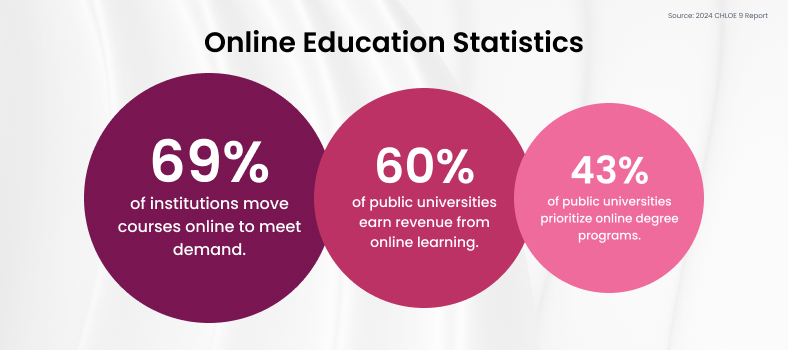
According to the 2024 CHLOE report, 69% of institutions are switching on-campus courses to online versions to meet rising demand.
Why is DigitalTransformation Required in Education?
What is digital transformation in education, exactly? The OECD defines EdTech digital transformation as the application of digital tools for institutional management, teaching, learning, and grading in classrooms. Global digitaltransformation in education started going mainstream as a response to the COVID-19 pandemic, and although the crisis has long passed, its effects are still reverberating in the new rulebook for businesses and institutions who use remote learning.
Let’s take a look at the most prominent reasons why digital tools are becoming a necessity in today’s education sector.
As learning increasingly happens online, it perfectly illustrates the ongoing EdTech digital transformation.
Better Students Retainment
Research shows that the gap is widening between what education systems provide and what society demands. For example, Gen Z values visually engaging and fun platforms that go beyond basic functionality — something schools and universities can’t always provide. As a result, formal institutions find themselves competing with EdTech entrepreneurs to close this gap.
For colleges and universities,digital learning transformation is now all about the competition to win prospective students — or lose them to EdTech businesses.
Support for EdTech Businesses’ Market Growth
The competition is also heating up for e-learning platforms, particularly with AI growth. The EdTech market will likely quadruple by 2034, and to remain competitive, your business needs to respond to subtle learners’ struggles, such a waning attention span.
As more platforms offer similar content, learners will gravitate towards those that provide a better studying experience. By adopting digital technologies, EdTech businesses can meet students’ demand for personalization and scale.
Simplified Learning for Students
“Most of the nation’s current K-12 learners are locked into the one-size-fits-all approach to learning that their parents, grandparents, and great-grandparents were,” — says Jean-Claude Brizard, CEO of Digital Promise and former chief executive of Chicago Public Schools.
Indeed, due to the lack of institutional resources, students often struggle with unified assessments and materials that are not always relevant for the modern job market. Digital tools can fill in the gaps where institutional resources are stretched too thin. For instance, personalized tutoring was once a privilege not every student could afford – but today, teachers can delegate this tedious but valuable work to an AI chatbot that is able to analyze each student’s unique learning style.
Altogether, the question that the education sector is asking now isn’t whether or not to go digital — but how to best accomplish its evolving strategic goals.
Core Areas of the EdTech Digital Transformation
This is not the first time the education sector has had to undergo a major digital transformation.
In the early 2000s, the industry was still going though growing pains, adapting to the new software that would soon become everyday essentials: Microsoft Office Suite, Moodle, Skype, and Blackboard. Coursera, edX, Udemy, and Khan Academy carved out their niches during the first wave of education digital transformation.
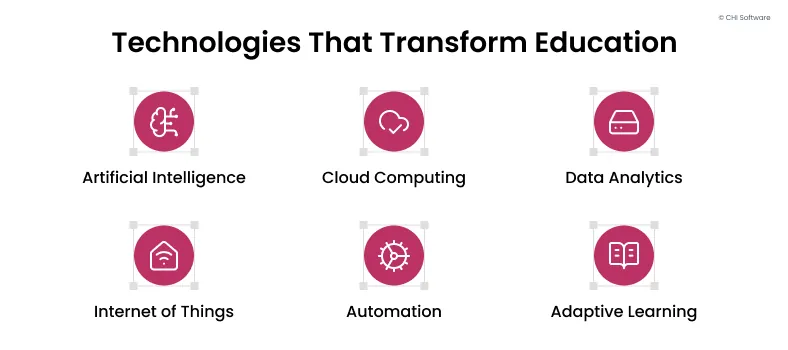
Today’s market expansion builds on these foundations, but now with far more integrated and data-driven systems. AI, cloud computing, data analytics, automation and Internet of Things (IoT) represent the five core areas driving digital transformation for education for the 2030s and beyond.
These technologies define how forward-thinking companies approach digitalization in education.
Artificial Intelligence
With the ability to transform content from text to voice or video, AI chatbots can replace customer support services, grade students’ work automatically, and tutor — these capabilities are the current reality.
Looking to the future, AI promises to even further change the methods of educating. Salman Khan believes that a plausible use of AI might be to assist teachers with real-time feedback notes like: “Hey, the kids zoomed through this topic – spend a little more time on this one” – meaning AI-driven digitaltransformation could step in where teachers’ limited human capacities are overburdened.
“With AI, more teachers would be able to do what excellent teachers do: create really engaging activities,” — Salman Khan, the founder of Khan Academy and Khanmigo.
AI in Modern Education: Applications and Real-Life Examples
Continue reading
Cloud Computing
Cloud computing helps universities and EdTech platforms to reach learners worldwide. Seminars, lectures, exams, and coursework can all be delivered and assessed on a single platform. For EdTech and formal education, the cloud removes geographical limits on a business’ customer base.
In 2023, 53.2% of students across the U.S. enrolled in distance education courses. Cloud computing will undoubtedly help that number grow significantly over the next decade and beyond.
Running educational institutions and businesses without data insights is a blindfolded game. Data analytics allows you to act strategically on what you know for sure about students and your operations.
As one interviewee put it to Harvard University researchers: “We have a lot of descriptive data about our students, but we don’t yet have systematic analysis of the student life cycle so we can describe how our students are doing.”
This gap between raw data and actionable insight remains a common challenge across education platforms.
In practice, advanced analytics help close that gap by tracking how learners interact with content, assessments, and feedback over time. We’ve seen this approach applied while developing a K-12 digital learning platform, where data analytics supported a more structured view of the student lifecycle across daily learning interactions. As education platforms mature, such lifecycle-level insight increasingly becomes a foundation for both personalization and long-term platform improvement.
Internet of Things (IoT)
The application of technology in education goes far beyond smartphones and laptops. IoT technology enables schools and universities to use interactive displays, projectors, wearable student ID bands, AI-enhanced security cameras, and more.
According to a report, in 2024, the K-12 sector already held a significant market share in IoT adoption — 39.6%. The same report also forecasts that the IoT market will reach around USD 92 billion by 2034, nearly nine times its 2024 value. Learning transformation is likely to blend digital and analog methods in classrooms in the near future, particularly through IoT.
Focus on your business growth — delegate technologies to those who know them best.
Talk to our expert
Automation
A 2022 study found that teachers work on average 54 hours per week, and only 25 of those are spent teaching students. Manual tasks like grading assignments, planning and administrative work take up the rest of the time.
Educators stand to save as much as 30 hours per week with digital tools such as auto-grading systems, AI-powered lesson generators, or student performance analytics apps. For instance, teachers can use software to generate context-relevant study materials and assessment questions, and to plan classes.
Adaptive Learning
Adaptive technologies can help each student learn on their own challenges and mistakes even in overpopulated classrooms. Twenty students given the same task will have varying knowledge levels, learning styles, and performance outcomes. Adaptive learning systems like analytics tools, machine learning models, adaptive assessments and tutoring systems can step in for each unique student case.
A literature review shows that adaptive learning increased academic performance in 59% of studies. That’s where a chatbot for e-learning best shows its benefits: with AI chatbot assistants, each student can have an individual learning assistant, either developed or provided by an institution. Businesses and universities have the chance to deliver a product before students give up in frustration.
AI and Adaptive Learning: Personalizing Education with Data
Continue reading
Top Examples of Digital Transformation in Education
The digital transformation of education can take as many forms as there are ways of studying. Take any link in students’ learning journey — note-taking, collaboration, revising — and imagine that everything can be digital. But how do you strategically choose what to transform in your business?
Below are some cases where the shift has proven successful and beneficial to both business and students.
Entertaining and Educational Learning Platform
The first wave of digitaltransformation shifted studying from workbooks to electronics and computer devices. Developing an educational app can help your business ride the next forecasted big wave: in-app spending. Across all industries, it’s likely to grow 267% by 2030.
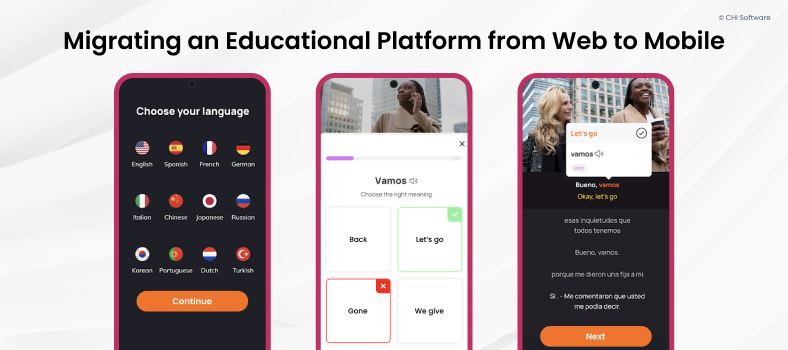
In this case study, education digital transformation took shape as a mobile app, reflecting users’ preference for learning on smartphones.
In the case of one U.S.-based EdTech company, our client successfully used movies and documentaries to help learners practice languages naturally. But users preferred studying on their smartphones. Migrating from web to mobile helped the platform expand the user base by 40% and achieve 35% longer user sessions.
QANDA
Digital transformation education cases can sometimes be as ambitious as putting an entire profession at users’ disposal. QUANDA is such a project — making a pocket-sized math tutor available to millions of users at once, via their smartphones.
The platform enables learners to take photos of math equations and then uses AI to solve the problem. Now, the platform reports over 6.3 billion questions solved.
Online Learning Platform for Kids
The solution we built for a Swedish EdTech client is a prime example of how digitalization in education can achieve things that teachers hadn’t even conceived could be possible.
Through the EdTech digital transformation, elements such as personalization and gamification supported our client’s expansion across nine new markets.
Typically, teachers need to be part-time entertainers in their classrooms when students start to lose attention. Continuing to balance that with also monitoring their own teaching to see what works with students and what doesn’t can be a lot for a teacher to handle. Instead, we developed a platform that now allows educators to use interactive lessons, reward systems, and unlockable achievements to entertain the children. Moreover, the platform then collects all kids’ interaction data and feeds it to dashboards available to teachers and parents.
With new personalization and gamification features, the client has already expanded to nine new countries.
Do you know how students learn better when they actively engage with material and teach others? But in real classrooms with up to 30 kids and one teacher, such interactivity just isn’t possible.
To address this challenge, Stanford Smile developed a platform that can shift even the most overpopulated classroom from a monologue to a two-way dialogue. Students can use the tool to ask questions about material in real time and receive answers from their classmates and teacher.
Automated Assessment Platform
One of the main time-killers for teachers is grading students’ work. Even after a long day spent teaching classes and filling out paperwork, educators often have to spend their evenings planning and assessing lessons. That’s valuable time they could be spending resting or expanding their knowledge or skills.
Automated assessment is a key direction in education digital transformation, helping teachers focus on creative work instead of routine administration.
We helped one of our clients, a Norwegian EdTech company, to build a platform that grades open-ended responses while also detecting plagiarism. By saving teachers’ time, this digital transformation in the education sector has turned headaches into an opportunity for our client – the team has already reported that time spent grading has been reduced by 70%.
Alice.tech is an example of how digitalization of education can be intertwined with existing studying routines. When preparing for exams, students revise their workbooks and notes, create flashcards, and ask friends to quiz them.
Alice.tech saves learners time preparing for routine tasks. Students can simply upload the material, and the platform creates summaries, keynotes, and quizzes. It’s an example of a digital tool serving as an accessible study buddy.
AI Chatbot for Educational Institutions
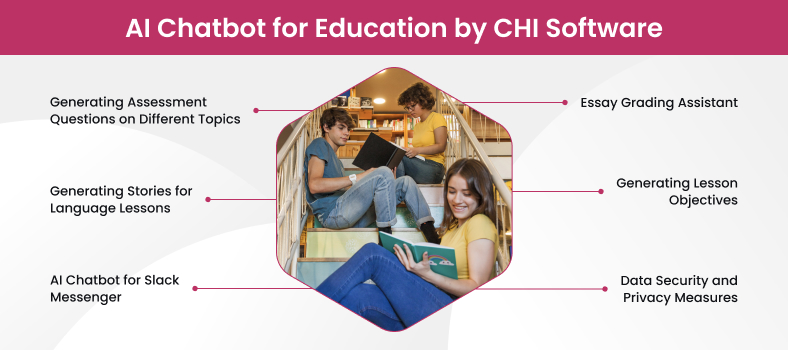
For one U.S. based company, diverse learning content was an essential part of the platform’s value proposition. However, with teachers spending up to 40% of their work time creating studying materials, specifically writing unique assessment questions. We developed an AI chatbot that automatically generates questions across a diverse set of topics and assessment types.
Chatbots, as one of the main drivers of digital technology in education, open new opportunities for both students and teachers.
Applying this EdTech digital transformation solution has brought our client a 50% reduction in teachers’ workload.
How to Implement Digital Technology in Education
When your company is on the verge of choosing EdTech digital transformation services, many factors can pull you in different directions. But where do you start? How can you implement new technology without collapsing the existing systems?
Let’s discuss the first steps that we see as a necessity in delivering measurable ROIs to our clients.
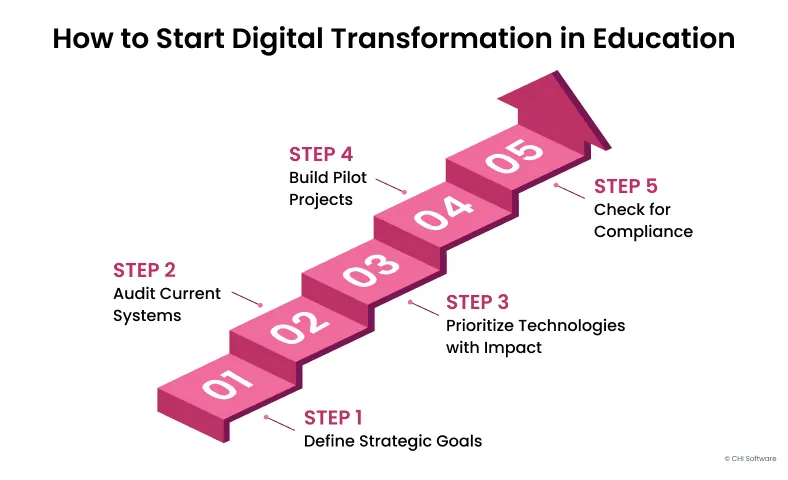
Here’s a simple roadmap of digital learning transformation in five steps, from initial goals to the final compliance review.
Step 1: Define Strategic Goals
Digital technology in education shouldn’t make you feel like you have to transform everything about your business all at once. Digital tools can help with different goals, from improving your student engagement rates to managing data across departments. But to start off, choose one area that nudges your budget and efficiency the most.
For example, your users sign up but don’t complete onboarding or the first lesson. Does the problem lie in a confusing UX design? Or perhaps there are too many required steps and users are quitting before they finish signing up? Set a specific goal: for example to increase the activation rate from 20% to 45% over the next six weeks, and try a data analytics tool to help you resolve the issue.
Your strategic goal should be measurable enough to track how new technology impacts the final KPIs.
Plans to implement new digital tools often stumble over data and your business’ processes in working with it.
For instance, both Moodle (a learning management system) and PowerSchool (a student information system) have the ability to store grades, attendance, and course progress. When you try to find insights for better customer retention in course completion rates, you could face multiple confusing records. System audit helps to remove roadblocks before setting a new tool on rails.
A good audit should capture workflows – rather than just lists of software and databases. What interests us as developers when updating an already existing architecture is how data and processes move through departments and systems.
Ivan Kuzlo
Engineering Director
Step 3: Prioritize Technologies with Impact
Our EdTech software developers can build any solution that you can dream of. But before taking on a project, we always start by asking both ourselves and a client: “Is that what they actually need?”
Let’s say your conversion rate from demo lesson to paid subscription is less than 2%. The reason may be low product value or wrong targeting. But if your data collection is inconsistent (e.g., LMS and CRMs use different IDs for the same user), subscribing to Tableau won’t fix the problem. You will need to do data cleansing first. That’s why it’s important to choose tools wisely.
Yana Ni
Chief Engineering Officer
Step 4: Build Pilot Projects
Pilot projects are like safety nets for your business. Digital transformation in the education sector can affect many areas of your operations, for instance, when a new tool impacts your customer or data management. With hundreds of users, your solution may not always behave as expected at the first trial. That’s why we recommend migrating to new systems one class, one faculty, or one process at a time.
The Real Challenges of Using AI in Modern Education
Read more
Step 5: Check for Compliance
Before you implement and scale the new tool system-wide, it’s wise to make sure that it works well locally before expanding its use. During implementation, you may want to run a small pilot group to test for GDPR or FERPA compliance. For instance, when performing a ChatGPT integration for EdTech, we usually start by testing the tool with a small group, such as a cohort of teachers trying an AI-assisted grading tool.
By the end of your digitaltransformation project, you should have verified proof that everything in the system runs smoothly.
Conclusions
Modern education looks vastly different from how it did a decade ago — schools have replaced group desks with cloud tools, and students can attend lectures from the comfort of their beds. But as the field continues to grow, AI, cloud technologies, data analytics, IoT, and automation tools are bringing a lot to the table.
To take the leadership role in the digital market, companies need to strategically adapt their infrastructure by choosing the right challenges to pursue and the right educational app developers. At CHI Software, we are seeing the digital shift happen clients by client. Some of them came to expand to new countries and some to retain existing users, but one thing is unanimous: they’ve reached their goals to implement new digital tools, and are reaching even further to new goals thanks to their investment in transformation.
If digitization has sparked your interest, fill out the contact form. We can help you shape a digital product that fits your market and strengthens your business model.
FAQs
How do EdTech digital transformation services enhance learning outcomes?
In our practice, there are several common ways businesses use digital technologies to improve students’ results:
- Using data analytics to adapt content and the platform’s formats to learners;
- Automating monotonous tasks to free teachers time to communicate more with students;
- Making platforms accessible anywhere, anytime, with a switch to mobile and cloud technologies;
- Helping learners to track their results.
Altogether, digital environments support students in the gaps where human capacities may be limited.
What are the six pillars of digital transformation in education?
It is a framework developed by UNESCO and partners to find a common language about technology across the whole sector. Six pillars are:
1. Coordination and leadership;
2. Connectivity and infrastructure;
3. Cost and sustainability;
4. Capacity and culture;
5. Content and curriculum;
6. Data and evidence.
How can institutions start their digital transformation for education?
To transform where the underperforming areas of your institution lie and how to address them, the first thing you need is clarity. For instance, if you are yet unsure about contacting specialists, you can ask yourself instead:
- What do our students complain about most often?
- Do we have the resources to fill the gaps our students are struggling with?
- Is there a simpler way to optimize in our situation? How might we know?
- What types of data do we already have? What use may we already have of it?
After assessing these questions, you can choose tools or vendors to audit your current systems and roll out a pilot project to test the first impact of technology on your ROI.
Why partner with a digital transformation provider for EdTech?
A good tech provider takes the burden of software development, security, and fine-tuning off the business’s shoulders. In particular, tech providers often:
- Offer a ready-made and scalable infrastructure;
- Handle software maintenance;
- Manage data security and compliance;
- Offer troubleshooting support;
- Bring a proven record of expertise in the field.
Altogether, partnering with tech experts backs up your project with niche-specific expertise safety nets. At CHI Software, we have proven success cases ranging from K-12 sector to enterprise-grade assessment tools, with our tools delivering measurable results, such as 50% higher engagement and 40% less teacher preparation time.
Ivan keeps a close eye on all engineering projects at CHI Software, making sure everything runs smoothly. The team performs at their best and always meets their deadlines under his watchful leadership. He creates a workplace where excellence and innovation thrive.
Yana oversees relationships between departments and defines strategies to achieve company goals. She focuses on project planning, coordinating the IT project lifecycle, and leading the development process. In their role, she ensures accurate risk assessment and management, with business analysis playing a key part in proposals and contract negotiations.
Are you wondering how much it'll cost to add a chatbot solution to your business? You're not alone. As AI gets more competent, more companies are thinking about jumping on the chatbot bandwagon to boost their customer service and streamline operations. But let's face it – chatbot development costs can be as clear as mud. Whether you're a tech whiz...
Is your company thinking of implementing AI tools to be able to work faster and with better insights? Or perhaps your team has decided to move to the cloud because it's a more scalable and less pricey option? Both are smart moves, but without a clear understanding of your data, these projects can easily go off track. Having solid data...
The mobile app industry is booming, and AI application development is shaping the way apps look and function. Because of the Internet and smartphones, mobile apps are essential for everything from social connections to customer support. And the trend is not slowing down: by 2026, the number of app downloads worldwide is projected to reach nearly 181 billion. More...
We use cookies to give you a more personalised and efficient online experience.
Read more. Cookies allow us to monitor site usage and performance, provide more relevant content, and develop new products. You can accept these cookies by clicking “Accept” or reject them by clicking “Reject”. For more information, please visit our Privacy Notice











A good audit should capture workflows – rather than just lists of software and databases. What interests us as developers when updating an already existing architecture is how data and processes move through departments and systems.