AI technology in education offers an exciting opportunity to innovate the entire sector and move learning off the beaten path of study methods. The new rails of education are already clear from outset: “I want my students to be proactive in building their learning skills. AI helps gather content while students make the connections,” says Romaine McCarthy, Learning Specialist at Isidore Newman School, LA.
Romaine’s words echo a theme discussed in our podcast on building AI tools that teachers actually use. In the podcast, CHI Software’s experts shared their experience in how AI and educational software development help businesses and institutions use technology as a partner, instead of a replacement for actual studying.
In this article, we continue the conversation and discuss the key applications of AI that can actually transform the classroom and real cases of businesses that have already done so with AI tools.
Want to learn more about how technology shapes education? We’ve put together a few examples for you.
In our experience, AI adoption offers as much as 70% accuracy in predicting which students might struggle with learning concepts.
AI Technology in Education: Market Overview
The role of AI in education revolves around four groups that shape the industry: students, educators, institutions, and EdTech businesses. Each group approaches the AI market for different purposes – it could be to help them study, or to help teach more efficiently, or to optimize institutional operations. As AI’s power to fulfill these needs grows, so does the industry, and the growth trend has been steady over the last few years.
But what’s actually driving this market expansion in education, beyond just hype? Below are the most noteworthy takes on the current market condition and its drivers.
Market Size and Growth
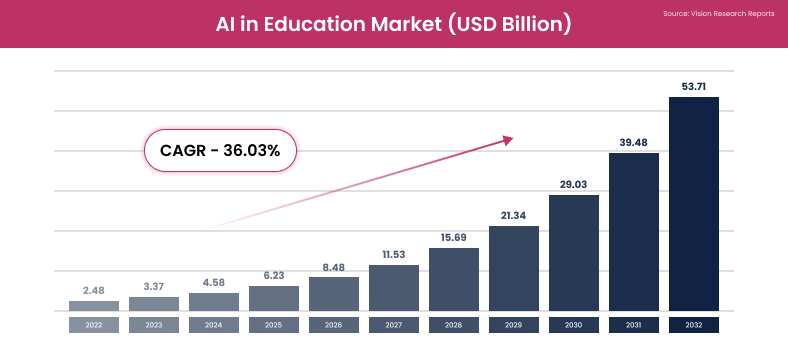
First, let’s look at the numbers — the global AI education market is indeed one of the drivers of the entire education sector, with a projected CAGR of 36.02% by 2034. Moreover, the overall AI in the education market size grew by 50% in the last three years:
Here’s how the market of AI in education has expanded over the past three years.
As the data shows, the numbers are growing steadily over time, given that AI adoption only began to go global in late 2022. For businesses, that means the time to jump on opportunities is only at its peak.
Market Drivers: Why Adopt AI in Education?
The main driver pushing the educational sector to adopt AI is the economic potential. According to Access Partnership, AI can contribute up to USD 6.6 trillion to the economies of the US, Germany, India, the United Kingdom, and France.
But while the economic possibilities of AI are promising, the drivers for adopting artificial intelligence in education vary across students, teachers, and institutions:
Firstly, students are pushing AI adoption from the bottom up. 88% already use generative AI for assessments — a dramatic jump up from 53% in 2024.
The main drivers for the high rates of adoption of generative AI among students are the need to get information efficiently (53%), brainstorming (51%), and help with schoolwork (62%).
Educators follow suit, driven by efficiency needs. 87% of teachers use at least one AI tool daily, mainly to automate grading (65%), reduce administrative tasks (45%), and personalize learning (32%).
As the numbers show, strong demand for AI is already present in the market, and growing by the day – driving more novel applications of AI in schools and on digital platforms. Now let’s get into the applications of AI.
Top AI Trends in 2026 for Business Growth & Automation
Read more
Applications of AI in Education
AI technology can enhance nearly any learning technique, from lesson design to assessments and progress tracking. In a recent podcast, CHI Software invited Olha Kanishcheva, PhD, an education and AI research expert at Heidelberg University, and Oleg Baydakov, technical lead of EdTech AI implementations, to share their expertise.
Below you will find more applications of AI in education along with highlights from the experts’ conversation.
Personalized Learning
AI can support personalized learning where it matters by tracking students’ learning patterns and analyzing their thinking. For businesses, all of these collected insights can lead to better content recommendation systems.
AI doesn’t replace teachers — it gives them more opportunities to focus on creativity, communication, and personal interaction with students.
Olha Kanishcheva
ML/NLP Engineer, Researcher
Notably, AI applications are multifaceted — the technology can aid personalization both on EdTech platforms and in schools’ classrooms. As Olha puts it: “When there are many students, it’s hard to give detailed feedback to everyone. AI can help by generating more personalized feedback for each student.”
Intelligent tutoring systems offer distinct benefits compared to one-on-one human tutoring. In particular, these systems can provide quick explanations, adjust the style of narration, and track students’ progress across multiple KPIs simultaneously.
These effects of AI on education appear most in self-paced and distance-learning environments.
The system could identify when a student was struggling and automatically adjust difficulty or provide different types of explanations.
Oleg Baydakov
Data Engineer, AI Architect & Technical Lead
Therefore, in situations where a real teacher’s attention is stretched too thin, an AI assistant can serve as a digital mentor ready to assist students at any time.
Automated Assessment and Feedback
“AI deals not just with data, but with people — with students who learn in very individual and sometimes unpredictable ways,” notes Olha Kanishcheva. Indeed, fairly addressing different learning styles is a significant growth area for teachers, and AI can boost this growth.
Data Engineer, AI Architect & Technical Lead
When we started working with Imagine Learning, a major K-12 platform, we discovered that teachers were spending up to 40% of their time just on assessment creation.
Oleg Baydakov
Data Engineer, AI Architect & Technical Lead
AI tools can save this time by evaluating essays, tests, lab work, and creative tasks with consistent quality and speed.
AI-Powered Content Creation
AI can assist teachers and students in tailoring study content to individual needs or preferences. Whether the student needs something from their textbook explained in a friendlier tone or a more engaging test-preparation quiz, the task is achievable with generative AI. This tailoring ability can also scale: a powerful AI tool can learn from universities’ knowledge bases to create new content for all classes.
AI can help prepare lectures, presentations, and other course materials, as well as create test assignments. Since many students now study online, it’s important to adjust courses to individual needs, so that each student can follow their own learning path.
Olha Kanishcheva
ML/NLP Engineer, Researcher
Learning Analytics and Predictive Insights
For businesses, AI can serve as an early warning system to predict where students may lose momentum and start churn. Here’s why it matters: student’s frustration with courses, lessons, and the platforms’ UX can get lost in business analytics. Even with good data analytics tools, numbers alone do not tell the story of subtle user experience issues that can show in engagement drops — but machine learning can. AI in EdTech enables businesses to gain insights into students’ learning ahead of the curve and act accordingly.
Virtual Assistants and Chatbots
Students’ administrative and academic questions can often form a never-ending loop. The topics for these questions may vary: course enrollment, assignment clarifications, deadlines, or lost access to the personal account. These issues continue to occur regularly, and it is usually left up to teachers or faculty IT staff to resolve them.
A lightweight chatbot for e-learning can significantly reduce the workload and staff expenses associated with addressing repetitive issues. AI in schools can become a 24/7 student support service that knows the answers to 95% of typical questions, and can automatically pick out a free slot in teachers’ schedules to answer the remaining 5%.
The Real Challenges of Using AI in Modern Education
Read more
Language Support
Text-to-speech, speech-to-text, and real-time translation AI tools can be supportive in multilingual classrooms. Imagine this: now the teacher has to consider language accessibility for verbal instructions, written materials, and every piece of audio or video content. AI can free up teachers’ hands by removing the language barrier in teaching.
Because this ability can be handy in classrooms, it’s no wonder that the trend is on its way up:
What I’m noticing now is the rise of multimodal data processing, where educational systems handle text, audio, video, and even images.
Olha Kanishcheva
ML/NLP Engineer, Researcher
AI and education specialists can now collaborate to fully adapt any piece of content to students’ needs – even traversing the language divide.
All these innovations taken together may sound overwhelming — we’re here to make them simple and easy to implement.
Let's schedule a call
Real-Life Market Examples of AI in Education
Businesses are actively using AI applications across their digital platforms, and the impact is already visible. Since 2022, solid examples of AI in education have begun to prove themselves. What started out as just a chat partner has now expanded into adaptive learning systems and automated grading tools. But what makes a truly successful AI application in education? Below are several standout cases of particularly successful AI adoptions by global EdTech companies.
Squirrel AI Learning
Personalized learning systems often suffer from a common flaw: they tend to present businesses with user behavioral patterns without fully explaining the reasons behind them. After Squirrel AI Learning addressed this issue using machine learning algorithms, its platform now integrates EdTech and AI to provide real-time insights into students’ problem-solving processes. The innovation brings valuable features to the platform, including a personalized studying roadmap and customized interactive exercises.
Digital Transformation in Education: Driving the Future of Learning
Read more
Carnegie Learning
Artificial intelligence applications in education often stand at the intersection of pedagogy and technology. Carnegie Learning is a prime example — the platform applies experience in curriculum development and AI to deliver step-by-step feedback on the students’ progress on their learning journey.
As a result of this expertise and tech collaboration, the platform’s solutions innovate in a few subjects, including math, languages, and literacy. For instance, Carnegie Learning proposes studying math in a more meaningful way — through collaborative exercises. For literacy studies, the platform helps to immerse students in rich texts and develop their critical thinking through digital-first curriculums. The technical capacity behind all these features, though, stems from AI.
CHI Software’s technical lead, Oleg Baydakov, observed a similar key to success from one major partnership: “The key wasn’t just automation — it was understanding curriculum standards and maintaining pedagogical quality.”
Carnegie Learning seconds on this connection between pedagogical research and automation: “We’ve channeled our cutting-edge research into tools and technology.”
Automated Assessment Platform
One of our Norwegian-based clients helps educators grade more efficiently and make testing fairer for students. Open-ended responses have rarely fit well with efficiency, though: it usually took the human mind to evaluate written text critically. But with AI, we helped our clients to change the rules of the game.
Fair and efficient assessment is one of the strongest examples of AI in education.
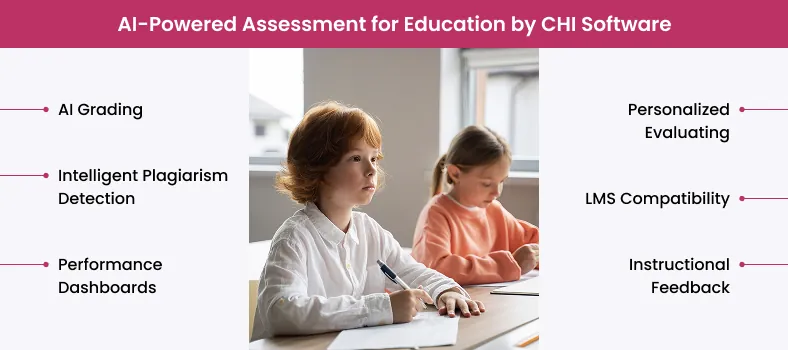
Our deep learning models now enable the platform to detect whether students cheated on written assignments or plagiarized. At the same time, AI learns typical students’ patterns with each assignment, so it’s not just there to make intelligent judgments, but also to advise teachers on how to better understand students’ issues. An automated AI grading software now benefits both parties: grading time dropped by 70% for teachers, and student engagement increased by 50% due to better assessments.
Quzlet’s Q-Chat is an example of how AI technology can bring new value to grow a user base for already well-performing features. The platform built its success on a simple foundation – flashcards. On its own, this method is fragmented, as it only promotes efficient memorization. That’s where the company implemented AI to expand the platform’s offering with contextual discussions and tutoring. Now, AI-enabled Q-Chat allows users to ask questions about their flashcards and get advice on memorizing the material.
Coursera’s Skill Graph
The corporate learning sector is always on the lookout for up-to-date upskilling platforms. The problem is apparent: an employee could invest their time in starting to learn one particular Python architecture only to realize later that the market has already moved on to a new one.
Coursera weaved AI and EdTech together to address this segment with large-scale AI to map relationships among skills, courses, and real-time market demand. With machine learning, Coursera’s Skill Graph can analyze millions of profiles and job postings at once to supply corporate learners with an up-to-date roadmap on upping their skills.
Chatbot for Educational Institutions
Teachers don’t want to be replaced by AI, they want AI to handle repetitive tasks so they can focus on actual teaching.
Oleg Baydakov
Data Engineer, AI Architect & Technical Lead
One tool we developed with one of our USA-based clients was an example of automation to cut down on time tediously wasted. In this case, we used an AI chatbot to generate varied and up-to-date assessment questions, saving teachers up to 40% of their time for personalized instruction. Overall, applying AI for EdTech purposes allowed our client to reduce teachers’ manual workload by 50%.
Microsoft Immersive Reader
When interacting with the material, students may prefer different formats (text, video, audio) or formatting (font, contrast, spacing). Some learners, such as those with dyslexia or vision impairment, may require this adaptability to be able to study at all.
That’s where Microsoft implemented AI to make studying accessible for all learners across Word, Teams, and OneNote. In particular, Microsoft’s environments use AI to convert text to speech and translate entire webpages into the user’s language — a significant accessibility and learning experience benefit for students.
Conclusion
By now, the education field is already a few years deep into AI adoption. In this span of time, the sector has learned to apply AI mainly for personalized learning, brainstorming, automating administrative tasks, and content generation. As market applications and examples show, even these seemingly simple use cases have a massive impact — from a 50% increase in student engagement to a 70% reduction in manual grading time.
All things considered, it’s important to remember that AI in education is simply a tool, like any other. But this tool does have the potential to support millions of different applications at scale, advance your business, and it is highly likely to grow in the coming years. If you’re looking to leverage that boost for your platform, contact CHI Software. We have already implemented AI for several EdTech clients and have watched as their KPIs grow. After you fill out the contact form, we will provide you with a free estimate of the AI potential for your specific case.
FAQs
How can an EdTech company start integrating AI without having to overhaul its entire platform?
More often than not, you won’t need to rebuild your platform at all; you just need to add AI functionality on top of existing layers smoothly. Here’s how:
1. Assess platform readiness. Determine if your current architecture supports AI integration, including APIs and data accessibility.
2. Audit your data. Check if your data is structured, accessible, and sufficient for AI training and analytics.
3. Start small with pilot features. Choose AI capabilities that can work as add-ons, such as recommendation engines or automated feedback.
4. Think strategically. While testing pilot features, think about where AI can naturally fit into your core offering. That’s where it would be easiest to integrate next and have the most impact on your KPIs.
What’s the difference between adding AI features and building an AI-driven product?
The difference lies in the system’s core logic:
- AI-native products rise from the ground up through machine learning. The product’s primary offering then relies on AI capabilities of reasoning, content generation, data analysis, and self-learning. For instance, Squirrel AI learning is such a product: all of the platforms’ lessons rely on some AI component.
- When AI features are instead implemented as add-ons to the leading platform’s features and workflows, the platform’s value can remain sustainable if the AI component fails. For instance, an AI chatbot that answers students’ questions in the university’s portal is an example of such an add-on.
How long does it take to implement AI features in an existing platform?
The timeline depends on your business’s technical and strategic readiness. In particular, it may depend on your data management quality, project scope, and expected deliverables.
Approximate timelines are the following:
- Simple integrations (chatbots, recommendations) can take 2–3 months.
- Moderate integrations (AI-powered analytics dashboards, personalized learning paths, adaptive quizzes) may take 4–6 months.
- Adaptive learning or predictive analytics may take 6–12 months.
Also, note that if the platform lacks clean, structured historical data, preparing datasets can add one to three months to the timeline before AI integration even begins. However, remember that most projects start with a simple proof of concept testing, which lasts one to two months.
How do you maintain data privacy and compliance in education when building AI products?
Our information security includes several measures, involving:
- Data and device encryption;
- Several firewall stages, backups, and regular system updates;
- Closed repository servers for each project.
For compliance in education, we also follow a careful checklist:
- Conducting safety checks in accordance with GDPR, FERPA, COPPA, and other relevant standards;
- Applying secure data storage, encryption, and multi-factor authentication;
Implementing role-based access control (RBAC);
- Using anonymization and data-minimization techniques so AI models learn from de-identified datasets.
What measurable ROI can AI bring to educational platforms?
Applying AI to your educational platform most often can pay off in the platform's efficiency and improved customer engagement rates. In our experience, proven ROI for our clients has included:
- 50% boosted user engagement rate;
- App load time reduced by 40%;
- 40% increase in user satisfaction rates.
Ivan keeps a close eye on all engineering projects at CHI Software, making sure everything runs smoothly. The team performs at their best and always meets their deadlines under his watchful leadership. He creates a workplace where excellence and innovation thrive.
Olha boasts a decade-long journey in NLP, currently serving as a researcher at Jena University and a Consulting ML/NLP Engineer at CHI Software. Her expertise extends to various realms of NLP, including text summarization, named entity recognition, and keyword extraction. Olha's Ph.D. thesis explored knowledge representations and information retrieval in librarian systems.
Learning management systems (LMS) and customer relationship management (CRM) systems in EdTech generate billions of data points a day, tracking user engagement, learning paths, and more. This mass of data may seem like an enigma – but it is actually your most reliable resource for business decisions. As soon as your platform grows past around 10,000 users, regular data management...
Every industry adopts new technologies at a different pace. The educational sector tends to take on new ways of operating quickly, as it often needs to keep up with the brightest minds. That’s why institutions and startups continually seek ways to optimize their processes, including through EdTech development services. But when it comes to software updates, there’s still one technology...
Generative AI is already reshaping how people learn. A recent study by Pew Research shows that about a quarter of U.S. teens turned to ChatGPT for schoolwork in 2024 – twice as many as in 2023. With numbers like that, it’s no surprise that demand for ChatGPT integration in the educational sector keeps growing. What will we see by the...
We use cookies to give you a more personalised and efficient online experience.
Read more. Cookies allow us to monitor site usage and performance, provide more relevant content, and develop new products. You can accept these cookies by clicking “Accept” or reject them by clicking “Reject”. For more information, please visit our Privacy Notice










AI doesn’t replace teachers — it gives them more opportunities to focus on creativity, communication, and personal interaction with students.