Every industry adopts new technologies at a different pace. The educational sector tends to take on new ways of operating quickly, as it often needs to keep up with the brightest minds. That’s why institutions and startups continually seek ways to optimize their processes, including through EdTech development services. But when it comes to software updates, there’s still one technology that remains at the heart of everything – and that’s cloud computing.
“If we’re talking curriculum, nearly 100% has moved to the cloud. If we’re talking business applications, probably 50%,” says Matt Penner, Director of Information and Instructional Technology at Val Verde Unified School District.
These key statistics highlight two broader truths.
First, EdTech leaders like Penner are positioning their institutions ahead of the competition with agile, cost-effective services. Secondly, cloud computing in education goes far beyond just data storage. Both formal institutions and EdTech startups gain from cloud solutions, which offer greater mobility and efficiency compared to on-premise computing systems.
In this article, we’ll take a glance from cutting-edge perspectives on applications of cloud computing in the education sector. At CHI Software, we bring years of expertise to cloud computing for EdTech — and we’re ready to share our proven use cases and best practices here.
We're helping our clients change the education at this very moment! Check out our EdTech projects.
According to the HolonIQ report, recent years have seen a dramatic 89% decline in venture capital investment in EdTech. Following a peak in 2021, investors now approach EdTech more cautiously, but still double down on the stronger players.
According to eCampus research, 63% of respondents reported ease of access to data as the primary benefit of cloud computing. Another 62% cite mobility as a key advantage.
Cloud computing in the education system needs to be able to handle log spikes during application and exam seasons. For EdTech businesses, the cloud allows for scaling in content creation and user data management. In our experience, an AI-powered chatbot reduced teachers’ workload in these key periods by up to 50%.
Benefits of Cloud Computing in Education
The benefits of cloud usually lie in cost reductions, reliable performance, and scalability. But what is cloud computing in education, and how exactly does the cloud deliver on these promised benefits?
In essence, cloud-based servers offer custom software capabilities for businesses and universities on a pay-for-use basis, and outsource development, installation, and support to external providers. The move to cloud-based infrastructure also enables custom software modernization, allowing organizations to update learning platforms, grading systems, and communication tools without rebuilding everything from scratch.
Previously, universities used to install softwaretools, including learning platforms, grading systems, and communication apps, on campus servers or individual devices.
In such a setup, an institution typically has to invest in powerful hardware, undergo rigid licensing, and handle manual maintenance. Running hardware 24/7 can be very costly – both financially and in terms of staff resources.
Luckily the cloud can replace these old-school practices. Let’s take a closer look at the benefits of cloud computing in education for EdTech businesses.
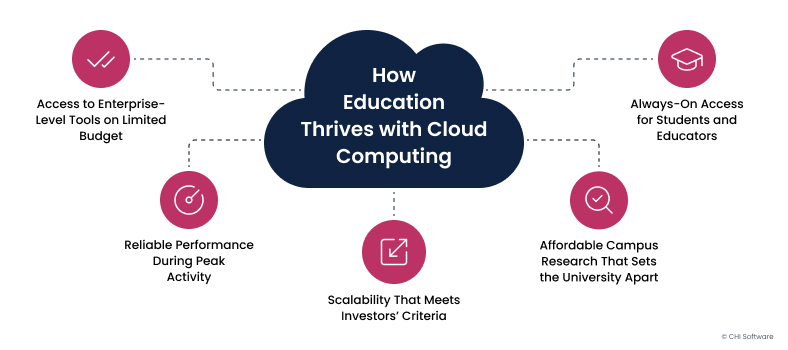
The importance of cloud computing in education lies in its ability to deliver enterprise-level tools, reliable performance, and scalability that supports both institutions and investors.
Enterprise-Level Tools on Small Institution Budget
The efficiency and smooth operations of large corporations often come from investing heavily in infrastructure first.
But for most K-12 schools or EdTech apps with up to 5,000 students, that level of up-front investment is simply unrealistic. In such cases, you need to be smart about cutting costs – for example by choosing a pay-per-use model instead of fixed server expenses.
Unlike on-premise systems, cloud computing doesn’t require hardware running 24/7. During off-peak times, such as weekends and summer breaks, institutions don’t need to pay for cloud capacity when they aren’t using it.
“Today, whenever I use a cloud environment, I pay for what I use. I literally pay for it for three months out of the year, and then usage goes way down. I don’t have to pay for servers to sit idle” shares Rob Dickson, CIO of Wichita (Kansas) Public Schools.
With cloud computing in the education sector, schools and businesses gain access to enterprise-level tools without incurring enterprise-level costs.
Reliable Performance During Peak Activity
The start of the new semester or exam weeks often overloads university servers as thousands of students are highly active all at the same time. For EdTech businesses, the same happens after a successful marketing campaign, when sudden traffic surges cause unexpected downtime.
According to IBM, even a one-second delay in an app’s operations can cut customer conversions by 7% and drop satisfaction by 16%. But is it worth maintaining powerful hardware year-round just to cover these occasional spikes? Not really – especially when distributed cloud technology can automatically handle heavy user loads.
Using cloud computing in education enables your organization to scale capacity up or down as demand changes. With this flexibility, the growth of your platform depends only on your marketing reach.
Platform’s Scalability That Meets Investors’ Criteria
Cloud computing in the education system has become a key enabler of EdTech platform modernization, helping businesses remain operationally reliable and attractive to investors.
According to the HolonIQ report, “venture capital investment in EdTech showed a dramatic 89% decline from the 2021 peak. Expect the EdTech funding to continue focusing on scalable, tech-driven solutions.”
In other words, the investors now support EdTech more cautiously, but also double down on the stronger players. In this environment, cloud computing is the tool to meet both investment criteria: scalability and tech-driven unique selling proposition (USP).
For example, with scalable platforms, businesses can deliver real-time analytics in adaptive learning, host multimedia content, or automate plagiarism detection. All of these solutions require high-volume processing capacity, unavailable or costly with on-premise hardware.
As an EdTech startup, you can kick off by buying one or a few servers and add more over time. But later on, you may end up drowning in inefficient operational processes because you’ve been doing things a certain way. Better develop good operational habits from the start.
Ivan Kuzlo
Engineering Director
Affordable Campus Research That Sets the University Apart
Running large-scale simulations or analyzing sensitive medical data for research often requires dedicated hardware and costly labs. On most campuses, only a few departments can afford and access the infrastructure.
Teams’ connectivity across faculties is another challenge. Too often, researchers share progress chaotically, through personal chats or casual conversations over coffee.
“Shifting to cloud resources enables professors to increase the volume and the impact of their research publications. It allows researchers to ask different questions,” notes Clifton Chow, senior research technology consultant at Bentley, a private business school in Waltham.
Adopting cloud computing for education can democratize research in universities. The shift creates an environment where discoveries happen faster and budgets stretch further.
Always-On Access for Students and Educators
When people are working hard at learning, they often like to pause, review, or speed up lessons as needed. They may revisit material over time and sometimes connect with teachers across different time zones.
Cloud computing in schools enables learning that fits different preferences and time zones, providing enough flexibility for businesses to meet the most innate human learning habits. According to eCampus research, the most widely reported benefit of cloud computing is ease of access (63% of respondents). Another 62% cite mobility as a key benefit.
With on-premise servers, students and teachers in different time zones may face slow connections or an inability to log in at all if network conditions aren’t ideal. Any maintenance or hardware failure causes the entire platform to shut down, instantly damaging customers’ loyalty.
If you need a small school management tool for a single campus, servers will do for a while. But any actually promising software development would require cloud services. Let’s say, collaborative tools or multimedia streaming can only be efficient on the cloud.
Sirojiddin Dushaev
Lead Data Engineer & Cloud Solutions Architect
Applications of Cloud Computing in Education
The benefits of cloud computing in education sound quite promising, right? But it’s always more exciting to see the real cases and get more clarity for your upcoming projects.
The examples of cloud computing in education vary by company size, technology stack, and budget. Let’s see a few cases where cloud computing development services have delivered a measurable impact.
AI Chatbot Relied on Cloud to Reduce Manual Teachers Work by 50%
Our client, a U.S.-based educational platform, consistently delivered high-quality content to students from kindergarten through grade 12. However, coming up with original context-relevant assessment questions consumed a ton of time for teachers.
The questions needed to cover a variety of topics, including IT and business. The desired tool also had to support different question types – essay, checklist, and more – while being customizable for different lesson types.
This project shows the role of cloud computing in education, where AWS scaling and cloud-native design enabled an AI chatbot to serve thousands of users without downtime.
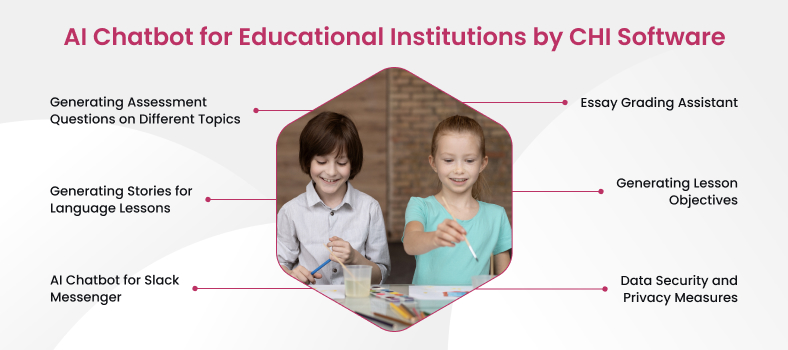
We designed an AI-powered chatbot that can generate questions in multiple formats. The chatbot had to serve large datasets to hundreds or thousands of users across the country without downtime, so we used the AWS ecosystem and cloud-native architecture to meet customer expectations. Teachers now use the chatbot to generate original questions quickly, cutting their workload by 50% compared to before.
Kahoot! Uses Cloud to Collaborate with Schools (And Earn New Users)
The platform’s live quizzes for classrooms and remote studying rely heavily on cloud infrastructure. Cloud hosting enabled Kahoot! to synchronize learners’ progress across devices, as well as store massive volumes of flashcards.
According to Google, cloud technologies helped Kahoot! to double their users from 15 to 30 million in 18 months. The results are no surprise – cloud scalability also enabled Kahoot! reach markets that are unusual for EdTech. For instance, the platform collaborates with K12 schools to organize global competitions. The effort earns a company young and loyal users globally, all by relying on cloud resources.
Digital E-learning Platform Applied Cloud to Expand to New Markets
Educational platforms for children often hit a glass ceiling when scaling to foreign markets. User expectations vary in each new country, and differences in user behaviors can significantly impact your user acquisition rates.
A similar business’s challenge led us to a new project with a learning platform for kids. The client planned to expand its market reach abroad, but realized the associated acquisition risks. The platform needed engaging and cross-device features that comply with sensitive student data regulations across multiple countries.
The project illustrates the benefits of cloud computing in education, where a scalable, multilingual e-learning platform helps children learn across nine countries.
Cloud computing enabled us to build a modular, scalable platform with multilingual support. The platform is now reliable regardless of the access region on the Web, iOS, and Android. Successfully adopting these new features helped the client to expand to nine countries.
Digital Transformation in Education: Driving the Future of Learning
Read a full guide
DreamBox Learning Personalized Lessons with Cloud-Based Analytics
The success of adaptive learning platforms often depends on understanding user needs better than competitors and delivering the features more smoothly.
But when serving thousands of users, how can a business know each student’s expectations in specific contexts, like a math-studying app? That’s where the importance of cloud computing in education steps in. Applying data science in the cloud allows organizations to understand all whys, hows, and whens about all their users — all at once.
DreamBox Learning, a US-based platform for K-8 students, was facing exactly this issue. They needed to deliver personalized math lessons to learners with diverse learning preferences, all at once. By using cloud computing, the company integrates curriculum and constant formative assessments to personalize instruction.
The appeal for customers is clear: what kid wouldn’t love math lessons explained personally, and in a way that makes sense to them?
Quizlet Built a New Value Proposition on Cloud-Hosted LLMs
As a major player in the EdTech market, Quizlet has long led the market niche in flashcard learning. However, the platform continues to adapt; most recently, with the launch of Q-Chat, an AI tutor that can review users’ progress.
Both Quizlet’s core business value and new AI-powered features rely on cloud technologies. The cloud gives Quizlet users a seamless studying experience across devices and access to a vast educational content library.
Knewton Alta Applied Cloud to Personalize Feedback on Students’ Assignments
Knewton Alta is what many startups strive to deliver: a tool that recommends different learning materials based on the student’s mistakes. It’s like a digital tutor that can suggest additional reading on the student’s weak spots.
The impact of cloud computing in education shows up here — it powers adaptive analytics that allows platforms like Knewton to process data instantly and tailor learning to each student.
According to the platform’s tutorial, when the student gets a few questions wrong, Knewton identifies specific topical content as a refresher. But how does the platform know what readings to propose? That’s cloud-based analytical tools in action, helping the platform both adapt to each student and constantly improve the courses.
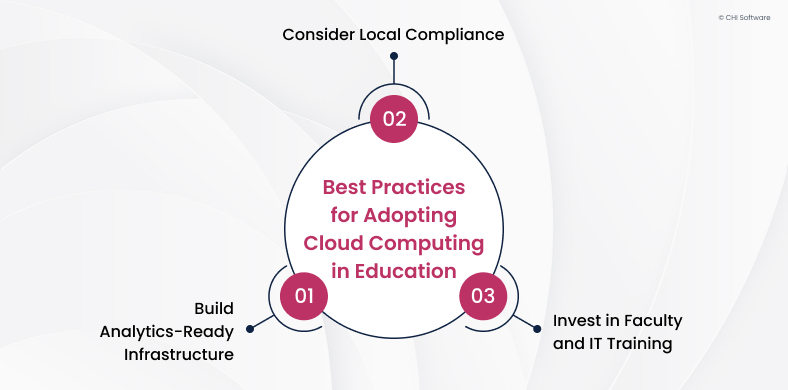
Best Practices for Adopting Cloud Computing in the Education Sector
The future of cloud computing in education will depend on how effectively educational institutions can use new technology’s full potential. But in our experience, a successful adoption often hinges on a few technical details that aren’t always obvious to businesses. Here are some insider points that worked well in our projects.
Applying the best practices for adopting cloud computing in schools helps institutions balance innovation with security and create a sustainable digital learning environment.
Build Analytics-Ready Infrastructure
We know from our conversations with clients that most teams already understand the value of collecting and analyzing data. What often goes unnoticed, though, is that storing student activity in raw forms leads to expensive and unmanageable data lakes.
Cloud computing in education enables an easy implementation of ETL (Extract, Transform, Load) pipelines. Use AWS Glue or BigQuery Dataflow services to convert raw data into structured records that can feed dashboards.
Sirojiddin Dushaev
Lead Data Engineer & Cloud Solutions Architect
Designing an analytics-ready infrastructure can make it easier to run predictive models, for instance, identifying students at risk of dropping out. Often, when clients first approach a vendor, they don’t need predictive features right away. But later, the business may want to expand their feature set. In that case, built-in cloud analytics save costs on unnecessary rounds of software development.
Data Analytics in EdTech: Find Out Your Opportunities
Read more
Account for Local Compliance
According to a 2023 Department of Education report, security concerns remain among the main disadvantages of cloud computing in education. The hidden complexity often lies in tracking where the data is being physically stored and processed.
A valuable insider tip is that cloud platforms allow you to choose storage regions, but not every business takes advantage of this flexibility.
The best practice is to adopt multi-region storage strategies. For example, sensitive student data, such as grades and IDs, should stay in-country. At the same time, you can process anonymized engagement metrics globally. Diversified approach optimizes performance and costs.
Yana Ni
Chief Engineering Officer
In addition, cloud computing providers offer automated solutions for managers concerned about compliance monitoring. AWS Config or Azure Policy can continuously verify whether resources align with standards like FERPA, CDPR, or HIPAA.
Looking for a reliable tech team to cover these practices for you? CHI Software is here to help!
Start a project with us
Invest in Faculty and IT Training
When the company doesn’t invest in staff training, features such as role-based dashboards or serverless automation remain unused. Yet the uses of cloud computing in education are the most cost-effective when all features work to their maximum potential.
For IT teams, we recommend building sandbox environments. Training paces are safe replicas of production systems that allow teams to practice upgrades. The key is to train for outcomes, not features. For example, don’t just practice how to run a query but rather how to interpret insights it delivers.
Yana Ni
Chief Engineering Officer
Without proper training, teams also lose control over versioning.
The duplicates and outdated datasets lead to additional data processing to clean the records. Although tech providers can easily handle such issues, your departments may struggle with multiple conflicting records in the meantime.
EdTech Platform Stack: Essential Technologies for Modern Learning
Read more
Conclusion
The role of cloud computing in education becomes clear when it’s put into practice: universities rely on it to manage data during peak activity, and EdTech startups use it to scale quickly and add market-relevant features.
But to truly benefit, businesses need a technology partner who meets them where they are. At CHI Software, we understand the realities of connecting cloud computing and education, including bureaucracy, funding constraints, and staff resistance that leaders face when initiating the change. That’s why we continuously evolve both our technical expertise and willingness to go alongside our clients in meeting their KPIs.
If you’re unsure whether cloud computing is the right solution for your business challenges, that’s understandable. But every solution starts with conversation. Our EdTech specialists are ready to step into your shoes and dig into what truly fits your needs. Fill out the contact form, and let’s discuss your current business needs.
FAQs
What are the signs that my EdTech platform needs cloud adoption?
Your EdTech platform needs cloud adoption if you're facing any of the following:
- Your servers constantly run into downtimes;
- Hardware costs are escalating;
- Successful marketing campaigns result in waste because of scaling restrictions;
- You plan to expand on the market;
- You want better feature updates, based on data;
- Your business research showed that customers want better user experience.
How can cloud solutions reduce IT costs for educational institutions?
Cloud solutions reduce costs thanks to three main factors:
- By replacing costly on-premise servers and around-the-clock maintenance;
- By offering a pay-as-you-go pricing model;
- By providing built-in backup and recovery features instead of third-party tools.
What challenges come with cloud adoption in education, and how do you solve them?
Some typical obstacles in cloud adoption include:
- Data compliance and privacy: We solve the issue by using automated compliance monitoring tools, such as AWS Config and Azure Policy.
- Complexities of migration to the cloud: We use phased migration plans, meaning that the transferring happens in gradual steps. This way, your platform can function while we migrate your software.
- Misconfigurations: Incorrect permissions can lead to security risks. Our prevention practices include automated configuration checks, role-based access, and ongoing audits.
How fast can an EdTech business move to the cloud?
The speed of adopting cloud computing in the education market depends on the starting point and goals. For instance, a small SaaS EdTech company can migrate core services within weeks. A large university may need several months for phased adoption.
What is the future of cloud computing in education?
Cloud is the foundation for adaptive, personalized e-learning experiences and institutional research. The next wave will likely focus on a few areas:
- Supporting AI-driven tutoring;
- Advancing real-time trend analytics;
- Developing AR/VR learning environments;
- Transitioning to fully data-centric education models;
- Expanding intelligent automation in administrative tasks;
- Creating self-optimizing learning platforms powered by AI;
- Embedding ethical AI and data governance frameworks.
Sirojiddin is a seasoned Data Engineer and Cloud Specialist who’s worked across different industries and all major cloud platforms. Always keeping up with the latest IT trends, he’s passionate about building efficient and scalable data solutions. With a solid background in pre-sales and project leadership, he knows how to make data work for business.
Yana oversees relationships between departments and defines strategies to achieve company goals. She focuses on project planning, coordinating the IT project lifecycle, and leading the development process. In their role, she ensures accurate risk assessment and management, with business analysis playing a key part in proposals and contract negotiations.
Almost everyone has had experience with online learning. It may have been a corporate training course, an attempt to learn a language using online platforms or apps, or even while getting a higher education. Sure, online learning is highly convenient: you can take your classes anywhere and any time that suits you. But you know what can take it to...
Today, educational app development has grown far beyond being simply classroom support tools – now, it is the driving force that powers entire learning ecosystems. Today’s users are used to – and have come to expect – an intuitive, personalized experience that goes well beyond simply accessing content. According to Business Research Insights, the global EdTech market was valued at...
Generative AI is already reshaping how people learn. A recent study by Pew Research shows that about a quarter of U.S. teens turned to ChatGPT for schoolwork in 2024 – twice as many as in 2023. With numbers like that, it’s no surprise that demand for ChatGPT integration in the educational sector keeps growing. What will we see by the...
We use cookies to give you a more personalised and efficient online experience.
Read more. Cookies allow us to monitor site usage and performance, provide more relevant content, and develop new products. You can accept these cookies by clicking “Accept” or reject them by clicking “Reject”. For more information, please visit our Privacy Notice












As an EdTech startup, you can kick off by buying one or a few servers and add more over time. But later on, you may end up drowning in inefficient operational processes because you’ve been doing things a certain way. Better develop good operational habits from the start.