Learning management systems (LMS) and customer relationship management (CRM) systems in EdTech generate billions of data points a day,tracking user engagement, learning paths, and more. This mass of data may seem like an enigma – but it is actually your most reliable resource for business decisions.
As soon as your platform grows past around 10,000 users, regular data management tools start to fall short, causing you to miss valuable insights. That’s when companies typically switch from basic data management to big data analytics.
As a big data development company, we apply big data analytics in education to extract business insights buried in terabytes of data that may be sitting idly by in your operations. In this article, we’ll explore real business results coming from these insights.
In 2024, educational apps ranked among the top four categories worldwide in Android app uninstall rates (44,17%). Big data analytics may help you retain users before the exodus starts impacting your finances.
About 85% of pedagogical tools in EdTech are either a poor fit or implemented incorrectly, aUNESCO study reports. Big data is a way for your business to gather insights into market demand for your product.
In our experience, implementing big data analytics and AI resulted in a 30% improvement in student engagement for the client.
Importance of Big Data in Education
At the start, education businesses and institutions track only simple metrics such as student enrollment, course uploads, and payments. But as the student base grows, your cloud storage or learning management system starts storing thousands of user interactions, course views, and feedback comments.
Before long, you will have amassed enough data to understand what your users like, purchase, and subscribe to. But how do you translate that data into actionable strategy points? For example, how can data on course views help to improve your learners’ engagement rates?
Here is where you stand to gain most from the benefits of big data in education. Big data analysis can help you to process huge, diverse, and unstructured data to support decision-making across every part of your operations. Let’s take a look at which specific business metrics that benefit most from big data analytics.
Using big data in education opens new possibilities to both learners and teachers.
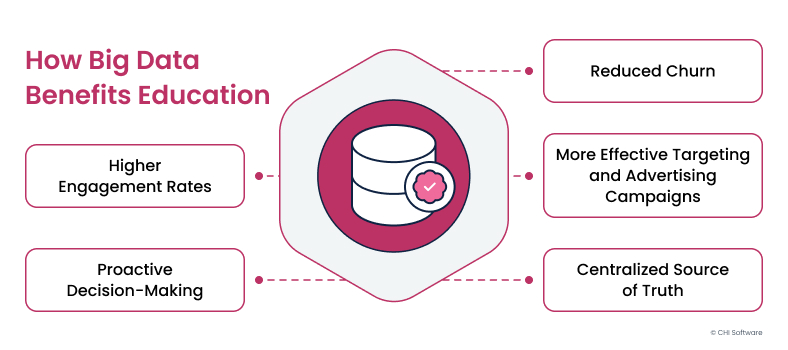
Higher Engagement Rates
According to Statista, in 2024, American children spent an average of 10 to 34 minutes per day using learning apps. But what keeps kids engaged for this half an hour – and how can you capture their attention so that they stay with your platform consistently?
To understand and improve engagement rates, you need to analyze clickstream data — that’s every interaction a user makes on a website, no matter how small: which pages they open, where they click, even how far down the page they scroll. Tracking metrics such as page views or timestamps shows you which curricula, content, and interactive features keep users on your platform longer. But things get more challenging as your student base grows.
Here’s a quick estimate: If you have five thousand regular users, and generate roughly 50–200 tracked actions per session, that means your platform experiences around 500,000 data events per day. This is where the importance of big data in education becomes clear: big data analytics can process millions of user actions to inform your next course improvements.
Reduced Churn
According to Statista, educational apps ranked among the most frequently uninstalled app categories worldwide in 2024. Does that mean that people are getting tired of learning? Of course not – it just means that the technology needs to catch up with user demands. In practice, though, you can notice the first disengagement signs long before a user decides to delete your app. The problem, however, is that most companies don’t have the analytical tools in place to react before it’s too late.
For instance, as a business owner, you may notice the first signs of churn when course completions start to lag, session times shorten, or daily active users decline. When you start to notice metrics drop, you can use big data analytics to track activity across user segments.
If your customers live in different countries, seasonal installation drops during holidays will also vary. The analytics can separate regular fluctuations from emergencies – helping you discern the difference between false alarms and urgent calls to action.
More Effective Targeting and Advertising Campaigns
The role of big data in education is clear when you take a closer look at your customer relationship management system. Whether you analyze the records or not, CRMs create hundreds of entries on your lead funnels, marketing metrics, customer support records, and user segmentation. All this information can help you develop the right product value proposition and market positioning.
When businesses ignore data insights on their marketing strategy, the final product often fails to land with your intended users. In particular, UNESCO reports that 85% of some 7,000 pedagogical tools used by the EdTech sector, which cost USD 13 billion, were “either a poor fit or implemented incorrectly” when put into practice.
Picture a crisis scenario: When your lead-to-enrollment conversion rate is down and the cost per acquisition is skyrocketing, you won’t have much time for careful planning and decision-making. That’s the consequence of not having the right analytical tools ahead of time. Instead, using big data in education helps businesses predict significant declines in metrics before they happen.
When you notice the first signs of declining click-through rates on your course pages or ads, big data analytics can provide you with the foresight to intervene at the right time. Analyzing which specific features or messages cause click-through drops can inform your A/B testing in real time — something practically unattainable using regular data analytics. The voluminous scope of big data reveals patterns that may be invisible on smaller scales.
Centralized Source of Truth
LMS and CRM systems usually include built-in analytics for a quick trend overview. But where would you look for a drop-off reason when your CRM reports varying users’ responses to pop-up nudges and LMS shows low course completion? Big data in education brings together messy streams of insights into one manageable place.
In practice, a big data analytics tool can combine timestamped interaction logs from LMS with user segmentation data from CRM to detect when and which users disengage. Applying big data processing equips businesses and universities with a single source of truth for decision-making insights across all their operations.
Big Data Applications in Education
Regardless of whether businesses and institutions use big data for competitive advantage, daily operations generate information. Let’s take a look at some examples of big data in education where teams applied that information effectively to improve business metrics.
Early Warning System for Georgia State University
Low retention rates, especially among vulnerable, low-income, and first-gen students, are a common pain point for universities. Visionary educators have worked on this problem for decades, but the most complex issues require long-term data analysis. That’s where big data for education comes in.
A case study by George State University looked at the institution’s record of registrations, course performance, and financial metrics dating all the way back to 2012. That collection presented a brilliant opportunity to put available resources to search for big-picture insights.
After analyzing the data, 10 years of recorded logs sitting around in disuse became the university’s new Graduation and Progression Success (GPS) system — an invaluable tool to support academic advisors with over 800 warning indicators of academically at-risk students. The analysis found that during the last decade, Georgia State University reported a 50% reduction in student withdrawals, a 30-point increase in retention rates, and a 30% drop in summer melt.
Large-Scale Analytics for Online Assessment Platform
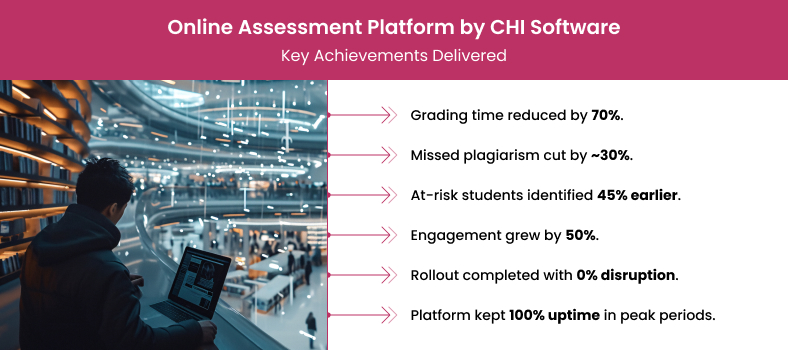
Our client, a Norwegian automated assessment provider, had already launched a grading tool that helped schools to manage exams without manual overwhelm. But as more schools began using the platform, the volume of student data also piled up.
Big data analytics in education turns exam results into insights, revealing each learner’s unique progress.
The platform collected millions of granular assessment points, such as test submissions, grading outcomes, and behavioral patterns, like skipped questions. But the schools also wanted to understand more precisely why students were performing the way they do.
CHI Softwareused big data to help the client answer the “why” from the teachers’ point of view. In our client’s case, using big data for EdTech added new business value to the product — teachers could now use the tool that both automatically grades assessments and gives insights into each student’s progress.
Big data solutions always differ. Share your context — we’ll show where progress is possible.
Get your project proposal
Fishtree’s Real Time Content Analytics
The difference that sets Fishtree apart from competitors is that their platform shows exactly how product features can deliver a personalized learning experience for users.
The idea is simple: each student selects learning objectives or competencies. The platform then asks the learners about their interests and knowledge gaps to choose content that best matches with their preferences. Then Fishtree shows student progress and adapts to every behavioral pattern with more efficient content at every step of the way.
Fishtree applies big data for the education sector to deliver the benefits of a personal human content curator, but with the accessibility of an online tool.
AI Big Data Analytics Engine for Interactive K-12 Platform
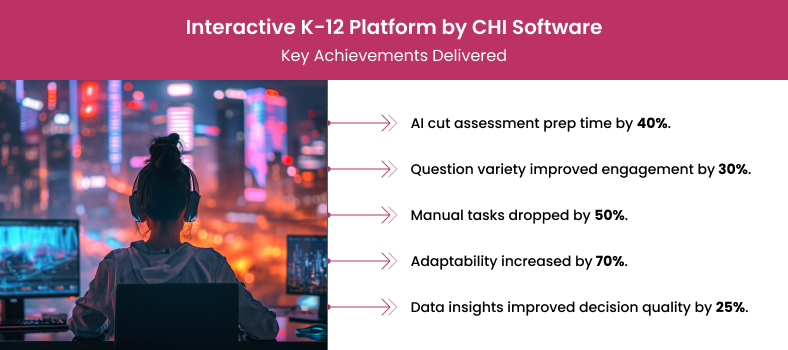
The overwhelming need for quality content creation never ends in EdTech. Schools and platforms constantly try to personalize learning for thousands of students with their own interests. In particular, teachers often need assessment questions that link curriculum material to up-to-date news to make the content relevant to students.
Big data applications in education give educators the insights they need to create content that truly resonates with students.
One of our U.S.-based clients was noticing that educators were spending a lot of time customizing relatively standard questions to add relevant context. Accordingly, the idea was to create a tool that generates context-relevant and format-adaptable questions for tests on a scale. But how do you know what interesting questions should look like for students? Big data applications in education usually answer exactly this type of “hows”.
In our case study, CHI Software combined big data and AI technologies to train a chatbot on large volumes of the platform’s existing educational and behavioral data. As a result, the client reported a 30% improvement in student engagement.
Innive’s Multi-Platform Big Data Pipelines
Big data analytics in the education sector can help teachers build coherent insight-generating systems where now they face scattered student and content materials.
Innive has built a successful business model around the need for educators to make sense of large amounts of incoming data. The platform collects student logs, assignment results, and similar data points from platforms like Zoom and Google Classroom, and aggregates them through a centralized data pipeline.
As a result, schools and teachers need not mess with messy data at all. They only interact with final analytics dashboards that directly point to the next actionable steps regarding students’ performance.
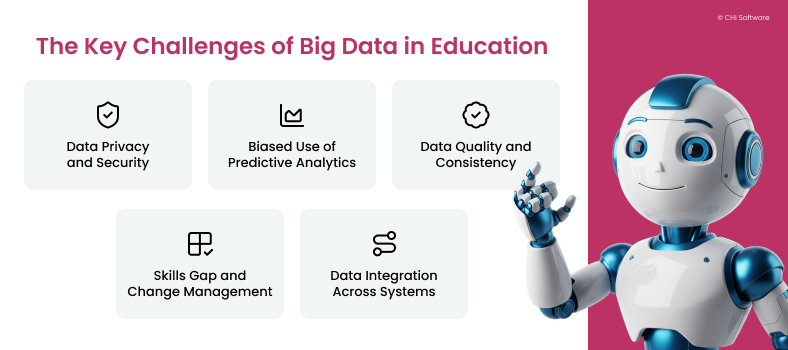
What Are the Challenges of Big Data in Education and How to Address Them?
The challenges of big data in education stem from its nature. Large volumes of information are hard to manage, clean, and secure.
But as an experienced big data development company, we’ve spent years developing proven strategies to deliver measurable results to our clients amid all kinds of challenges. Let’s take a look at some best practices we’ve developed.
Implementing big data for EdTech can be complex, but with experienced engineers, the risks stay low.
Data Privacy and Security
Big data in higher education often gathers sensitive information, such as academic records, demographics, or student identity information. The more data an institution handles, the higher the risk of breaches and misuse, especially when integrating external tools and AI models.
Data security is not an IT problem; it’s rather a governance problem. Encryption alone cannot protect sensitive information effectively. You need to build the privacy policy into data collection workflows as early as possible.
Ivan Kuzlo
Engineering Director
Biased Use of Predictive Analytics
Big data in the education industry can help identify at-risk students and help them early on. But when applied unethically, it can reinforce existing biases. For example, if a university uses data on students’ socioeconomic status to form a prejudgment of their academic performance. To prevent such instances of bias, we recommend adopting ethical data governance frameworks before beginning to work with big data.
As a university or business continues operating for a long time, cleaning its data becomes more complicated. When dealing with years of records, you will almost certainly run into incomplete fields and outdated entries.
For instance, students’ contact information may have changed, or you may have updated course codes several times. If you need to see course performance data over the years, how do you correlate course completion rates with multiple repeated course codes?
The rule of thumb is simple: if you haven’t performed a quality data audit in six months, your data warehousing is already lying to you somewhere. Big data and the education sector both need frequent updates.
Yana Ni
Chief Engineering Officer
Skills Gap and Change Management
Applying big data analytics in education requires advanced skill sets on the vendor’s side and strong cooperation from institutions. On CHI Software’s side, we are confident in our staff’s expertise — our 80+ AI and software engineers include 14 PhDs.
However – “even the most advanced tools fall flat without teacher buy-in,” says Trish Sparks, CEO of Clever.
Our job, then, as a tech partner, is to explain how big data analytics will not add more work to educators’ already busy schedules. We can propose a coherent outline for staff trainingprograms to our clients, so that data insights show where they are needed most — in the classrooms.
Data Integration Across Systems
One disadvantage of integrating student, marketing, and operational data from different sources is that data sets arrive unsorted, in various formats, and often contain duplicate or contradictory records. That’s where we at CHI Software usually start data cleaning for our clients.
To collect raw data streams from your LMS, CRM, and payment tools, we first create a data lake. At this stage, formats can vary from database tables and logs to HTML or PDF reports. Big data management tools then allow us to reorganize data into a consistent structure, with uniform formats for dates, time logs, student contact information, emails, and session logs.
Conclusions
Institutional systems can generate terabytes of information for EdTech on a daily basis. The growing volume of data is inevitable, and organizations can either use big data tools to improve their services or let the information pile up, slowing operations in the future.
The impact of big data analytics in education shows in quite big ways. In our experience, big data-informed approach helped clients to improve student engagement by 30% and create new product value.
If your business or institution already has unused data entries collected over several years, this may be your chance to use information technology and gain from an already-existing resource. Contact us to see how EdTech software developmentsolutions can make large data sets serve your business goals.
FAQs
How can educational institutions start using big data if their systems are outdated or fragmented?
You will need a few steps to make your outdated system running again:
1. Start with a lightweight data warehouse or data lake. Even fragmented logins, attendance, course progressions records collected in one place can start generating valuable insights.
2. Map out what data you already have. The data from your student information system and learning management system can be stored in silos, but unifying and cleaning it will likely provide more effectiveness than adopting a new system.
3. Define data gaps. Missing session duration logs, course abandonments, and CRM fields expand your understanding on what you don’t see yet.
What data sources are most valuable for improving educational products?
In our expert view, the most valuable data sources help answer not only “what happens” but the “why does it happen” — for instance, the most value can come from:
- Assessment data to map student competencies, skill gaps, and build adaptive learning logic;
- Content interaction metrics showing which material holds students’ attention;
- CRM and payment data that may reveal user purchase motivation and course value perception.
What are the first technical steps to make an existing EdTech product data-ready?
As we start working on the project, the first technical steps usually include:
1. Unifying identifiers. We make sure that every user, course, and interaction has a unique ID.
2. Creating data pipelines. We define how raw logs flow to storage.
3. Adopting a cloud. Store all data in a central, accessible location.
4. Setting up data taxonomy. We clearly define what each metric means so that the client’s analysis can remain consistent.
5. Starting with pilot dashboards. We try on small-scale visualizations to test the platform.
What if our organization lacks in-house data scientists or analysts?
The lack of specialized expertise on your staff doesn’t have to be a barrier. You can partner with external data engineers to build automated pipelines first, then look for a suitable person for the data analyst role.
As our practice shows, it is more important to provide effective data literacy training for your internal decision-makers first. A data analyst can keep a system running. But first, you need to coordinate all business processes with data insights.
What measurable ROI can an EdTech company or school expect from big data analytics?
Typically, organizations first see the improvements in the tracking accuracy of learning outcomes and their user engagement rates. For instance, in our experience, a client reported improving users’ overall learning experiences by 30%.
As big data analytics help educators to gain clear visibility into their resource allocation, teachers can expect to see a 10-20% improvement in efficiency. In particular, our client reported a 70% reduction in time spent grading after implementing a tool built on big data analytics.
Ivan keeps a close eye on all engineering projects at CHI Software, making sure everything runs smoothly. The team performs at their best and always meets their deadlines under his watchful leadership. He creates a workplace where excellence and innovation thrive.
Yana oversees relationships between departments and defines strategies to achieve company goals. She focuses on project planning, coordinating the IT project lifecycle, and leading the development process. In their role, she ensures accurate risk assessment and management, with business analysis playing a key part in proposals and contract negotiations.
Every industry adopts new technologies at a different pace. The educational sector tends to take on new ways of operating quickly, as it often needs to keep up with the brightest minds. That’s why institutions and startups continually seek ways to optimize their processes, including through EdTech development services. But when it comes to software updates, there’s still one technology...
Generative AI is already reshaping how people learn. A recent study by Pew Research shows that about a quarter of U.S. teens turned to ChatGPT for schoolwork in 2024 – twice as many as in 2023. With numbers like that, it’s no surprise that demand for ChatGPT integration in the educational sector keeps growing. What will we see by the...
Today, educational app development has grown far beyond being simply classroom support tools – now, it is the driving force that powers entire learning ecosystems. Today’s users are used to – and have come to expect – an intuitive, personalized experience that goes well beyond simply accessing content. According to Business Research Insights, the global EdTech market was valued at...
We use cookies to give you a more personalised and efficient online experience.
Read more. Cookies allow us to monitor site usage and performance, provide more relevant content, and develop new products. You can accept these cookies by clicking “Accept” or reject them by clicking “Reject”. For more information, please visit our Privacy Notice








Data security is not an IT problem; it’s rather a governance problem. Encryption alone cannot protect sensitive information effectively. You need to build the privacy policy into data collection workflows as early as possible.