Wealth is not in materials, but in ideas. That may sound like just an aphorism, but it’s really true – and the data back it up. According to the World Economic Forum, over 80% of the market value of S&P 500 companies is non-physical assets such as data or software. The ratio has completely flipped from the previous century, when most of a company’s value could be found in tangible assets like machinery and buildings. But today, market growth depends on technology and data – and education is no exception.
Today, data analytics in Edtech is able to guide thousands of data points across the product lifecycle to guide the business decisions that inform education for millions. But which data actually brings in new leads and returns customers?
Technologies are changing education at this very moment — check out real cases and opportunities!
See our portfolio
If you are exploring or currently building a profitable EdTech business with strong metrics, keep reading. As a big data development company, CHI Software has consistently helped our clients in online learning platforms for children to boost user engagement by 50% through data analytics upgrades. In this article, we will share the insights from our experience and show how data analytics transforms EdTech.
Article Highlights:
- E-learning data analytics can save on business costs by improving customer retention rates. Across different industries, retaining customers is more cost-effective than attaining new ones.
- The top three cases when EdTech businesses benefit most from data analytics are scaling, optimizing content, and driving upsells.
- The six main customer expectations in interacting with digital platforms are empathy, personalized learning, efficiency, certainty, safety, and needs prediction. Data analytics can supercharge the marketing advantages for businesses who are committed to delivering on their customers’ expectations.
EdTech Data Analytics Drives 6 Opportunities for Business
For e-learning businesses, thousands of user interactions can generate raw data every day, spanning course completions and support tickets to payment flows. On its own, this information can often be fragmented and unhelpful. Data analytics works to expose where high-return opportunities may be hiding in the data.
In our experience, the richest growth comes when analytics guides product improvements. Customers don’t stay with a business because of its clever marketing – but because the product is reliably meeting their actual needs. Which business investments can really help you deliver value on your offer? The answer is most likely lying in your data.
The question is: what do data analytics opportunities look like in practice? Below are six cases where EdTech analytics for personalized learning translates into tangible possibilities for business growth.

The growing use of data analytics in EdTech reshapes how platforms understand learners and improve educational outcomes.
Opportunity #1: Uncovering Retention Insights
Every student and teacher knows that there’s always more to learn, on any subject. For EdTech businesses, keeping learners continually learning is a valuable lever of growth. A long lifetime value decreases the costs you’ll ultimately spend on advertising to new ones. Implementing data analytics in your app will help to uncover which features keep learners engaged – and which ones fall flat.
Take children learning platforms as an example. Which lessons do they finish, and which ones are they more likely to quit mid-way? Are badges and avatars actually entertaining them and leading them to stay in the game? Analyzing child-friendly surveys and parental interviews helps to tell which features kids and parents love or ignore.
In our experience, one team approached us with an e-learning platform that needed more engaging features for learners aged 3 to 16. The business wanted to scale beyond the country, so the features had to be captivating enough to compete in foreign markets. With new interactive modules and gamified elements, the platform gained a customer satisfaction boost of 40%. But this achievement was only possible due to thorough data analytics.
Opportunity #2: Identifying High-Value Audience Segments
In order to keep pace with constantly shifting market demand it’s a smart idea to create products matched to personal preferences of audience segments which will lead to a high return on investment. Analytics is what helps teams to uncover those niche audience segments.
According to the KPMG 2023-24 Customer Experience Excellence report, personalization ranks among the top expectations for digital platforms. As one respondent put it, “I want the platform to anticipate my needs and proactively help.” That means that businesses need to leverage the data on students’ needs to develop unique selling propositions to target those narrow segments.

In e-learning and data analytics, tracking user segmentation metrics helps EdTech businesses refine the user’s learning journey.
For instance, if your platform offers language learning courses, analyzing student error patterns can help to identify audiences that struggle most with grammar or fluency. The insights will then feed into the strategy for targeted marketing campaigns.
Opportunity #3: Prioritizing High-ROI Product Investment
Users come to EdTech for varied reasons: it could be for their own casual personal development or for a specific and temporary strategic career growth goal. Efficiency and usability for these target audiences can also differ widely. Data analytics for EdTech business helps to find which investments will be the most effective at boosting revenue.
For instance, casual learners most often value ease of use and quick wins. EdTech applications then need to put effort into discovering what keeps these users engaged. On the contrary, learners who come for career advancement care about outcomes, educators’ credibility, and a well-structured study space.
For the e-learning platform for kids that CHI Software developed for our client, a reward system and parental monitoring was what mattered most. The common misconception in similar platforms is that companies need to invest in complex animations or follow trends in AI integration to see results – but the proof is in the data. Analytics will help save on development costs associated with irrelevant add-ons and help you figure out what features will have a high return on investment.
Opportunity #4: Expanding Business Offerings for the Market
The role of data analytics in Edtech can be subtle, and the areas where it makes the biggest difference can often be the most hard to identify. However, when done right, data analytics can pinpoint the frustrations customers are experiencing and help you turn those pain points into new products and features.
For instance, take an example where your learning platform only tracks lesson completion, rewarding users for finished units. Users usually want to reflect and correct mistakes as they go, and may be expecting your platform to help them – but how would you know that? Your data analytics team can review engagement patterns and built-in feature feedback loops to reveal these insights. Based on data, you can develop a progress dashboard that rewards users for correcting their own mistakes.
To summarize from our experience: small, market-aligned features make leads choose one platform over countless competitors.
Opportunity #5: Optimizing Operational ROI
We’ve gone over exactly how EdTech data analytics delivers insights on why users stick with a platform. From the business perspective, these insights are among the most valuable for optimizing costs — specifically, when you want to understand the true expense of acquiring and retaining customers.
Retaining existing customers is far more cost-effective than acquiring new ones. According to FirstPageSage:
- The average Customer Acquisition Cost in the B2C Education sector is USD 134 for organic and USD 177 for paid CAC.
- The average Customer Acquisition Cost in the B2B Education sector is USD 862 for organic and USD 1,985 for paid CAC.
As a logical consequence, higher retention rates lower churn and acquisition costs. Well-engaged users are more likely to upgrade to paid subscriptions, generate referrals, and even buy upsells when they are offered to.
Opportunity #6: Reducing Compliance Risks
Reassuring learners that their information is safe is a technically challenging task. Businesses can analyze patterns in access logs to identify suspicious activity. Consistent analytics of your safety data helps you to stay in compliance with GDPR and FERPA guidelines. For some user categories, like parents or corporate learners, safety with their sensitive information adds to brand loyalty.
We’ve seen this approach applied in practice while working on a K-12 digital learning platform, where data analytics supported continuous monitoring of access behavior and helped reduce compliance risks as the platform scaled. For certain user groups — such as parents or corporate learners — confidence in how sensitive information is handled directly contributes to long-term trust and brand loyalty.
When EdTech Business Actually Needs Data Analytics
But is data analytics for EdTech business a must-have at every stage of an EdTech product lifecycle? Not necessarily.
Operational and product information only adds value when it can be tied to clear strategic goals. Let’s look at the situations where investing in analytics makes sense, and when it may not.

As platforms grow, data analytics in EdTech becomes key to strategy, product focus, and personalization.
Scaling User Acquisition and Retention
Smaller platforms with few users or minimal paid offerings may not need advanced data experts and analytics just yet. As long as Google Ads, Excel, and basic Canvas reports can cover a few key data streams, these tools often work well for teams of 5–10 people with up to 2,000–5,000 active platform users. Such cases are similar to how big data in logistics becomes essential only when companies move beyond spreadsheets and need optimization.
However, once the goal shifts to boosting trial-to-paid or free-to-paid conversions, more targeted analytics starts to become an absolute must-have. The business may need to analyze customer acquisition cost (CAC) and early churn predictions to attract new paying users.
Optimizing Content and Platform Offering
In our experience, businesses start to see real value in data analytics when they need to improve a product’s performance for users.
For example, one of our clients was noticing signs that their young was receptive to more entertaining features and gamified elements. In situations like this, data-driven metrics such as feature popularity actually matter to improving customer satisfaction.
Data analytics may not be so helpful for highly niche or boutique courses, though. These platforms usually face low competition, enjoy stable subscription bases, and experience minimal churn.
Maximizing Upsells
Data analytics for EdTech platforms is particularly beneficial for businesses promoting premium plans, as well as driving cross-sells and upsells. Key metrics to consider for sales upgrade are:
- Average revenue per user (ARPU),
- Customer lifetime value (CLV),
- Expansion revenue.
Analyzing these metrics enables your business to understand the value of its current user base and set realistic growth benchmarks.
For platforms offering only a single product or minimal upsell options, analytics may not be necessary.
Is data analytics really what you need at the moment? Our technical consultation will cover all your questions.
Schedule your call
3 Steps Before Implementing Data Analysis
Although EdTech services may appear to share some common objectives, that’s not always the case under the hood — mobile apps, SaaS, and AI-driven products will all have different business models and goals. That’s why applying data analytics for education technology requires a clear project scope and milestones tailored specifically for your project.
From our experience, certain steps in the implementation process always result in the best deliverables and satisfied customers. Here are the tips that have earned us the most valuable feedback.

Preparing for EdTech data analytics begins long before vendor selection: with clear objectives, data readiness, and internal alignment.
1. Gather an All-Team Meet-Up First
Before planning analytics, you need to have clarity on your objectives. Identify specific business goals you want to achieve, like increasing retention by 20% in one month, or understanding a new market’s preferences through free-to-paid conversions.
The clearer and more measurable your goals are, the better your technology partner can advise on the right tools to hit your targets.
2. Define Your Internal Stakeholders
Analytics in EdTech involves more than just IT teams. Insights from data analytics engineering services also benefit academic leaders, administrators, and even a few teachers or tutors working in your teams. That’s why it’s important to involve those who will shape and use new tools internally.
Before reaching out to vendors, define who will track the project’s development internally. It may not necessarily be a technical expert, but a person (or a small group) responsible for aligning analytics with educational and business goals.
3. Choose the Right Tech Partner
A trusted partner can guide your team through hidden obstacles, such as choosing the right tech stack for your specific monetization format. How can you choose wisely? We recommend carefully reviewing vendors’ EdTech data analytics use cases.
This check list will help you to compare the vendor’s offers against your situation:
- Tech stack compatibility. Will vendor’s available services integrate with your existing LMS and CRM platforms?
- Scalability. Which vendors can set up a smooth scaling process that will grow alongside your user and content bases?
- Customization. Can the vendor tailor analytics to your niche audiences, product, language, and content types?
When we apply data engineering services at CHI Software, we guide our customers through tricky issues. We’ve partnered with leading platforms like Imagine Learning, Albert, and Inspera. In all cases, delivering measurable results, like up to 85% feature adoption, resulted from expertise in managing project milestones.
3 Cases When Data Analytics Actually Drew EdTech Growth
E-learning and data analytics are closely connected: only with data can you see and understand students sitting on the other side of the screen. In our experience, analyzing raw data helped most with market expansion and user retention. Below are the insights on how data analytics helped to reach real business goals.
Data Analytics Helped Platform Expand to Foreign Markets
A newly founded startup came to us with a digital learning platform to improve education for children. The team wanted to grow to a multi-country presence, offering a safe and engaging studying space –but expanding to new markets required a strong user engagement strategy. And when your users are children, gathering reliable behavior data is a challenge. By analyzing data leaks in platform operations, CHI Software came up with a cross-platform e-learning solution that involves parents directly in the loop.
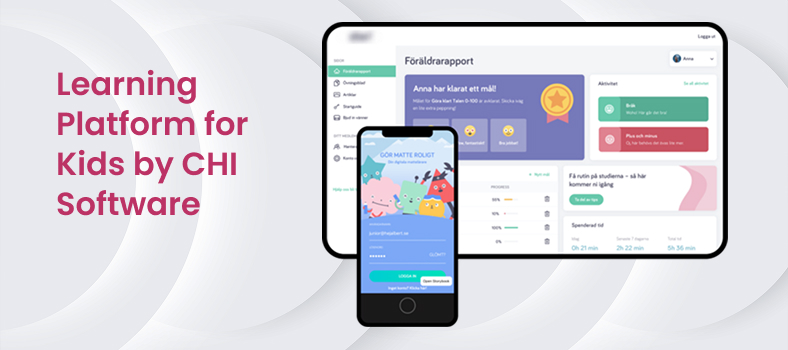
A cross-platform e-learning solution by CHI Software that applies data analytics in EdTech to track learning progress and deliver real-time insights for teachers and parents.
The final software deliverables covered all engagement analytics the team will need for the foreseeable future:
- MongoDB was utilized to store learning records and behaviour logs;
- AWS provided secure storage and processing;
- WebSocket provided updates on kids’ progress for parents and teachers in dashboards.
The client now has a helicopter view of what’s driving the engagement and growth for their platform. They have since scaled up their product to nine new countries, and reported a 50% boost in overall user engagement.
Each business is unique. Let's discuss what KPIs you aim to achieve with data analytics.
Get project estimation
EdTech Data Analytics Solution Supported Teaching Efficiency
For our U.S. EdTech market client, efficient content creation was one of the key revenue-driving features. However, teachers spent the vast majority of their time developing customized and relevant questions for students. This manual task constantly drained the company’s budget and staff capacity.
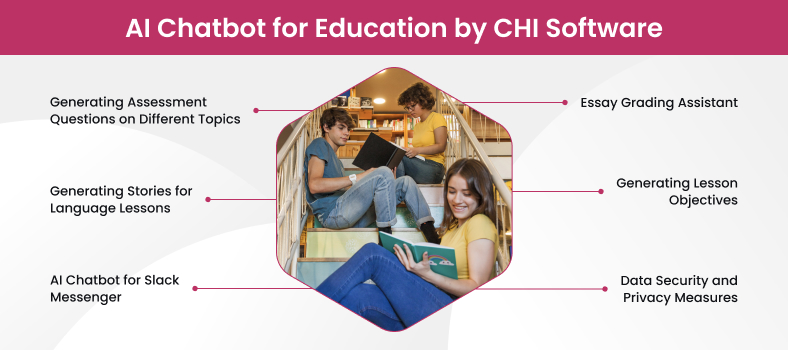
An AI chatbot for educational institutions by CHI Software helps teachers create diverse questions faster, while built-in EdTech data analytics tracks results and improves teaching efficiency.
A custom AI chatbot resolved the client’s problem, allowing teachers to generate various types of questions for diverse topics. We integrated chatbot data analytics straight to the platform to collect information about survey results.
With analytical features, the client can now custom-develop topic-specific open answer tasks, surveys, or checklist questions. As a result, the client has already reported a 40% increase in teachers’ time management.
Data Analytics Powers Smarter Assessment
For one project, an intelligent assessment platform, the client had already launched it on the market. The business was constantly missing valuable information because the team could not process unsorted raw data without using additional software.
Past assessment results, mistakes, and student hesitations could inform the platform’s value development. But with all of it sitting idle and underutilized, opportunities were passing the company by.

CHI Software enhanced an assessment platform with data analytics for education technology, integrating data from multiple sources into real-time progress dashboards.
CHI Software experts used data integration from multiple sources to build a centralized data warehouse for the client. Now, the platform is able to offer personalized student evaluation features and progress dashboards backed up with real-time analytics. The toolset detects signs of student studying issues 45% sooner than before, hitting business goals for user engagement.
Conclusion
Data analytics in the EdTech industry is the number one way to get a comprehensive understanding of how students interact with platforms and what they value. Applied strategically, analytics prevents wasted resources on irrelevant features. It is a crucial investment for any business that is ready to scale.
EdTech data analytics solutions uncover a few strategic opportunities for business. Insights into your business operations can help to improve retention, grow your audience reach, and polish product features.
If you’re unsure whether data analytics can solve the problem that’s been eating at you lately, we understand. Choosing the right investment is complicated, and we at CHI Software are here to support you in making an informed decision.
Contact us today, and we will be glad to answer any questions about data analytics and EdTech development services and brainstorm together on the best solutions for your case!
FAQs
-
Why choose CHI Software for data analytics in EdTech?

At CHI Software, we bring nearly two decades of expertise in software engineering and apply it with a focus on direct impact on your goals. We know exactly how student engagement and adaptive assessment tools can shape business performance, because our clients report tool adoption rates of 50–85% and up to 40% reduction in teacher workload.
CHI Software focuses on impact. We go beyond session duration or clicks. Our analytics frameworks measure learning outcomes, adoption rates, and user satisfaction.
-
Can data analytics scale as my EdTech platform grows?
Absolutely. Each case is unique, and you can always specify scalability volumes within a contract. Most modern analytics solutions are built to grow alongside your user base and feature set. In our practice, scaling often involves adding more learners, teachers, and content formats. The system can usually integrate new data sources and handle higher volumes with stable performance.
-
What security measures do you provide to protect student and teacher data?
We follow strict industry standards for data privacy, including:
- Compliance with GDPR and COPPA;
- Role-based access control for sensitive information;
- Security audits and vulnerability testing;
- Secure cloud infrastructure with backup and recovery options, on demand.
-
What are the most common challenges in using data analytics in EdTech, and how do you solve them?
Some frequent struggles we face in our projects are:
- Fragmented data sources, which can be solved by integrating LMS and CRM into a single data ecosystem.
- Low data quality or gaps. We address this problem by cleaning, enrichment, and feedback loops integrated into a system.
- Challenges in interpreting insight. We build intuitive dashboards, considering specific final user needs.
-
How soon can we expect results after implementing data analytics?
The first results, like an improved visibility into learner engagement, benefit the business from the first weeks of use. More strategic outcomes, such as increased retention or improved course performance typically emerge within 2–3 months of consistent use.
About the author
Sirojiddin is a seasoned Data Engineer and Cloud Specialist who’s worked across different industries and all major cloud platforms. Always keeping up with the latest IT trends, he’s passionate about building efficient and scalable data solutions. With a solid background in pre-sales and project leadership, he knows how to make data work for business.
Ivan keeps a close eye on all engineering projects at CHI Software, making sure everything runs smoothly. The team performs at their best and always meets their deadlines under his watchful leadership. He creates a workplace where excellence and innovation thrive.
Rate this article
60 ratings, average: 4.87 out of 5









I agree with Harvard Business School that two-thirds of startups fail either due to the founding team or the business idea. Developing actual quality EdTech software requires understanding what your segment expects and why current offerings aren’t delivering.