In today’s healthcare landscape, data is generated at an unprecedented scale. From patient records to real-time sensor data, the sheer volume of information now available is reshaping how care is delivered, managed, and improved. At the heart of this shift are powerful tools like big data and AI, which enable healthcare providers to make faster, smarter, and more personalized decisions. But how exactly does it all work – and where is it all headed?
Big data and healthcare are revolutionizing patient care and business operations by enabling new possibilities that range from predicting outbreaks of diseases to personalizing patient treatment plans. With the help of data engineering services, healthcare providers can build reliable infrastructures to process and analyze vast volumes of medical data. This article will share some of CHI Software’s experience and insights.
In this article, you’ll learn about how putting data into action can impact everything from clinical trials to hospital workflows. We’ll also discuss the challenges healthcare faces when implementing analytics. Let’s get right to it!
Do you need professional consultancy on big data analytics in healthcare? Prepare your questions – we're here to provide the answers.
Fill in this contact form
Article Highlights:
- The global market for big data in healthcare is projected to grow by 19.21% year by year from 2025 to 2034, driven by advances in AI, personalized medicine, and the expanding telehealth sector;
- Big data analytics improves both hospital operations and patient outcomes, making it a key force behind the industry’s transformation;
- There are seven core big data solutions set to accelerate innovation across the healthcare ecosystem, including AI and machine learning (ML), Internet of Medical Things (IoMT), cloud warehouses, etc.
The Growing Role of Big Data in Healthcare
Big data processing is transforming the healthcare industry in major ways. Hospitals, doctors, and insurance companies now use advanced analytics from huge amounts of data for different purposes. But to get a better overview, let’s start from the beginning – what is big data analytics in the healthcare industry?
mHealth App Development: The Complete Guide
Read more
Big data in healthcare refers to collecting and analyzing all sorts of information stored in clinics and hospitals that are too complex to grasp and understand using solely manual tools. Such data includes patient images, nursing notes, medical equipment reports, social media, etc. Handling this diverse information requires data pipeline development, which enables healthcare organizations to collect, move, and prepare data from multiple sources for advanced analytics.
According to Precedence, big data in the healthcare market was valued at USD 56.47 billion in 2024 and is projected to reach USD 67.32 billion in 2025. Moreover, healthcare providers are expected to spend more on big data than any other group during the next 10 years. And the result? By 2034, the value of healthcare big data analytics is forecasted to reach USD 327.57 billion.
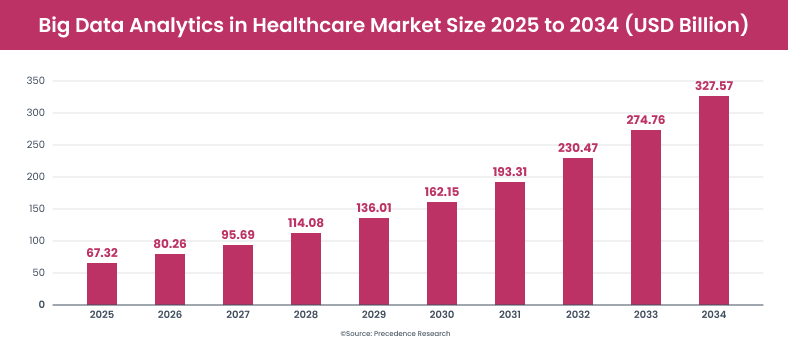
According to Precedence Research, the market of healthcare big data analytics is projected to grow five times between 2025 and 2034.
Benefits of Big Data in Healthcare: The Revolution Is Happening
We’ll divide up the business advantages provided by big data in healthcare into two categories: operational, which help improve hospital workflows and patient experience, and strictly medical, which help doctors in making decisions.
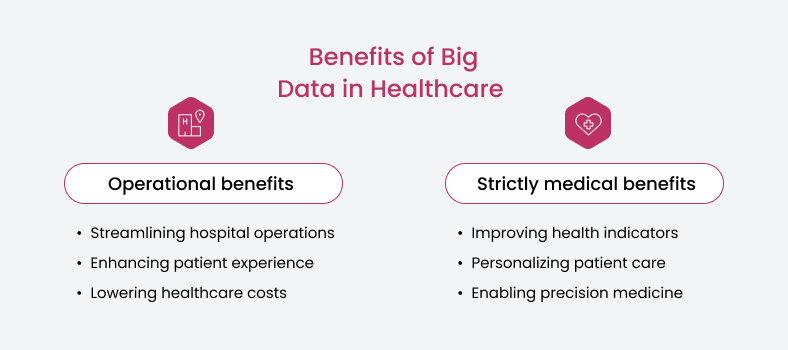
The advantages of big data in healthcare can be devided into two key groups.
Streamlining Hospital Operations
Every second, hospitals generate vast amounts of clinical data from patient records, prescriptions, and medical devices. Only the application of big data in healthcare can ensure quick and precise information analytics, identify inefficiencies, and optimize hospital operations.
For example, healthcare systems for data analysis can predict patient volume and enable better resource allocation. They can also minimize wait times by forecasting which departments will be the busiest. Morevover, hospitals increasingly adopt DataOps services to automate pipelines, reduce operational bottlenecks, and deliver reliable real-time insights across departments.
Predictive Analytics in Healthcare: Improving the Future with AI
Read more
Enhancing Patient Experience
With the power of big data analytics, healthcare providers can elevate the overall patient experience. Big data is one of the components which leads to improved outcomes and greater satisfaction in interactions with medical professionals. Regular checkups and doctor appointments can become a pleasant routine, rather than a headache.
What happened after the adoption of digital triage systems in England is that patients were more easily able to contact general practitioners, as the system streamlined the appointment process.
Lowering Healthcare Costs
Data mining can detect patterns in patient data to reduce unnecessary tests and procedures. For example, analytics might show that certain blood tests or scans rarely change the course of treatment for a specific condition. Insights like these show how big data analytics can reduce healthcare costs by avoiding unnecessary treatments.
Big data can also help after a patient leaves the hospital. By analyzing medical history and recovery data, hospitals can spot which patients are at higher risk of complications or readmission. This way, patients can receive early follow-up with support, and hospitals save their money.
Improving Health Indicators
Discovering the potential of big data analytics has been a game-changer for public health outcomes, from tackling diabetes and mental health challenges to lowering suicide rates. A recent study in the Journal of Medical Internet Research highlighted the role of big data analytics in diagnosing illnesses and managing chronic conditions.
Personalizing Patient Care
Advanced data analytics in healthcare services transform raw data sets into insights that help doctors make better treatment decisions. Algorithms can detect patterns linking symptoms, conditions, medications, and patient outcomes. Doctors can use these patterns to select the most effective treatment plan for a patient’s individual circumstances.
One powerful example is precision medicine, which uses a person’s genes, lifestyle, and environment to create personalized treatments. Thanks to new technologies in data science, it’s now possible to reduce the time needed to identify and diagnose illnesses, minimize the trial-and-error process of finding the right treatment, lowering healthcare costs and shifting the focus from reactive care to prevention.
Such personalization relies on data modeling services – they structure clinical and patient data into clear frameworks for accurate analysis and decision-making.
How to Create a Health Insurance Mobile Application
Read more
Enabling Precision Medicine
Precision medicine uses data analytics in healthcare to understand how a person’s genes, environment, and lifestyle influence their health. Analytics help identify subgroups of patients who share biological or environmental characteristics that affect how they respond to certain treatments. Doctors can then tailor treatments based on a patient’s genetic profile and health data.
In oncology, it’s estimated that cancer drugs are ineffective for as many as 75% of patients, showing a clear need for more personalized treatment. Big data makes this possible through precision medicine, which tailors treatment to a patient’s genetic profile. For example, cancer patients who received personalized therapies lived about 6.4 months longer without their disease progressing.
Top Healthcare Data Analytics Technologies and Their Use Cases

Big data analytics in the healthcare industry can be both a lifesaving innovation for patients and an indispensable asset for hospital operations.
Healthcare can improve the way people live, and in turn, people can improve how healthcare works. It’s a fair bargain, isn’t it? Let’s see how innovations impact our well-being.
1. Electronic Health Records (EHR) with Analytics Engine
EHRs are digital versions of paper patient charts, providing easy and quick access to everything from complete medical histories to the latest lab results and medications.
How it works:
EHRs integrate data from various sources: hospital databases, laboratories, pharmacies, and even data provided by patients themselves. All this information can further be updated in real time, with authorized personnel having access to it.
How it helps:
- Reduces medical errors by enabling smooth interaction between different systems;
- Serves as fully automated information bases that independently monitor reporting and monitor reporting and regulatory compliance;
- Simplifies the coordination of patient care between different healthcare providers without compromising the quality of care.
Analytics tools working with EHRs can do even more:
- Spot trends (groups of patients more likely to develop chronic conditions) so healthcare teams can react early.
- Send alerts if a patient is missing a key lab test or has an allergy to a prescribed drug.
Logistics and Big Data: Use Cases & Proven Practices
Read more
2. Artificial Intelligence and Machine Learning
We know how big data and AI work together, and machine learning is the key to making these tools even smarter. ML allows AI to learn from medical data, spot patterns, make predictions, and support doctors with better decisions.
How it works:
AI and big data in healthcare use large amounts of medical data to learn how to recognize patterns. For example, by analyzing thousands of X-rays, an AI system can learn to spot signs of pneumonia or cancer. Over time, the more data it processes, the better results it can yield.
How it helps:
- Improves diagnostic accuracy, sometimes even surpassing human performance;
- Assists doctors in choosing the best treatment by quickly analyzing all available patient data.
Machine Learning in Healthcare: 15 Use Cases
Read more
3. Big Data Platforms and Cloud Warehouses
Finding a place to store and process medical data is one of the challenges of data analytics in healthcare. Let’s find out how big data platforms and cloud warehouses can help you with that.
How it works:
Cloud warehouses store data from various sources (EHRs, lab systems, wearables, and more) in one place. Big data platforms then organize and process this information, making it accessible for analysis. Because it’s all in the cloud, authorized users can access the data from anywhere in real time.
How it helps:
- Minimizes the cost of data silos, one of the most costly challenges of big data;
- Facilitates running advanced analytics and sharing insights across departments, with everything stored and connected in cloud;
- Simplifies scaling and integrating new data sources as needed.
Healthcare organizations often rely on data migration consulting to transfer critical information from legacy systems into modern cloud warehouses without disrupting operations.
4. Internet of Medical Things (IoMT)
IoMT refers to a network of connected medical devices and software applications communicating via the Internet to collect, transmit, and analyze health data in real time.
IoT Healthcare Solutions: Innovating Care Delivery With Connected Devices and Data Analytics
Read more
How it works:
IoMT devices collect physiological data from devices such as wearable monitors, insulin pumps, and ECG patches and transmit it to cloud platforms, where analytics engines process and display the data on dashboards for doctors or patients.
How it helps:
- Provides seamless remote patient monitoring after discharge;
- Alerts doctors to any deviations from normal in real time;
- Improves patient engagement by giving individuals access to their own health data;
- Enhances the accuracy of diagnoses by providing a steady flow of real-time health data rather than relying on occasional check-ups.
5. Natural Language Processing (NLP)
NLP, a field of artificial intelligence that enables computers to understand human language, is among other use cases for big data in healthcare.
How it works:
NLP algorithms extract insights from any unstructured text (doctor’s notes or patient feedback) by identifying relevant medical terms, symptoms, drug names, and even sentiment or intent within the text. Then AI extracts insights, structures, and integrates them into healthcare systems, making the data easier to search and utilize.
How it helps:
- Spots signs of depression or adverse reactions to medications in clinical notes;
- Saves doctors time by automatically generating summaries or discharge reports;
- Detects adverse drug reactions and unusual symptom patterns mentioned in unstructured reports;
- Makes healthcare data more accessible for both doctors and AI systems by turning messy text into structured information.
6. Genomics and Bioinformatics Platforms
These platforms analyze DNA, RNA, and protein sequences to identify genetic markers, mutations, and variations that may be useful for diagnosis and research.
How it works:
Genomics and bioinformatics platforms process biological data such as DNA, RNA, and protein sequences by converting a patient’s genetic material into digital form. Once digitized, the data can be analyzed by AI using specialized bioinformatics tools.
How it helps:
- Enables the development of targeted therapies by analyzing tumor mutations and genetic markers;
- Supports early diagnosis of rare diseases through whole exome or genome sequencing;
- Applies big data processing techniques to predict a patient’s risk for inherited conditions, enabling more preventive care options.
7. Data Visualization and BI Tools
These instruments turn complex healthcare data into easy-to-understand charts, dashboards, and reports to help hospital staff make faster and better decisions.
How it works:
Data visualization and BI tools pull information from multiple sources (EHRs, lab systems, IoMT devices, and administrative platforms), then organize, clean, and combine it before presenting the results through charts, dashboards, and reports.
How it helps:
- Makes complex medical data easy to understand through clear charts and dashboards;
- Supports faster decision-making by providing real-time insights at a glance;
- Improves hospital operations by identifying inefficiencies and tracking performance metrics.
Behind the scenes, ETL migration services standardize and clean data from multiple sources, ensuring that visualization tools deliver accurate and reliable insights.
If you’re unsure how to build or use mentioned tools effectively, an healthcare AI consulting team can guide you through the process, offer best practices, and help you avoid common pitfalls.
Healthcare Big Data Challenges: What Are They, and How to Eliminate Them?
Although big data analytics holds great promise for enhancing healthcare, it also comes with obstacles that must be addressed. We’ll cover them now, one by one.

Keep in mind these challenges of data analytics in healthcare.
Data Silos
Healthcare facilities often have data spread across many disconnected health systems that don’t communicate with each other. Such systems include separate electronic health records, billing, and insurance systems.
What to do?
To gain a full view of patient information, you’ll need to break down these data silos through system integration and interoperability. Advanced platforms can help collect and organize data from multiple sources for holistic analysis.
Privacy and Security
Data security is non-negotiable when processing medical information. Strict laws like HIPAA regulate how healthcare information can be used and disclosed. Any big data health system must fully comply with these laws and have robust security measures in place to protect sensitive data.
What to do?
- De-identification techniques like masking or tokenization can help the required information to be used for analytics while preserving privacy.
- You’ll also need tight control over who can access data through identity management and access control policies.
Developing Wellness Apps for Seniors: Accessibility and Usability Considerations
Read more
Data Quality
Poor data quality is one of the biggest obstacles to gaining meaningful insights from big data. Inaccurate, incomplete, and inconsistent data will lead to unreliable conclusions.
What to do?
- Healthcare organizations need to invest in data governance consulting and data management services to ensure high-quality information. This includes processes for data standardization, validation, and cleaning.
- Master data management can also help link related information and resolve inconsistencies.
From Data Centers to Patient Care: The Cloud’s Impact on Healthcare Efficiency
Read more
Skills Gap
Working with a healthcare system based on big data requires specialized skills that many healthcare organizations lack. You’ll need people with expertise in data science, analytics, data engineering, and data visualization. This demand for big data talent currently outweighs the supply, making it difficult for some organizations to fill these roles.
What to do?
Companies looking to overcome the skills gap partner with CHI Software to train existing staff, hire new talent, and cope with their data challenges. We provide big data software development, from consulting to integration. If you need help figuring out where to start, we’ve got you covered.
Conclusion
Now you know that big data and artificial intelligence in healthcare bring a lot of engagement to the industry. From improving patient outcomes to reducing costs and streamlining operations, the examples we’ve covered show the tremendous potential of analytics in this field.
Healthcare providers of all sizes stand to benefit immensely, so consider jumping on board right away! Start small if needed, but be bold and think big. With the right data strategy and solutions, you, too, can leverage big data to make a real difference in people’s lives.
The future looks bright, but you’ve got to be proactive and get the ball rolling. It’s time to get excited about the impacts you can make. It’s time to message CHI engineers and get the innovations going!
FAQs
-
How do organizations set up data collection in healthcare?

There are several sources providing big data for health care facilities. They include electronic health records (EHRs), medical imaging, genetic data, and wearable technology. But that’s not all. Any source of information can be a valuable tool if you know how to process every data set. Other sources are patient surveys, clinical trials, monitoring devices, etc.
-
How do I know if my healthcare organization is ready for big data initiatives?
You're ready to start using big data if:
- You already collect patient data (from EHRs, devices, tests, etc.);
- Your systems are interoperable and can communicate with each other, or you can upgrade them to do so;
- You have secure, scalable infrastructure (on-premise or cloud-based), or you have the resources to build one;
- You have clear objectives (improving patient outcomes or reducing operational costs).
-
What kind of ROI can I expect from investing in big data for healthcare?
Investing in big data in healthcare usually brings strong returns. The exact numbers will depend on your goals, but here’s what you can expect:
- Cost savings: Big data helps reduce unnecessary tests, hospital readmissions, and medical errors;
- Improved efficiency: Analytics automates routine tasks and improves operational efficiency by 15–20%;
- Better patient outcomes: More personalized and accurate care with big data can lead to 30% improvement in treatment accuracy;
- Automated regulatory compliance: Big data tools can make it easier to meet regulatory requirements (HIPAA).
-
How long does it take to implement a big data solution in a healthcare environment?
The timeline of big data for healthcare depends on the complexity of the project and your current IT environment. Here’s a general breakdown:
- Pilot projects (e.g., predictive analytics for one department) take two to three months;
- Mid-size solutions (e.g., integrating EHRs with analytics dashboards) take four to six months;
- Enterprise initiatives (e.g., a full data warehouse with AI tools) take six to 12 months.
- If you want to define the timeline for your particular project of big data in the healthcare industry, contact our consulting team! We'll help you assess your starting point and build a realistic implementation plan.
-
How can healthcare professionals prepare for the impact of big data?
Healthcare professionals can keep up with the times by pursuing education and training in data analytics and health informatics. Participating in workshops, online courses, and certification programs can provide new knowledge and advantages. Last but not least, collaborating with data scientists and IT professionals can help healthcare workers integrate data-driven insights into their clinical practices.
About the author
Sirojiddin is a seasoned Data Engineer and Cloud Specialist who’s worked across different industries and all major cloud platforms. Always keeping up with the latest IT trends, he’s passionate about building efficient and scalable data solutions. With a solid background in pre-sales and project leadership, he knows how to make data work for business.
Ivan keeps a close eye on all engineering projects at CHI Software, making sure everything runs smoothly. The team performs at their best and always meets their deadlines under his watchful leadership. He creates a workplace where excellence and innovation thrive.
Rate this article
125 ratings, average: 4.93 out of 5