Nearly 1 in 3 students loses focus within the first 15 minutes of a lecture. Attention doesn’t disappear because students are lazy, but because learning environments were never designed to hold student engagement.
Gamification in education transforms that design, taking the same game mechanics behind the video games people play for hours and building them directly into the educational experience. As a result, gamified learning produces a 36% higher knowledge retention rate than traditional learning environments.
In this guide, we will break down how gamified learning works, what game elements drive results across different learning styles, and how to implement step by step, from single learning activities to learning platforms.
What Is Gamification in Education?
Gamification introduces structured game elements in existing learning activities to encourage students’ critical thinking during the learning process.
Within the learning activities themselves, gamification can take many forms. For example, in an Economics course, students might compete in a virtual stock-trading competition; in a Political Science course, students might role-play as diplomats or policymakers in mock negotiations involving a labour dispute.
Gamification vs. Game-Based Learning
These two terms are often confused, but they describe different gamification strategies:
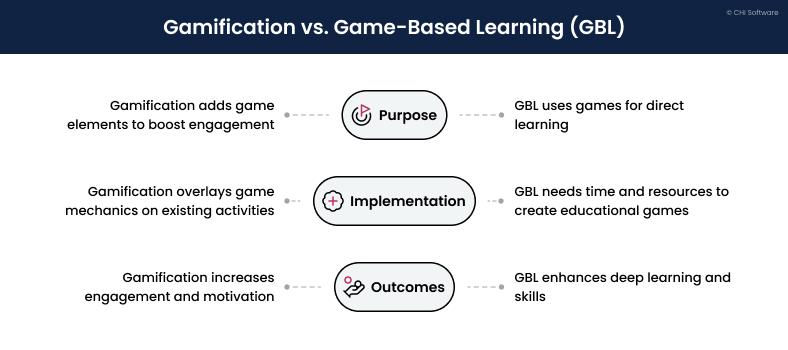
- Gamification in education involves applying game mechanics, such as reward systems, progress tracking, and challenges, to learning environments. The core material stays the same, but the delivery changes.
- Game-based learning uses actual educational games as the primary learning vehicle. Students play a game specifically designed to teach a concept, such as a virtual reality simulation or serious game.
Once you start looking for gamification, you see it everywhere, from interactive learning environments in K-12 to training activities in higher education:
- EdTech platforms that keep you on a daily streak and celebrate student achievements at every milestone.
- Corporate L&D teams use gamified elements and reward systems for healthy competition, engagement, and motivation.
- Schools and universities are embedding progress tracking dashboards and reward points into their learning management systems.
- Outside the classroom, examples include customer loyalty programs, fitness apps that track milestones, and video games that reward players for completing challenges.
Global gamification in education is on track for double-digit growth, with over 70% of companies using game design elements in training activities.
Why Gamification Works in Education
Students could spend hours playing video games, yet they often lose focus during traditional classroom activities. What is different? Games rarely feel like work because players see visible progress. Each small achievement encourages them to continue.
Education has started borrowing these principles to motivate students:
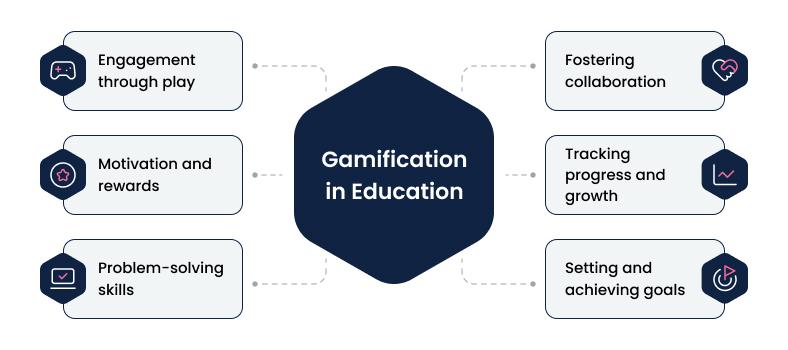
Progress and Reward Motivation
People are naturally motivated by progress. In educational contexts, learners feel engaged when they move up a leaderboard, gain a status benefit, or unlock an achievement with fun elements of gamified classrooms.
Short Feedback Loops
Traditional education often delays feedback. Students complete an assignment and wait days or weeks for a grade. Gamified elements provide immediate feedback help, such as points for correct answers or badges for completing tasks, helping learners improve in real time.
Active Participation Through Challenges
Passive learning leads to lower knowledge retention. Challenges, quests, and competitive elements are required to facilitate learning to solve problems, making the process more engaging and memorable.
Visible Progress Builds Commitment
When learners see how far they have come and how close they are to the next milestone, intrinsic motivation builds commitment. Visible progress turns a vague goal into a clear path with defined checkpoints.
Step-by-Step Guide to Implementing Gamification in Education
Before creating implementation strategies, remember that game-like features work best when applied systematically. Random game elements may seem fun, but they rarely support educators or enhance the overall learning experience without a clear structure.
Effective game mechanics align with learning objectives and educational settings. Here’s a practical step-by-step framework.
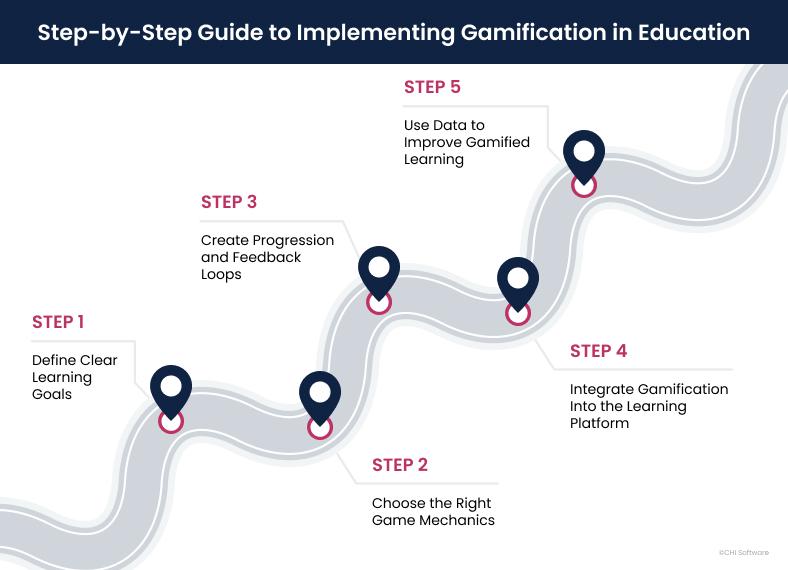
Step 1: Define Clear Learning Goals
No gamification system can succeed without a clear foundation. The first step is identifying what learners need to know or be able to do by the end of the learning experience. Every game mechanic you introduce must serve these learning objectives:
What specific competencies or behaviors should learners develop? Mapping core skills clarifies the learning journey. For example, a coding course might progress from syntax basics to building a functional app, while a compliance module focuses on understanding rules and applying them in real situations.
- Connect Mechanics to Outcomes
Once educational objectives are defined, ask how each game mechanic supports them. Students complete a lesson and earn points, reinforcing their completion of the material. A badge for helping peers in a discussion forum reinforces collaborative learning. A time-limited quiz challenge reinforces recall under pressure. Every mechanic should map directly to a learning outcome.
- Avoid Entertainment Without Learning Value
The most common mistake at this stage is designing game elements that are fun but pedagogically hollow. A spinning reward wheel that dispenses random points may be momentarily exciting, but if it is disconnected from learning behavior, it adds noise rather than value. The goal is discovery education, not entertainment without pedagogical value.
Step 2: Choose the Right Game Mechanics
Selecting the right game mechanics is key to making learning engaging and effective. The goal is to boost motivation while reinforcing student learning.
Here are the most effective mechanics used in gamified education:
Points are the main currency of gamification. They provide immediate feedback for every action — completing a quiz, watching a lecture, or submitting an assignment. XP tracks overall effort, showing learners how much they’ve invested and encouraging progress.
Badges are trophies for student achievements: completing a module, mastering a tricky skill, or contributing to the community. Collect them all and show off your progress — identity points unlocked!
Progress bars are among the most psychologically powerful game elements for visible progress. Nothing says “you’re almost there!” like a progress bar. Watching it fill gives a mini dopamine boost and makes goals feel real and reachable.
Turn tasks into missions to foster critical thinking. A quest to solve a real-world business problem, decode a data set, or master a grammar rule gives the activity stakes and identity beyond a simple assignment. Timed challenges add an element of healthy pressure that sharpens focus.
A healthy competition never hurts. Showing relative positions among peers motivates learners without overwhelming them, especially when paired with private or small-group rankings.
Step 3: Create Progression and Feedback Loops
Have you ever started watching a TV series “just one episode” and suddenly it’s 1 AM? Progression and feedback loops are at work. Good gamified learning environments build the same pull that sustains intrinsic motivation.
A dashboard showing completed modules, earned points, unlocked badges, and remaining content turns a course from a black box into a learning journey. When learners see the path, they’re far more likely to follow it to the end, a critical factor for student engagement across diverse learning styles.
Finishing a module is a small victory. Treat it like one. A badge, a celebratory message, unlocking the next level — these micro-celebrations acknowledge student achievements and signal to the brain that progress is worth celebrating.
As soon as the student completes a task, provide immediate feedback. Not tomorrow — now. Whether that’s a score breakdown, a personalized tip, or a satisfying animation: immediate feedback is what creates the loop. Effort in, reward out.
Step 4: Integrate Gamification Into the Learning Platform
Gamification delivers more value when it’s built into learning management systems. Embedding game mechanics directly into quizzes, dashboards, and course modules keeps learners engaged throughout their learning experience.
Quizzes are where other game mechanics do some of their best work in learning environments. Award reward points for correct answers. Trigger a streak counter for five in a row. Show a real-time score climbing as the quiz progresses. Interactive elements turn something that used to feel like a test into one of the more engaging educational games.
When a learner logs in to the learning management system, the first thing they should see is their own story: current level, recent wins, upcoming challenges. It creates context, builds anticipation, and answers “Why am I here today?”
- Rewards Tied To Course Models
Reward systems should motivate students and reinforce the right behaviors. When they finish a module, they receive a badge. Contributing to a discussion unlocks a bonus resource, and passing a challenge assessment allows them to move up to the next level.
“Your colleague just earned the Advanced Analytics badge!” That one notification does more for engagement and motivation than a dozen reminder emails. Social interactive elements like activity feeds, peer challenges, and collaborative quests remind learners that they’re part of something.
Step 5: Use Data to Improve Gamified Learning
Building a gamified system and leaving it alone is like publishing a book and never checking if anyone reads it.
Don’t you want to know what your learners think? Ignoring users’ behavior means missing the most valuable feedback, the data that shows what engages, motivates, or frustrates them.
Here’s how analytics can guide improvements in gamified learning:
Every click, quiz, or post provides clues. Drop-off points show where gamified learning struggles. Analytics help identify these weak points in gamified learning so you can adjust the content, improve the learning experience, and inspire students.
A module with a 40% completion rate is telling you a story about student learning. Poor results on a core lesson may mean prerequisites aren’t clear, while weak participation in an optional challenge could indicate the rewards aren’t motivating enough. Each number is a question waiting to be answered.
Participation in optional challenges is an early warning sign. High engagement shows that learners want to play even when they don’t have to, so gamification techniques are working. When participation is low, something in the equation is off: the framing, the difficulty, the visibility. Find the weak link and fix it.
- Knowledge Acquisition Retention
How many learners come back after 7, 30, or 90 days is the ultimate proof that your gamification strategies are working. A University of Glasgow statistics course that introduced gamification elements saw 82% of students achieve a passing grade in the semester following implementation, compared to 60% the year before.
Examples of Gamification in Education
Seeing how gamification in education plays out in real products makes it concrete. Here are three examples that show gamefied elements working across very different educational settings.
K‑12 Online Learning Platform
A US‑based EdTech provider enhanced its K‑12 math and coding platform with game design elements such as badges, challenges, and visual tasks. Progress carries over between home and school, making learning feel continuous and rewarding — helping improve engagement across modules.
Drops Language Learning
Drops turns language learning into quick, fun sessions filled with interactive word games, personalized multiple paths, and bite‑sized progress. The gamified design, including streaks, visual exercises, and rapid gameplay, helps users stay engaged and build habits, which is why the app has tens of millions of users worldwide and keeps learners returning daily.
Digital E‑Learning Platform for Kids
A Swedish startup’s kids‑focused learning platform was upgraded with unlockable achievements, rewards, and interactive lessons. Gamified features significantly boosted user engagement, with clients reporting a 50% increase after incorporating elements of a game.
Common Mistakes in Gamification in Education
Despite its potential, gamification frequently underdelivers when implemented poorly. Understanding the most common pitfalls helps designers and educators avoid them from the start.
Focusing on rewards instead of learning: Prioritizing extrinsic rewards over learning by designing a system that makes learners chase points and badges without truly engaging with the material. When the game becomes the goal, the learning suffers.
Adding too many game elements: Overloading a course with game mechanics overwhelms and reduces the impact of each element. Start with one or two mechanics and expand only when they are working well.
Ignoring user motivation diversity: Different learners are motivated by different things. Some thrive on competition; others find leaderboards demotivating. Ignoring individual learning styles and designing a one-size-fits-all system will alienate a significant portion of the audience.
Designing without progress tracking: Without a progress tracking system, learners cannot see their growth, and the sense of advancement, one of gamification’s most powerful psychological drivers, is lost entirely.
Neglecting content quality: Adding game elements to a poorly designed course without addressing the underlying instructional quality. Gamification enhances good content; it only enhances high-quality educational experiences.
Treat gamification as an instructional design decision, not an add-on. Every mechanic should be justified by its contribution to learning outcomes.
Conclusion
Gamified learning sparks intrinsic motivators and improves learning outcomes, but only when game elements are designed to support learning objectives
Think of learning like a game — one that students can enjoy at their own pace. When points, badges, progress bars, and challenges are tied to real learning goals, students stick with it, stay motivated, and actually remember what they’ve learned.
At CHI Software, we help clients turn gamification elements into discovery education results. Whether you need to sustain motivation in higher education or corporate training activities, we can help your learning platforms level up.
FAQs
-
What is gamification?

Gamification is the integration of game elements, such as points, badges, leaderboards, challenges, and rewards, into a learning experience to support student engagement, foster intrinsic motivation, and encourage participation.
-
What is game-based learning?
Game-based learning is an approach where students acquire skills or knowledge by actively playing games designed specifically for educational purposes.
-
Can gamification and game-based learning be combined?
Yes! Educators often blend gamification and game-based learning to create a more dynamic and motivating learning experience.
-
What tools or platforms can help implement gamification in education?
Many learning management systems (LMS) and online platforms offer gamification features, such as badges, levels, and leaderboards. Tools like Kahoot!, Quizizz, Google Forms, and specialized gamified apps can help educators create engaging experiences.
-
What makes these gamified approaches effective?
Key factors include clear goals, immediate feedback, game mechanics that support intrinsic motivation, and interactive challenges that mirror real-world scenarios. These elements help students stay motivated, take ownership of their learning, and retain knowledge more effectively.
About the author
Ivan keeps a close eye on all engineering projects at CHI Software, making sure everything runs smoothly. The team performs at their best and always meets their deadlines under his watchful leadership. He creates a workplace where excellence and innovation thrive.
Rate this article
27 ratings, average: 4.8 out of 5