Despite being in 2026, more enterprises still host their business systems on a monolithic architecture. For many years, it was the logical choice: one piece of code, one place to deploy it, and one location to search whenever things go wrong.
After that, the system starts growing. Things that took one day start taking three weeks. The application starts to suffer because you have to scale the whole app when one service gets busy. The architecture stops supporting the business; instead, it starts hindering it.
That pressure is what pushes so many teams toward microservices. A Gartner Peer Community survey of 300 respondents found that 74% of organizations already use microservices architecture, and another 23% plan to adopt it.
What follows is a practical playbook for moving from monolith to microservices, drawn from real migrations and covering the decisions, patterns, and traps that determine whether it pays off.
What Is Monolithic Architecture?
In monolithic architecture, everything is put into a single deployable package: business logic, data access, user interface, background tasks. The application is a single source of code, one data store, and everything is closely wired together. If you change something, you will redeploy everything.
You still see monoliths all over in big companies. A lot of the base of legacy systems, where all the business processes occur, includes ERPs such as SAP, where finance, HR, and supply chain are integrated, or core banking systems where accounts and transactions take place.
Why Monoliths Were the Standard for Years
In-house, a monolith can be quick to spin up, and you can enforce rules, security, and auditing in one place with much less effort than it takes to coordinate multiple, independent services. This simplicity still counts: for internal tools, products in their very first stages, and even greenfield projects that are tightly constrained to a single small domain, there’s a place for a solid, disciplined monolith. The cost of breaking a monolith out of our systems comes when it becomes so cumbersome that it’s truly getting in the way.
Why Enterprises Are Moving Toward Microservices
Microservices architecture splits an application into small, independently deployable services, each owning a single business capability and its own data. The move from monolithic architecture to microservices is driven by two different pressures, business and technical, and it helps to separate them before committing to a monolithic-to-microservices migration strategy.
A monolith that requires a full regression cycle for every small change is already limiting deployment frequency and raising change fail rate — a dependency audit maps which modules carry the highest coupling risk before any decomposition decision is made.
Get a Free Monolith Dependency and Risk Audit
Signs Your Monolith Is Holding the Business Back
Before planning any migration, ask a blunter question: Is the monolith actually the problem, or a convenient scapegoat? A few signs give it away.
Releases drag, with every deployment needing heavy coordination and a full-system test pass. Small changes force a rebuild and redeploy of the whole application. Onboarding crawls, as new developers spend months mapping the datastore before they can ship. Scaling is wasteful: one hot feature gets hammered, and you scale the entire system, so cloud spend climbs for capacity you don’t need. Teams collide over shared code and merge conflicts.
There is another signal: your architecture isn’t AI-ready. Adding AI capabilities requires yet another layer of tools, integrations, data pipelines, and workarounds because the existing architecture wasn’t designed to support them cleanly.
And over time, this can turn into an operational zoo: different teams adopt different tools and build their own processes around them, increasing operational risk every day instead of creating a transparent, measurable, and manageable engineering process.
If three or more of these sound familiar, the architecture may be the constraint, not the team. That’s usually the moment when moving a monolithic app to microservices starts to pay for itself.
Monolith vs. Microservices: Key Architectural Differences
A move from a monolithic to a microservices architecture changes five things in particular, and neither model is free.
| Aspect |
Monolith |
Microservices |
| Deployment |
Changes require redeploying the entire application. |
Services can be released independently. |
| Scalability |
Resources are scaled for the whole application. |
Capacity can be increased for specific high-load services. |
| Team ownership |
Teams share one codebase and have less isolated ownership. |
Teams can own individual services from development to production. |
| Data management |
A shared database simplifies consistency and access. |
Separate data stores improve service independence but complicate data sharing. |
| Fault isolation |
A failure can affect the entire application. |
Failures can be contained within individual services. |
Business and Technical Drivers Behind Monolithic to Microservices Migration
This should be a choice of how fast you want to grow, how stable you want your delivery, and what you want to prioritize modernizing. Teams that go to microservices because microservices are another trend usually end up with a distributed version of what they have today; teams that go for more substantial reasons stand firm.
Business Case: Faster, Safer Change
The business case is speed and safety of change. Teams ship features independently instead of waiting for the whole application to rebuild, and experimentation gets cheaper because you can roll back one service without risking the rest. That release independence is often the strongest argument, and where CHI’s application modernization services enter the picture.
Technical Case: Targeted Scaling and Flexibility
The technical case is targeted scaling and freedom of tooling: push resources at the one service under load, and let each service use the language or datastore that fits, which is where cloud modernization services matter. Decomposition also lets you modernize in stages, so you keep upgrading the system as functionality moves out of the monolith into new services.
Delivery Stability: From Microservices to Platform Engineering
Third factor all the development teams underestimate: Stability. Without infrastructure for deploying microservices as well as for observability, security, and governance, it doesn’t just make the modernization effort leaner, but exponentially more complex operationally.
Platform engineering is no longer only about developer experience. The conversation is shifting toward governance, control, and agent experience, which means fragmented tooling creates platform risk rather than just operational friction. A growing zoo of tools, processes, and team-specific workflows makes it harder to maintain consistent controls, measure performance, and govern an increasingly distributed architecture.
The DORA metrics from Google’s DevOps Research and Assessment program (deployment frequency, change lead time, change fail rate, recovery time) show whether an architecture change is actually helping. But microservices only improve those numbers if your DevOps foundation is ready: independent deployment demands mature CI/CD, containerization, and automated testing. Without it, splitting a monolith raises change failure rates instead of lowering them. CHI’s DevOps transformation services exist for that gap.
The Risks Of Moving From Monolith To Microservices Too Fast
Microservices solve real problems, but they also introduce new ones. Rushing the transition can turn a known headache into a more complex one.
Splitting a monolith adds network latency, retries, timeouts, partial failures, distributed transactions, and higher infrastructure and maintenance costs.
AI modernization creates a similar risk. Gartner reports that 63% of organizations either lack or are unsure about having the right data management practices for AI, while 60% of AI projects unsupported by AI-ready data are expected to be abandoned through 2026.
This creates a new form of AI-induced tech debt. Without AI-ready architecture and architecture discipline, teams may rely on duplicate logic, shallow refactoring, and fragmented AI components, creating a maintenance drag, higher future maintenance cost, and a risk of complexity compounding.
The rule is simple: build the right capabilities and architecture discipline first, then decompose and extend. Otherwise, both microservices and AI can multiply technical debt instead of solving it.
Monolithic To Microservices Migration Strategy For Lower Technical Debt
A successful monolithic-to-microservices migration plan is not based on speed. It should be based on reduced delivery risk, preserved uptime, and avoiding the replacement of a cheap legacy problem with a more expensive distributed one, with planned steps and gateposts instead of a hero launch.
The process should also reduce the share of delivery capacity consumed by technical debt. This makes Tech Debt Ratio a useful metric for CIOs: if modernization is working, teams should gradually spend less engineering capacity maintaining legacy constraints and more delivering new business value. A declining TDR provides a measurable signal that the migration is reducing future maintenance costs rather than simply moving complexity around.
The goal is not to maximize the number of services created. It is to reduce TDR, protect delivery capacity, and make the architecture easier to evolve over time.
Evaluate Readiness And Assess Feasibility
Start with the business, not the code: which capabilities need to change or scale independently, and where is slow delivery costing deals? A migration from monolith to microservices that isn’t tied to a growth outcome tends to stall halfway. Then map the monolith honestly: identify component groups that could become services, trace which modules read and write which tables, and rank each candidate by coupling and risk. Software architecture consulting earns its keep here, because the cost of a wrong boundary shows up months later, not on day one.
Build Capabilities, Then Choose The Approach
You can’t operate microservices with monolith-era tooling, so before extracting anything, put containerization, an orchestration platform, and per-service pipelines in place. Each service also needs a tested rollback path and a recovery-time target agreed before deployment, not mid-incident. If those capabilities aren’t in-house, IT consulting and staff augmentation can close the gap while your team keeps shipping.
The platform requirement is also evolving with the rise of the agentic enterprise. CNCF’s view is that enterprises are moving beyond managing applications and infrastructure alone to managing AI agents as operational entities while still providing governed data access to teams. That makes platform readiness a prerequisite for safely scaling modern microservices alongside AI-driven workloads.
Then decide ownership: each service needs one team accountable end-to-end, because fuzzy ownership guarantees services that drift and rot. This approach, clear ownership tied to clear boundaries, then matches the migration pattern to the risk profile, and most enterprises land on the incremental, one-service-at-a-time approach the playbook below lays out.
How to Migrate from Monolithic to Microservices: Step-by-Step Playbook
Enterprises almost never survive a full monolith-to-microservices rewrite. Successful migrations happen one service at a time, while the existing monolith keeps running. So what’s your approach to converting a monolith without a shutdown? Incremental, in this order. Here are the steps to follow:
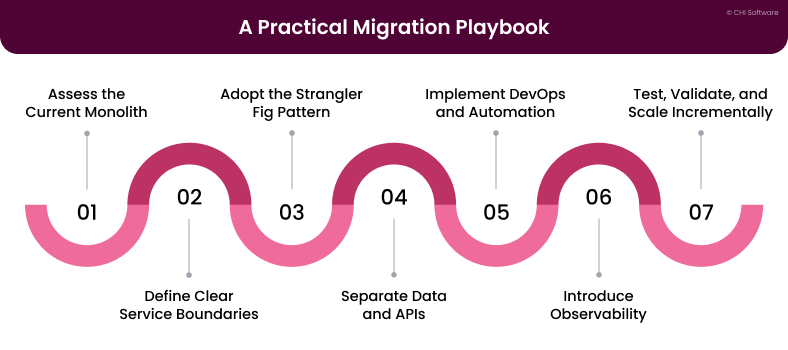
Step 1: Assess the Current Monolith
Dig into the codebase first. Find the seams where services could split, map dependencies, and note which parts change most often, since those churn hotspots make good early candidates. Follow the data: which modules read and write which tables. Flag cross-cutting concerns like logging and authentication early, and profile performance to spot resource-heavy services to carve out first.
Step 2: Define Clear Service Boundaries
Boundaries are the highest-stakes decision in migration. Get them wrong, and you’ll build services more tightly coupled than the monolith you left. Use Domain-Driven Design to identify bounded contexts, where one team owns a complete business capability, because a shared domain model leads to tighter coupling, which bounded contexts prevent. Map services to business functions like “Order Management,” never to technical layers, and give each team full ownership of a service rather than a thin slice.
Step 3: Adopt the Strangler Fig Pattern
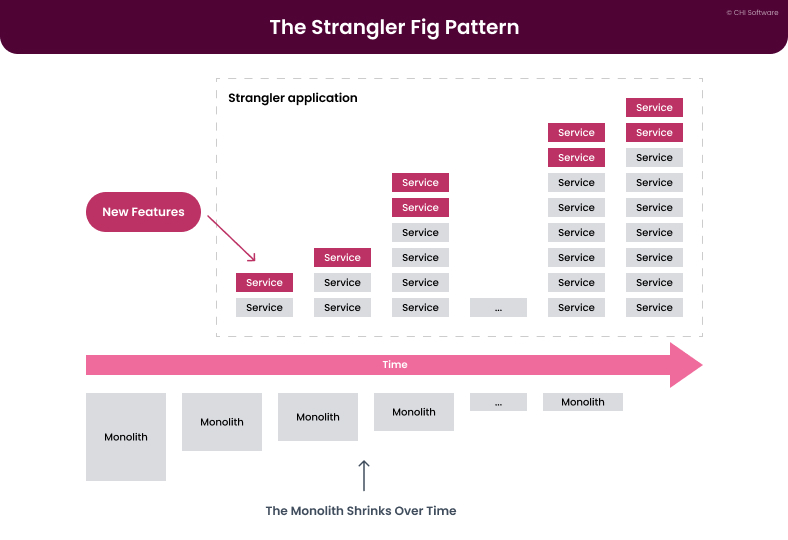
The Strangler Fig Pattern is the most well-tested pattern for transforming a monolithic application into microservices without a big-bang rewrite. You stand up your new service next to the monolith, slowly chipping away at its functionality and routing traffic away from it. Make your first service choice simple, with clear boundaries and few dependencies. While it’s all happening, users don’t miss anything, and the monolith continues its steady job while you’re essentially unbuttoning new features.
Step 4: Separate Data and APIs
Shared data stores keep components welded together, so each service should own its database and communicate through an API gateway, where CHI’s data modernization services and API modernization services do the heavy lifting. For non-instant interactions, use event-driven communication: services publish changes through message queues or streams like Kafka. This keeps services loosely coupled and avoids cross-database transactions.
For an AI-ready architecture, AI agents are becoming new consumers of microservices. APIs therefore need to support both human and agentic traffic, with observability and access controls built in from the start.
Step 5: Implement DevOps and Automation
As the number of services begins to scale, automation stops being optional. We want an easily deployable CI/CD pipeline for each one. Docker gives each a universal, transportable runtime environment. Kubernetes orchestrates all of them: roll them out, scale them up, and keep them running around our entire stack.
Step 6: Introduce Observability
As an increasing number of services spread throughout your stack, they’ll become much harder to debug. Integrate observability from day one. Aggregate your logs, have distributed tracing follow a request across your services, and monitor metrics for telltale signs, such as increased latency, rising error rates, etc.
Step 7: Test, Validate, and Scale Incrementally
Go-live is not where the project ends. Make sure you test your extracted services against the thing that used to provide them (i.e., test the boundary, not just the service!). Test that under load, in production, and then slowly dial it in as you monitor those DORA metrics; if the “change fail” rate goes up, or the recovery time for the system increases, don’t get excited and move to the next extracted service. Instead, fix the boundary, fix the architecture.
Each microservice needs its own CI/CD pipeline, infrastructure-as-code configuration, and distributed tracing before it goes to production; deploying services without that foundation is where Change Fail Rate climbs, and MTTR extends rather than shrinks.
See the DevOps Foundation for Microservices Delivery
Common Migration Pitfalls and How to Avoid Them
Teams migrating from monoliths to microservices tend to fail in the same handful of ways.
Too many services, too fast: Break the monolith into larger chunks first, then split further only once those are stable.
Ignoring transaction boundaries: Data consistency stops being automatic once databases are separated, so decide upfront how the system stays in sync.
Skipping integration testing: Services that pass in isolation can still break at the seams, so test how they behave together continuously.
Unclear ownership: Microservices rot as fast as monoliths when nobody owns them.
Siloed teams: Without shared standards, each service becomes its own dialect.
Tools and Technologies That Support Microservices Migration
Enterprises rely on a few categories of tooling, each addressing part of running distributed services:
- Containerization (Docker, Kubernetes): Makes services independently deployable and portable across almost any stack.
- API gateways: A single entry point for routing, authentication, and communication between the monolith and new services during migration.
- Service meshes (Istio): A layer for service discovery, security, and traffic control, so services find and trust each other.
- Event streaming (Kafka, RabbitMQ): Asynchronous messaging between loosely coupled services, so one doesn’t stall when another is briefly down.
- Observability (Prometheus, Grafana): Distributed tracing and centralized logging to follow a request across services and catch trouble early.
Real-World Enterprise Migration Example
Here’s one from our own work. A US-based oncology decision-support company had built a platform over six years that had stopped scaling. Every new integration brought another data format and set of edge cases, turning simple clinical workflows into slow, brittle processes.
We transitioned their monolithic legacy core, incrementally migrating one capability at a time, liberating core business functionalities while maintaining compatibility with the legacy system so we could never impact live clinical systems. This made a real, tangible difference – decisions were made around 40% faster, and there was around a 25% improvement in system capacity without impacting live systems in a positive and unobtrusive manner. A big-bang approach to such an important clinical system was not available from the outset.
Is Microservices Migration Worth It for Every Enterprise?
No, and a partner who tells you otherwise is selling, not advising. Sometimes the honest answer is to improve the monolith you have. A modular monolith is often the better call when:
- Your teams are small and would drown in the operational overhead of many services.
- Your existing applications are stable and don’t need a steady stream of new features.
- Your DevOps maturity is limited, and there’s no real automated testing culture yet.
For plenty of systems, tightening the monolith is the more cost-effective move, and recognizing that early saves real money and regret.
Conclusion: Plan Your Monolith to Microservices Migration Without Disruption
Moving from monolith to microservices is as much a question of strategy and team culture as of technology. Three principles carry most of the weight. Go gradual, since incremental migration keeps disruption low and gives you exit ramps at every step. Keep backward compatibility, so each new service stays compatible with the existing system, and you never bet the business on a single cutover. And align architecture with goals, so service boundaries mirror real business capabilities, not an org chart.
If you’re not sure where to begin, a team that has run these migrations before takes out a lot of the guesswork. We’ve done this end-to-end, from first assessment through extracting service boundaries and standing up the delivery platform underneath. That, in short, is how to migrate from monolith to microservices without betting the business on it.
Microservices migrations that hold up under production load share a common characteristic: the delivery partner brought open-standard tooling with full infrastructure documentation transferred at go-live, so the internal team owns and operates what was built rather than depending on the vendor to run it.
Request the Technical and Security Assessment Package
FAQs
-
How do you migrate a monolithic application to microservices without disrupting production?

The most common one is the Strangler Fig pattern, which involves adding new microservices in parallel to the existing monolithic system and redirecting traffic to them in a backward-compatible way. This is the most risk-free way: zero downtime and production still running throughout the migration, supported by auto tests, monitoring, and effective rollback.
-
What is the best strategy for a monolith-to-microservices migration?
No approach is right for all, but a staged, business-driven approach usually wins: analyze readiness, determine boundaries with Domain-Driven Design, establish basic DevOps capabilities, and then extract one service at a time. There is a well-grounded strategy to migrate from a monolith to microservices, focused on decreasing delivery risk and technical debt rather than jumping on adoption hype; hence, if you don’t need it for an expansion scenario, it's not for you.
-
Which migration patterns are used when moving from monolith to microservices?
The most frequently seen migration patterns are Strangler Fig pattern for incremental take-over, decompose by business capability to figure out boundaries, and database per service for segregating data, though event-driven communication for loose coupling comes in too - Most actual migrations will use one or a combination of multiple, though there aren't many truly one-at-a-time, in and out monolith to microservice migrations.
-
How do you handle data migration from monolith to microservices?
Instead of one database for everything, each service has its own. Copy the data objects one service at a time with the owning service, but do it gradually alongside moving over the service owning the data. Handle consistency between services with eventing instead of distributed transactions and accept eventual consistency where appropriate. Migrations are almost always the hardest part; get this right before you start code changes, not after.
-
When should an enterprise avoid converting a monolithic application to microservices?
If the monolith is relatively stable, the team is small, changes are infrequent, or your team is in the early stages of DevOps, your chances are good. The overhead of microservices will be too high, and refactoring a monolith into microservices will introduce only additional cost and instability. A good "modular" monolith might be a cheaper alternative.
About the author
Ivan keeps a close eye on all engineering projects at CHI Software, making sure everything runs smoothly. The team performs at their best and always meets their deadlines under his watchful leadership. He creates a workplace where excellence and innovation thrive.
Rate this article
28 ratings, average: 4.81 out of 5