Consider two engineering teams. Both purchased the same AI coding assistants last year. One of them is shipping twice as often and has done so with less rollback. The other is producing a lot of code but shipping more slowly. Same AI coding assistants, different outcomes. The difference is not in the assistants but in the system around them: how work is specified, checked, shipped, and measured. This effect is known as an AI software factory.
Here we will describe how it works, the elements it needs, the traps to avoid, a blueprint for building an AI software factory without making the problem worse, and how to tell whether it is paying off.
What Is an AI Software Factory?
An AI software factory is a holistic, AI-enabled approach to software engineering. It links requirements, development, testing, deployment, and monitoring through standardized processes, automation, and human supervision, so that a request is moved to a tested, reviewed, deployable change along a repeatable pathway rather than through discontinuous work efforts.
That definition has implications for what it excludes. Purchasing licenses for AI coding assistants isn’t a factory. Neither is creating a handful of isolated agents – with the rest of the pipeline separate and manual. The word that’s working here is factory – a manufacturing process, with raw materials, steps, quality assurance, and a quantifiable output. If you’ve already outlined an AI-powered SDLC, the factory is the delivery machine that takes that concept into the nooks and crannies of your entire organization.
So how are you supposed to decide if the idea is worth your time? Not based on how quickly agents write code, but on delivery throughput, production reliability, technical debt, and engineering results you can quantify. This metric is just the vanity metric for code-generation: a team could write three times as many lines of code and still ship later, because review queues still back up and rework still costs time.
Google’s DORA research on AI-assisted software development makes it clear: AI can help your organization do more. Good engineering gets even better. Weak ones get weaker. There is no neutral setting. If your software development life cycle (SDLC) is disciplined, an AI software factory will make that discipline even stronger. If it isn’t, the factory will ship your defective product faster and in greater volume.
How Does an AI Software Factory Work?
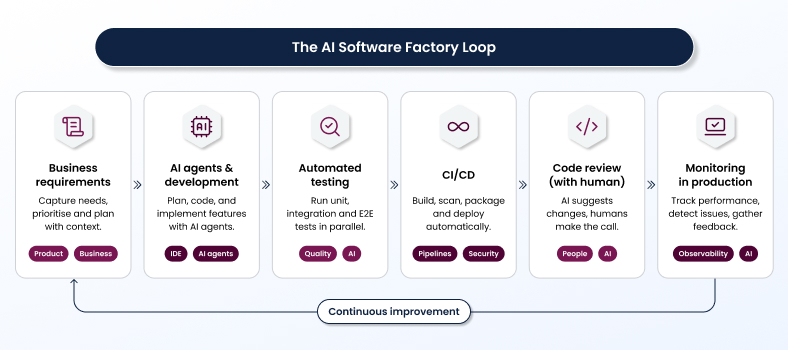
At the center of this process is a simple loop: a business need enters, a change is reviewed, tested, and then put into action. In between, engineers, AI coding agents, orchestration components, repositories, CI/CD pipelines, and monitoring systems work together. The challenge is deciding who owns what.
A few things can be automated. Most cannot be. Architecture decisions, optimizing for trade-offs when out of an abundance of demands, and the final “go” are made by people. That division isn’t just a paperweight until models improve. That’s a design. You don’t need fully autonomous to get a return on investment. Most operational factories have a hybrid assisted workflow-an engineer driving the operation and the agent assisting them-alongside semi-autonomous work, where an agent handles a single task, and a human signs off. Completely autonomous delivery is just a marketing slide-not a requirement.
From Business Requirements to Development Tasks
Work originates as intention, not code. A product goal or support ticket turns into software requirements, and those requirements can then be broken down into work that provides an agent with sufficient context: the technical requirements and constraints, the code that will be affected by the change, and the code style and conventions the team adheres to. This is where context engineering pays off. Provide the agent with a simple task and a new-to-it codebase, and its output will be plausible garbage.
AI-Assisted Coding, Testing, and Code Review
And then, the agent does the work! It churns out code, writes tests, opens pull requests. In more advanced implementations, it might even write the first iteration of automated tests. This is where all the problems creep in: human code review is not going away, people! It is the gatekeeper. A reviewer looks at the AI-generated code to check its correctness, security, and alignment with the architecture. This review is often where the real magic is, because it prevents the buildup of maintenance debt. Multi-agent teams can chunk tasks down further still – one writes code, another reviews, but you guessed it – the human eventually still approves.
Continuous Integration, Deployment, and Monitoring
Once the changes are merged, they go into the continuous integration and continuous delivery process. First, it’s built, then it goes through automated tests, then it’s moved into preview environments, and eventually, if the gates pass, it goes into production hosted on cloud infrastructure. Those gates are a production-ready check: has the change earned a spot in front of the actual users? After the release, runtime monitoring and observability see it with the live traffic, and that feeds back to the next iteration. Feedback loops are how the factory figures out if last week’s confident merge was the right move.
An AI software factory delivers measurable improvements in deployment frequency and change quality only when the underlying engineering process is already reliable. If your SDLC has gaps in CI/CD coverage, test automation, or code review, AI agents amplify those gaps before they amplify your throughput.
Assess your engineering readiness for AI-assisted delivery
Core Components of an AI Software Factory
Drop the operating model into a real enterprise, and it needs a specific set of parts. None is exotic on its own. The difficulty is wiring them together with clear access boundaries, because an AI software factory touches your source code, pipelines, and production systems at once.
AI Models, Coding Agents, and Orchestration
Underlying are the AI models and code agents on which they are built, as well as the orchestration layer, which is responsible for task orchestration, maintaining agent states, and decisions on responsibility sharing among agents. Teams often underestimate orchestration. One agent is a tool, but two or more agents without orchestration is chaos; a multi-agent system needs an orchestration module, which is like a dispatcher.
Codebase Context and Engineering Standards
Despite the agents’ agency, they do need the available context. For this to be provided, we need a secure, easily accessible place for an agent to review the code that they are being asked to do. In addition, working within the existing architecture and following the organization’s coding standards is very important; otherwise, the generated code will not fit with the existing approach to system development and will likely get “blocked” in pull requests rather than being smoothly integrated.
Development Environments and CI/CD Infrastructure
Agents need a safe place to operate. Reproducible development and preview environments allow changes to be tested before they reach a shared branch, while CI/CD infrastructure ensures the whole process is backed up from commit through build, test, and release. For most large enterprises, this is all cloud-native territory. In the CNCF Annual Cloud Native Survey, 82% of container users have deployed Kubernetes to production, and 66% of companies that run generative AI models use Kubernetes for some or all of their inference workloads. As a sign of the maturity of the cloud-native stack, this is not to say that every large enterprise must run Kubernetes. Small teams often do not or should not. What matters more than the platform is whether your pipeline can absorb agent-generated changes: fast builds, tests that don’t flake, and environments that spin up per change. DevOps transformation should come first, providing the pipeline and infrastructure needed to deploy and scale AI agents effectively.
Automated Quality, Security, and Governance Controls
Quality can’t be just a manual add-on after agents roll out changes at scale. Automated testing, security testing, and other software quality assurance are stitched into the pipeline, acting as pass/fail gates to determine whether a change can pass through. Governance controls sit next to these gates, governing what agents are allowed to access; for regulated teams, AI governance consulting becomes a pipeline component rather than a policy.
Agent Permissions, Observability, and Audit Trails
Finally, and most often forgotten, every agent should have scoped permissions, every action should be observable, and there should be an audit trail. When an agent makes a pull request or kicks off a deployment, we should be able to record what it did, the access it used, and for whom it did it. It may sound like a pain until that’s the only answer to a compliance question.
The same rules have to cover the agents engineers already run on their own, outside approved workflows. If the sanctioned path is slower than the unsanctioned one, people route around it, and the audit trail ends where the factory does. Making the governed path the easiest one is part of the design.
Benefits of an AI Software Factory for Enterprises
Done well, this model changes how an engineering organization scales. The honest version of the benefits is narrower than the hype, and more useful for it.
Faster Software Development and Delivery
The main benefit is a shorter lead time for making changes. If needs are converted into approved changes through a defined process and the drafting of those changes is delegated to agents, then time-to-production is shortened, and deployments occur more often. This is a benefit for teams that already have good pipelines.
Reduced Manual Work Across the SDLC
Much of the software build lifecycle involves repetitive work, such as boilerplate code, test scaffolding, regular refactoring, and a multitude of create-read-update-delete (CRUD) endpoints. Automation in software development eliminates some of this repetitive work, freeing up engineers to tackle the tasks that truly require their judgment, including the modernization backlog that usually waits behind feature work.
More Consistent Engineering Processes
As long as every adjustment adheres to the proven, extensively tested process, variation decreases. Engineering processes are no longer dependent on the person who performs them. While not as interesting as perfect repeatability, this consistency translates into predictable releases through uniform processes.
Scalable Software Development Workflows
Here is the distinction that trips up boards. McKinsey’s global AI survey found that 80% of respondents reported improvements in individual productivity, while only 37% attributed some positive EBIT impact to AI. Read those numbers together. Developers feeling faster is close to universal. Enterprise returns in the financials are not. Scalable software development workflows bridge the two, and that bridge is process, not tooling. A factory adds development capacity without adding operational complexity in a step. For the full argument about where the money comes from, our breakdown of AI ROI in software development goes into more detail. In practice, the first limit on that capacity is usually the pipeline. Once agents open more changes, build queues, flaky tests, and missing quality gates decide whether throughput grows or simply piles up.
Challenges and Risks of AI Software Factories
Now the part the vendor decks skip. A factory can fail to reach production reliability, and the ways it fails are specific enough to plan around.
Code Quality and Security Risks
AI-generated code can have defects, security vulnerabilities, and architectural inconsistencies that look good in a demo but can cause problems in production. Generated volume also produces rework: code that runs but has to be rewritten to fit the system properly. The NIST AI RMF Generative AI Profile of the AI Risk Management Framework discusses the risks associated with generative AI and outlines lifecycle actions to manage them. These principles apply directly to how you validate code, trace its origin, and keep a human in the loop. The profile doesn’t certify AI-generated software.
AI Infrastructure and Operational Costs
Scaling with operating agents comes at a financial cost. Model inference, the cloud infrastructure that supports it, the preview environment that starts for each change, and the observability stack all constitute ongoing operational costs rather than one-time costs. Focusing only on licensing costs, not operational costs, forces a team to face an unwanted bill after 3 months.
Human Oversight and Accountability
If a change is introduced by an agent and then a pipeline deploys that change, someone must be accountable. What we risk is that no one is, and responsibility, as with every other piece of our job, needs to be explicitly defined. Any approval gate should also specify who is accountable for that gate, and the audit trail should make it clear who did what.
Legacy Dependencies and Growing Technical Debt
This is a classic example of the silent enemy. An AI coding agent given legacy code that lacks automated test coverage, has gremlin mis-referenced module boundaries, and operates in an environment where standards are not enforced inevitably produces code that introduces the very same complexity. The result is a blow-by-blow increase in the technical debt that was there from the start – only automated.
This doesn’t mean AI has no place in legacy modernization. The key is how and where it is applied. Using the Strangler Fig pattern, teams can replace legacy functionality incrementally, introducing AI-assisted development where it adds value while keeping architectural changes controlled, testable, and aligned with the long-term modernization plan.
Done in that order, AI software factories can speed up legacy modernization instead of adding to the debt.
How to Build an AI Software Factory
Here’s a practical way to bring AI-assisted engineering into an existing delivery operation. It starts slow on purpose, because the expensive mistakes come from skipping the assessment.
Assess Your Existing SDLC and Automation Readiness
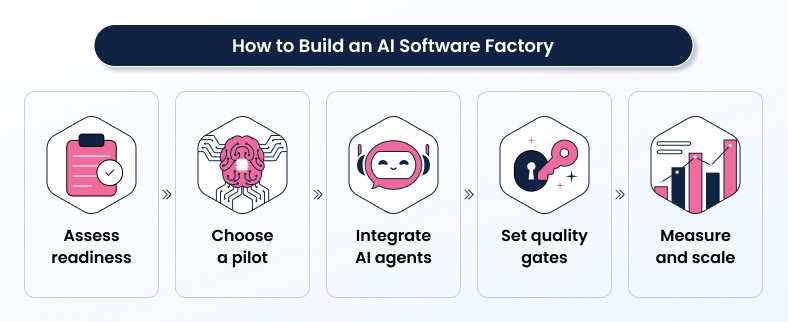
Before any agent touches your code, measure what you have. How mature is your CI/CD? How much of the testing is automated? Where are the real bottlenecks, and what legacy constraints will automation hit? Make sure you have a baseline of the current delivery performance, or you won’t know later if the factory helped or just added cost. A structured AI readiness assessment is the fastest way to identify gaps before they become expensive.
Select a Pilot Workflow and Define Success Metrics
Pick one workflow. The selection is limited, familiar, and inputs are adequate for a minimally viable implementation. Before starting, define quantitative criteria for success. This requires the items of lead time, change failure rate, review effort, and cost per change. If these have not been pre-ordained, a pilot risks becoming a political discussion rather than a scientific investigation.
Integrate AI Agents with Development Tools and Pipelines
Embed the agents into tools that your engineers already use – the repository, the CI/CD pipelines, the issue tracker. Integrate, don’t replace. Losing your current workflow on the way to the new one risks reducing adoption and running your pilot into the ground due to friction. For a fast, low-risk start, bring in engineers external to your team to work with you on deploying the first workflow – the model behind FDE as a service.
Establish Quality Controls and Human Approval Gates
Before scaling, allow gates rather than afterward. Checks and controls for quality and security are automated in the pipeline. Human approval gates are placed in areas where damaging changes could be disastrous, particularly during production deployment. These controls allow an agent to have more freedom later without worries.
Scale the AI Software Factory Across Engineering Teams
The pilot should only be scaled up when there is evidence of increased delivery and quality over baseline. Scaling should have a clear individual responsible for implementing the AI policy; another individual is responsible for developer enablement, and there should be a clear allocation of governance responsibilities rather than a blank slate of no one. The difference here is stark: in a survey of European IT and business professionals conducted by ISACA AI governance. Close that gap before you scale, not after something breaks. 83 percent felt that workers were using AI, but only 31 percent said there was a formal AI policy. We need to plug this gap before we scale rather than after.
AI software factories accumulate new technical debt when legacy codebases lack test coverage, clear module boundaries, or consistent engineering standards. Teams that skip that assessment before introducing coding agents inherit structured versions of the same problems.
Map legacy blockers before deploying AI coding agents
How to Measure AI Software Factory Performance
Measure outcomes, not code volume. That’s the whole discipline in one sentence. A factory that generates more code is not succeeding. One that improves software delivery performance is.
Start with the DORA metrics, as these directly affect delivery health: deployment frequency, change lead time, change failure rate, failed deployment recovery time, and rework rate. Then look at the metrics that AI might be hiding. The defect escape rate shows what has got through review. How well automated tests perform tells us whether verification gates are working. The developer review effort shows whether agents are saving time or just adding more work for reviewers. The cost of engineering each change and the operating cost of AI will tell us whether this is financially viable. Delivery predictability shows whether these processes are reliable.
When you compare each result to the baseline noted previously, if you have improved productivity while the defect escape rate and review effort have increased, you haven’t solved the problem in delivery – you’ve just moved it. There needs to be a laser-sharp focus on the bottom line. As Gartner’s forecast states, by 2027, “over 40% of agentic AI projects are canceled because of cost, lack of clarity around the business value and risk controls.” It’s important to be clear that this is a forecast, not a rate. To stay in the good books of this forecast, define measurable pilot success criteria and be honest about comparing what you get to what you started with.
AI coding agents amplify what your engineering organization already does well, and surface what it does not. CHI Software works with CTO and VP Engineering teams to design AI-assisted delivery workflows that improve DORA metrics, contain technical debt, and scale without adding operational risk.
Design a measurable AI factory pilot with our engineers
AI Software Factory FAQs
-
Is an AI Software Factory the Same as an AI-Powered SDLC?

They overlap, but they are not the same. An AI-powered SDLC describes how AI assists throughout the software development lifecycle. An AI software factory is a type of software factory that creates a standard way of doing things. It also makes sure the work is done correctly and that people are paying attention. The factory is the production system, and the AI-powered SDLC is a big part of what happens inside it.
-
How Is an AI Software Factory Different from an AI Coding Agent?
An AI coding agent is one worker. An AI software factory encompasses all the steps a worker takes: first, requirements intake; then, orchestration, CI/CD, monitoring, and governance; and finally, approval. One agent helps a developer move faster. A factory changes how the organization delivers its products or services.
-
Can an AI Software Factory Operate Without Human Developers?
No, and this shouldn't be the final goal. We are deliberately keeping decisions about design, difficult trade-offs, and release approval with engineers. Agents are handling bounded, well-specified tasks, while humans retain judgment and accountability. Anyone claiming delivered autonomy is just giving you the illusion of it.
-
What Does It Cost to Build an AI Software Factory?
It depends on the starting point; the bare cost of licenses is far less than the actual cost. Also, provisions for model inference, cloud infrastructure, previews, observability, and engineering time to integrate and maintain – there will be a cost. Operating cost is likely to be higher than the upfront cost – these should be modeled together.
-
Can an AI Software Factory Work with Legacy Applications?
Yes, but implementing an AI software factory in a legacy environment requires careful preparation. Legacy code with insufficient test coverage and unclear module boundaries can cause AI agents to introduce additional technical debt, so the sequence is important.
About the author
Yana oversees relationships between departments and defines strategies to achieve company goals. She focuses on project planning, coordinating the IT project lifecycle, and leading the development process. In their role, she ensures accurate risk assessment and management, with business analysis playing a key part in proposals and contract negotiations.
Rate this article
28 ratings, average: 4.81 out of 5