One of the main issues with legacy systems is that outdated software can sometimes be a roadblock to a businesses’ growth. You may see your competitors moving quickly with innovative features for your industry. To catch up, you’re going to need better operational efficiency, faster releases, and more platform stability.
Legacy modernization helps businesses to regain footing in the market. A modern tech stack can lower your operational costs, help deliver consistent performance, and even enable you to release updates and new features faster than ever before.
Below you will find practical details on what benefits you can expect when you modernize your legacy systems, with real numbers and case studies included.
Article Highlights:
- Within the first two to six weeks, modernization starts to improve your system’s performance and stability. In our experience, one global investment company achieved a 60% increase in system performance.
- Within the first three to four weeks, the most critical security gaps in your platform can be sealed. According to Microsoft, even simple multi-factor authentication (MFA) secures sensitive data in 98.56% of cases where one of the login credentials is leaked.
- In half a year after the modernization process starts, you can expect your platform to be able to sustain higher loads. Moving the platform to the cloud and transforming its architecture allowed our EdTech customer to achieve 99.9% uptime even during peak school hours.
- In about a year, modernization results in a better customer experience overall. For one of our clients, a Canadian store delivery company, modernization led to an impressive 40% increase in user satisfaction.
Immediate Benefits of Legacy Modernization
The most noticeable and immediate advantages of legacy modernization come from simple changes that don’t always require deep architectural rebuilds. Your tech partner can simply remove the bottlenecks in your customer management pipeline, resolving recurrent errors your users have reported.
Let’s walk through some of these “easy wins” you will likely be able to see from early on in the modernization process.
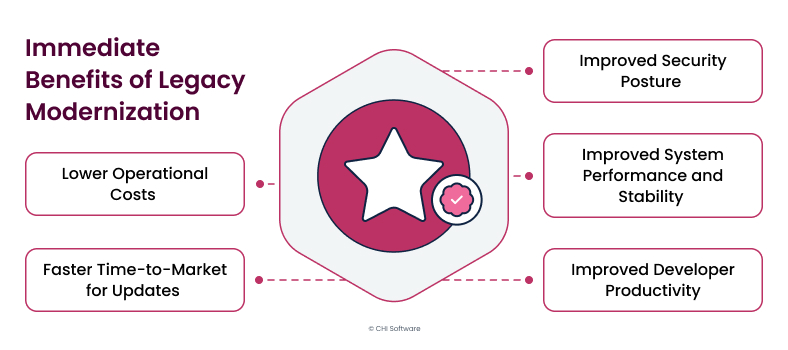
This illustration highlights the early, measurable benefits of legacy modernization.
Improved System Performance and Stability
Some legacy platforms slow down because of messy everyday workloads. Different parts of your platform may be using the same server or memory resources, and keeping your systems on-premises may be slowing down your operations.
Modernization can begin to resolve such issues within the first two to six weeks:
- Within the first week, engineers can separate workloads that are competing for the same resources.
- In parallel, developers begin refactoring the most obvious performance bottlenecks — for example, removing redundant queries or synchronous calls between your services.
- Within the next two to three weeks, engineers can partially migrate your platform or application to the cloud.
A good example comes from one of our US-based clients, a global investment firm which saw their trading platform beginning to perform more slowly as the client base grew. Splitting the platform into microservices quickly led to a 60% increase in system performance, and migrating to AWS helped the platform handle five times as many concurrent operations without any downtime.
Lower Operational Costs
In legacy systems, operational costs tend to be high because developers are often preoccupied with fixing minor but frequent issues, which can take around six to ten hours of developers’ time weekly, according to Atlassian.
Over time, quick fixes accumulate into bulky codebases, and your business ends up paying both for extensive manual work and to maintain legacy hosting.
Modernization can cut these costs within two to four weeks — we at CHI Software have successfully done just that for one of our Swiss clients working in the leasing industry. The business had to manually supervise each and every small update, all while processing an increasing number of leasing operations. We quickly automated their deployment pipeline, decreasing maintenance and manual labour costs by 20%.
Faster Time-to-Market for Updates
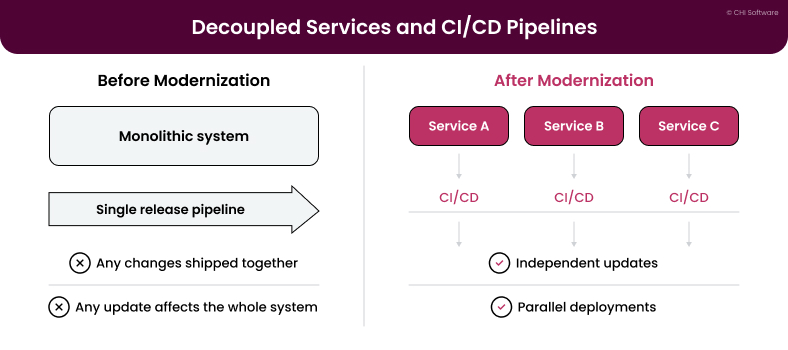
Legacy modernization advantages include faster releases and lower deployment risk when systems are decoupled and supported by CI/CD pipelines that enable independent, parallel updates.
Legacy modernization advantages can help you release new features or platform updates within the first few months of modernization. Here’s how it works: the main slowdown in your releases usually comes from tightly coupled components in your system. Modernization can fix this issue with a few approaches:
- In four to twelve weeks, engineers can decouple the components in your platform into independent modules, so that you can update each one independently and more quickly.
- In parallel, in about two to six weeks, engineers can introduce continuous integration/continuous deployment (CI/CD) practices. For instance, adding small changes to your system during the day and automating development and error-checking make updates more predictable and controllable.
That was the key benefit that our Swiss client saw soon after modernization started. Dividing the platform into smaller services allowed the company to upgrade more quickly — releases came three times faster, and business expansion accelerated by 40%.
Improved Security Posture
We’ve occasionally seen in our practice that some legacy systems lack even basic security policies, making these a top priority for businesses. Here’s why: Microsoft reports that even simple multi-factor authentication secures sensitive data in 98.56% of cases where one of the log-in credentials is leaked.
Modernization can establish similar security measures within the first three to four weeks, so you can feel safer right away, while you’re waiting ti implement full compliance. In particular, early modernization phases can:
- Update authentication mechanisms: Your tech partner can develop multi-factor or adaptive authentication protocols. The first places a few login processes, and the second analyzes the authentication context by scanning for unusual behaviors.
- Tighten access control: Introducing role-based and team-based access rules enables you to strictly control what your employees, partners, and services can see.
- Eliminate outdated dependencies: If some frameworks in your system no longer receive provider support, they compromise your security — such frameworks must be retired or replaced.
Improved Developer Productivity
Developer productivity within your team often improves in the first one to three months after updates because the first modernization stages reduce accumulated technical complexities, especially in high-impact areas. Thanks to automation, outdated frameworks that used to take a lot of effort have been replaced by automated tests and standardized environments, so your platform becomes easier to manage and developers have more time for actual development.
Another way engineers experience the benefits of legacy modernization is through better tools. An AI code assistant alone can significantly boost productivity: according to IBM, its internal tool helped developers automate 59% of code documentation, 56% of code explanation,and 38% of both code generation and test case generation.
Long-Term Legacy Modernization Benefits
Long-term modernization benefits emerge after removing architectural constraints that previously limited platform growth. Below, you will find the list of the most essential business gains.
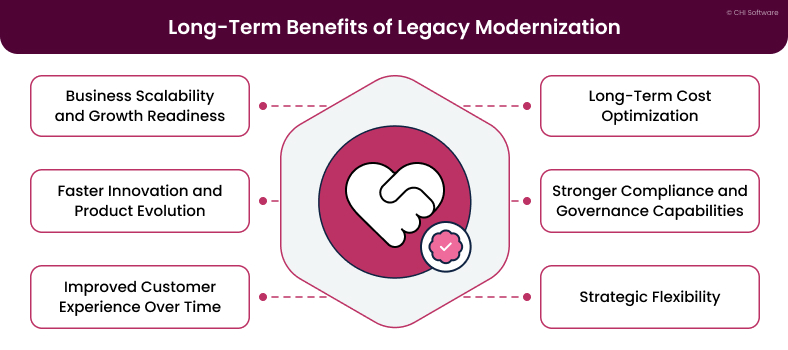
This visual shows how the benefits of modernizing legacy systems accumulate over time, supporting predictable scalability, faster innovation, and long-term cost optimization.
Business Scalability and Growth Readiness
Legacy systems can operate somewhat normally under typical load, but once you try to scale, or when the customer base grows — they break. This occurs because legacy platforms accumulate architectural compromises over time. Instead of scaling, you have to hot-fix unexpected issues that can come from the deep layers within your platform.
Modernization rebuilds the piles of architectural quick-fixes into clean systems.
One common example we see is when businesses gain new modular components that operate predictably even under a load. Within up to half a year after modernization, they are noticing that rolling out new features has become easier and that the platform performs consistently well.
One of our clients in K-12 education experienced a similar scenario: they achieved steady scalability after completing the digital transformation of their learning platform. Moving the platform to the cloud and transforming its architecture allowed 99.9% uptime even during peak school hours. As a result, our client can maintain high performance while their customer base grows to millions of students.
Faster Innovation and Product Evolution
Easier innovations start to show up within three to six months after modernization starts — that’s when your platform needs to fully absorb new technologies and integrations. After that, your team can present new ideas, and your system will be able to sustain them. Here are opportunities that come with a modern, sustainable platform, to name a few:
- Shorter product validation cycle: Modular, service-based architectures allow you to test and release new features independently. This way, you can validate product ideas in weeks instead of months.
- Parallel product development: Platforms with clearly separated services let your departments work on new releases simultaneously, without blocking each other.
- Faster integration of external services: Modern API-driven platforms can add new partners and tools quickly, whenever you need them.
In our experience, faster integrations were key to helping a US-based FinTech company land large corporate clients. The company had to be able to integrate with Salesforce, Oracle Fusion, or QuickBooks: diverse financial ecosystems that their clients used daily.
CHI Software incorporated much-needed integrations along with a few more features. As a result, this financial management system modernization increased the platform’s efficiency by 60% and enabled the company to propose a comprehensive offering to its enterprise clients.
Improved Customer Experience Over Time

The benefits of a modernized legacy system emerge when stable backend services and aligned data flows create consistent performance, reliable integrations, and a sustainable customer experience over time.
In legacy systems, customer experience often suffers because the backend performs unevenly. When your payment service doesn’t connect with the billing provider and the content module takes ages to load, users begin to churn.
Benefits of modernizing legacy systems show when your tech partner cleans up your backend processes, making sure that:
- Your core features are decoupled and stable, so that they can respond quickly to user actions.
- Data access, integrations, and processing pipelines are all aligned. When a customer places an order or accesses content, all services respond accurately.
Only when the backend is clean can you add final UX design touches and provide user-friendly services. The entire modernization process takes about a year — in that time, you may start noticing sustainable user retention.
One of our clients, a Canadian store-delivery company in the agriculture and consumer goods sectors, is a prime example of such a transformation. We developed clear route management, order processing, and inventory control for their platform. As a result, the company achieved a 40% increase in user satisfaction and a 97% customer retention rate following modernization.
Long-Term Cost Optimization
In the long run, modernization can shield you from unexpected emergencies and prevent rapid cost spikes. Modern systems are more incident-proof and cost-effective in two major ways:
- Modular platforms don’t require frequent rebuilding — they can manage sudden and large data flows and allow you fix minor issues one component at a time, without fully deconstructing the system. Such small fixes take much less investment.
- Cloud-based systems allow your platforms to use more or less resources on request and pay only for what you use. When the load on your platform unexpectedly spikes, the system just uses more cloud resources. But while it’s slow, you don’t need to pay to maintain resources “just in case.”
Here’s the practical cost-optimization number you may consider: as of December 2023, Nucleus Research indicated that cloud migration can potentially return USD 3.86 for every dollar spent.
Together, these benefits of a modernized legacy system allow you to leverage your infrastructure resources more efficiently over time. Usually, the transformational effect on your operations becomes visible during the first two years after modernization, once you can compare the costs against your previous spending on emergencies.
Stronger Compliance and Governance Capabilities
Regulatory requirements are always evolving across industries, so adjusting security standards frequently has become a regular business routine.
With modernization, integrating incoming regulations becomes easier — modernized architectures simplify audits, access control management, and adaptation to new compliance standards. Modernization can also clean and structure the platform’s security modules so they can pass external security audits easily. Such changes often take about a year of modernization, but you will likely see the practical benefits only when a new industry regulation rolls out.
Strategic Flexibility
Strategic flexibility comes in about a year after modernization, when technology no longer limits business decisions. As architectural constraints are gradually removed, organizations gain the freedom to expand into new markets, adjust business models, and scale operations without having to rework their core systems.
Risks of Legacy Modernization and How to Mitigate Them
The benefits we discussed above do not appear all at once. Most often, they happen when your tech partner guides you step by step through a well-planned modernization roadmap. However, if the provider’s planning or industry expertise is inefficient, your business may experience both the pros and cons of modernization.
Below are the common challenges for legacy systems, and our suggestions for hands-on solutions to prevent them.

This illustration shows that legacy modernization benefits do not come automatically, and require careful planning and mitigation at each stage.
Downtimes While Decoupling Tightly Connected Components
Separating services within your platform often results in splits among their shared connections, such as shared databases or implicit data channels. Changes in one such component may trigger breaks or slowdowns in others if they are not handled properly – and this depends on a close understanding of your business and its tech stack.
The solution lies in thorough preparation before any structural remakes happen. Our engineers often start by mapping any and all hidden dependencies in your platform. Then comes decoupling data flows and gradually preparing module changes.
Business Logic Fragmentation
Another common risk of digital transformation arises when business rules become tangled across different components. If the pricing module is too closely tied to content or user profile services, changes to one may also affect the other. Such risks require developers to define clear business roles before touching the architecture. This process even becomes one of the pros for legacy systems modernization: it pushes businesses to rethink implicit business logic that is often scattered.
Partial Modernization Creates Operational Blind Spots
The pros of legacy systems modernization become visible only when modernization is done end-to-end. Otherwise, partial upgrades can introduce operational blind spots that didn’t exist in the original legacy setup. That’s a common issue that comes from blindly following legacy modernization trends. Although helpful to businesses, it can be tempting to simply add a popular new AI tool without integrating it with the rest of the system.
Conclusion
Some benefits of modernization come early: you can expect better platform stability, performance and faster releases within the first half-year after start. Those that require deep structural changes take longer. You can unlock cost optimization, predictable scaling, and strategic flexibility within the first one to two years after modernization.
So, why modernize legacy systems? Because together, the benefits can significantly improve your business KPIs both in the short and long term. At CHI Software, we help align modernization steps with your current business needs. This approach allows you to optimize your platform with a clear, practical path forward.
If this matches what your business needs right now, feel free to reach out using this contact form.
FAQs
-
How do we know if our system actually needs modernization right now?

The most common case where modernization becomes an immediate necessity is when your legacy system slows down your pipeline to the point of losing clients or limiting business growth. But before these critical limits, you will see some earlier signs:
- Releases start to take longer each quarter;
- Even small changes require full rebuilds of the system;
- Performance issues worsen during peak load and launches;
- Engineers rely on manual fixes and temporary workarounds, and such fixes start to pile up and slow down your operations;
- Your module-to-feature dependencies are becoming outdated or too complex for your team. As a result, you postpone important updates;
- You avoid requesting changes because you know implementation will be slow or unpredictable.
If several of these signs appear at once, you probably need to consider modernization soon.
-
Is modernization worth it if the system is still “working fine”?
In our experience: yes, it is worth it. The reason is that timely modernization prevents you from wasting valuable time and resources dealing with emergencies. Even if your legacy system seems to be working fine now, it likely relies on fragile components under the hood — it may have tightly coupled components, growing data volumes, or outdated tooling.
Such issues can pile up and slow your business down in the meantime until they finally reach a breaking point. Instead of fixing incidents under pressure, you can work on it while it’s stable, which makes change more predictable and safe for your business.
-
How do we avoid over-investing in modernization?
Over-investing often happens if you don’t clearly align modernization with your business goals. In practice, such alignment comes from following three simple rules:
- Focus on the most critical user flows first, rather than modernizing everything at once;
- Start with modules that block growth or slow down your operations;
- Plan measurable modernization steps before committing, and calculate your expenses and potential ROI beforehand.
-
What parts of a legacy system should we modernize first?
From real projects, the best starting points are usually the areas that combine high business impact with high technical friction. In our experience, it is often:
- Components that change most often (pricing, onboarding, reporting, integrations).
- Bottlenecks in your operations, especially those that affect many user flows at once. Most often, our clients prioritize slow payment processing, data management, and API integrations.
- Parts of the system that break or slow down under load.
- Manual processes that consume engineers’ time.
- Security-sensitive areas, such as authentication, access control, and data management.
-
How does modernization affect future technology choices, such as AI or advanced analytics?
When we work with legacy systems, we start by resolving structural issues that can make daily operations impossible. Advanced technology choices always come after that — when a business has a clear vision of how these technologies can help its goals.
So, the short answer is: modernization often allows your system to be ready for AI or advanced analytics to start with. For instance, it can help your team to:
- Centralize and clean data so that AI models can analyze and use it;
- Make your core operations stable enough during experiments with new tools;
- Integrate external AI services or build internal models on top of the stable existing structure.
Without modernization, new tools and initiatives often remain in isolated experiments.
About the author
Yana oversees relationships between departments and defines strategies to achieve company goals. She focuses on project planning, coordinating the IT project lifecycle, and leading the development process. In their role, she ensures accurate risk assessment and management, with business analysis playing a key part in proposals and contract negotiations.
Ivan keeps a close eye on all engineering projects at CHI Software, making sure everything runs smoothly. The team performs at their best and always meets their deadlines under his watchful leadership. He creates a workplace where excellence and innovation thrive.
Rate this article
102 ratings, average: 4.93 out of 5








Usually, we don’t split the platform into components before the ‘homework’ is done. We define database boundaries and plan how information and operations will flow before we restructure the modules.