As we look into the legacy modernization industry, steady growth remains on trend, with the market now standing at USD 24.98 billion in 2025 and headed toward USD 56.87 billion by 2030. But what is really driving the numbers upward?
Predictably, AI is leading legacy modernization trends and strategies, but key market drivers also include data modernization, multi-cloud environments, API-first architectures, and more. Legacy software experts at CHI Software work closely with these technologies on a daily basis, and this expertise provides a helicopter view of what is happening in the market.
In this article, we share our observations on how each trend contributes to the modernization industry and explain how to navigate the most up-to-date modernization practices heading into 2026.
Do you want to know how modernization works for real businesses? Check our case studies covering FinTech, EdTech, and HealthTech industries.
Go to our portfolio
Article Highlights:
- AI-driven modernization leads the market, accounting for about one-third of enterprises’ modernization investment.
- IDC reports that 29% of enterprises name poor data quality as the top barrier to realizing the value of AI, making data modernization the second key modernization trend.
- Rearchitecturing appears across multiple modernization trends, as many companies are moving their platform to cloud and API architectures. As for the cloud, 91% of companies are already using containers with Kubernetes.
- CHI Software has seen direct store delivery software upgrade result in as much as 30% higher system performance.
10 Legacy Software Modernization Trends for 2026
At some point or another, a business is likely to discover that their existing software can no longer support their operations. Yet choosing how to modernize legacy systems is rarely straightforward. The market offers options with different trade-offs in cost and impact — that’s why understanding trends means knowing your options well before you commit to a modernization plan.
Let’s review the ten most prominent trends and the possibilities they can bring to your business.
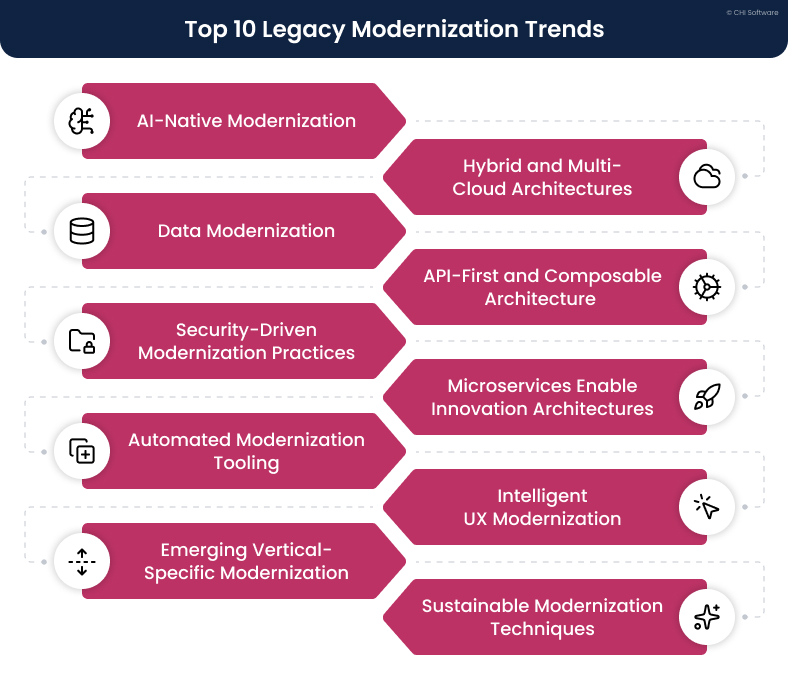
Technology evolves faster than we notice — these legacy app modernization trends show how far innovation and flexibility have already taken legacy systems.
Trend 1: AI-Native Modernization Takes Center Stage
Since 2022, software engineers have been widely adopting AI for code refactoring.Adoption is now expanding to rehosting and rearchitecting as well, making modernization fully AI-native. In practice, this means that AI can now support the entire product system’s evolution, including:
- Code analysis: Large language models can reduce poor code design 20% better than developers.
- Dependency mapping: AI can improve accuracy in dependency mapping, enabling engineers to better map the connections between modules within your platform.
- Building product architecture: AI-native rearchitecting helps unify diverse data flows across product management, marketing, and engineering teams to develop a more coherent and data-informed architecture.
Market giants are already riding the trend wave:
The demand behind the proposition is correspondingly high: AI now accounts for about one-third of enterprises’ modernization investments, and signs show that the trend will continue to grow.
Trend 2: Hybrid and Multi-Cloud Become the Default Architecture
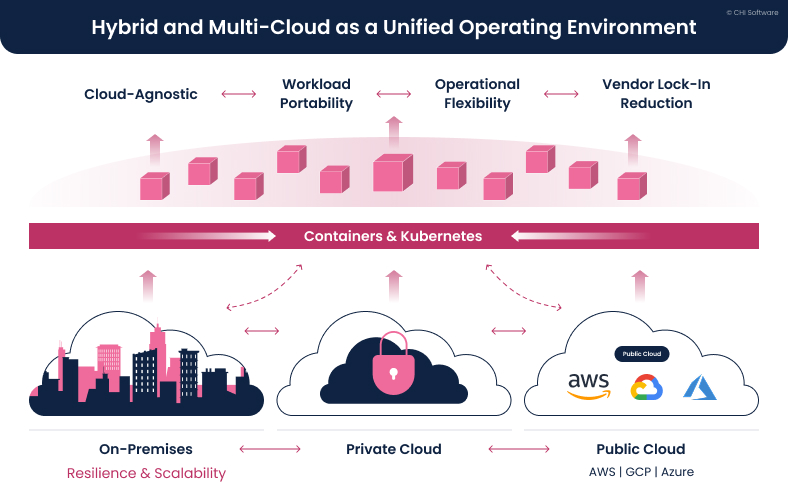
Hybrid and multi-cloud architecture as one of the key legacy system modernization trends, shows how cloud-agnostic, container-orchestrated platforms support flexible legacy modernization approaches.
Another modernization approach is shifting the status quo: companies are no longer re-platforming all their systems onto a single cloud. Some are decentralizing their resources to span both on-premise and cloud servers: Gartner reports that 90% of organizations will adopt hybrid cloud practices through 2027.
Others are looking out for emerging multi-cloud opportunities to enable them to use the services of two or more cloud providers simultaneously. One such opportunity came out recently: AWS and Google announced their collaborative multicloud network.
In line with the multi-cloud trend, modernized architectures are becoming cloud-agnostic and container-orchestrated, enabling your product to migrate and run smoothly across cloud environments.
Trend 3: Data Modernization Becomes the Core of Every Transformation
Another trend is changing how businesses treat their data: legacy systems built around isolated data warehouses are now moving to unified lakehouses.
The shift stems from two core issues in outdated warehouses: fragmented data ownership and a lack of real-time data streams. For instance, user profile information is often scattered across different marketing and product analytics teams using legacy systems. Fragmented data ownership means that in a few years or even months you may struggle to find the right person to ask about specific user logs. That becomes even more of a problem if you need to update data in real time, like when your client changes their email address.
Lakehouses resolve both issues — they aggregate data from different sources into a unified environment, while real-time data streams synchronize the flows. In this environment, the entire data infrastructure can systematically validate incoming data, monitor anomalies, and track how data moves within the platform’s operations. That level of insight into backend data flows enables modern businesses to identify the core bottlenecks across the rest of their platform.
IDC’s report strengthens the case for putting data at the top of legacy system modernization trends: more than 90% of enterprises share data externally, but only 30% do so strategically, treating data as a marketable product. That means there may be a possibility to use the data resources you already have for additional profit.
As Deloitte puts it, “data isn’t just an asset; it’s a product with well-defined owners, consumers, and quality standards.”
Trend 4: API-First and Composable Architecture Replaces Monolithic Logic
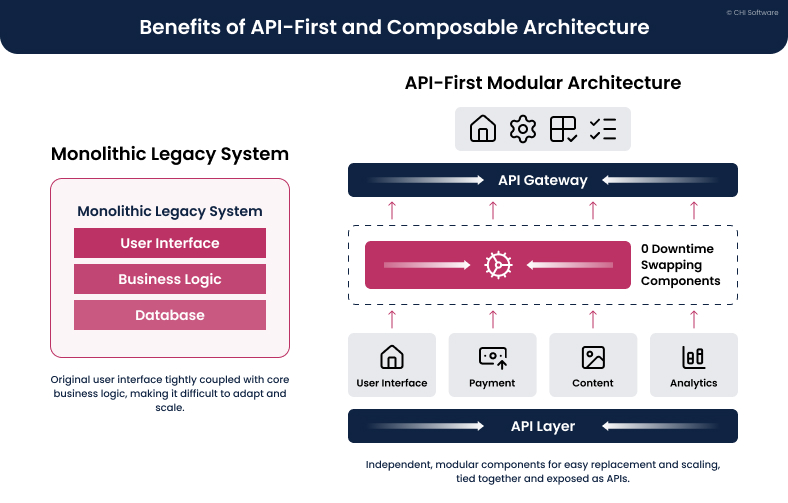
This diagram compares a monolithic system with a composable API-first architecture, highlighting application modernization drivers like lower downtime, faster internal processes, and smoother integrations.
Another big change comes to the platforms that are still running on a monolithic architecture. If that’s your case, all your platform’s functions are likely mingled in a single codebase in the backend. That may become a problem when you urgently need to upgrade a specific feature, such as changing your search and recommendation modules.
To avoid such issues, 82% of businesses have already adopted some level of API-first approach, and 25% operate as fully API-first organizations, according to the 2025 State of API Report. API-first architecture enables your platform to grow quickly by making each module independent and easy to update.
If you want your platform to grow, you'll need smooth scalability. Consult our cloud compluting engineers for the best results.
Get a free consultation
Beyond the efficiency benefits of updating, here are a few more application modernization drivers behind API adoption:
- Businesses adopt APIs to improve integrations within their digital ecosystems. You may need external systems for payments, supply chain, and shipping. Composable architecture keeps all your integrations in sync with your platform.
- APIs also help internal processes respond to threats or customer orders much faster. Your inventory, payment, security, and any other module doesn’t have to wait for a monolithic architecture to run the query linearly.
- API adoption comes up as a natural step toward event-driven architecture, where services on your platform react to changes instantly, in real time, rather than polling each other for updates.
Trend 5: Security-Driven Modernization Accelerates Adoption
Security and compliance requirements push the need for modernization even further. In fact, regulations such as GDPR, PCI DSS, HIPAA, and the emerging AI Act set the expectation that companies should be building their digital platform as fully security-compliant from day one. Any outdated infrastructure not designed for this purpose now has to catch up to strict data protection, auditability and access control requirements.
That’s why legacy system modernization approaches have evolved to take on more advanced security measures such as Zero Trust architecture, isolated environments, and encrypted data flows:
- Zero Trust architecture assumes no implicit trust and continuously verifies identity, device health, and behavior, even after users log in to the network.
- At the same time, isolated environments and encrypted data flows mitigate the risks of feeding internal data to LLMs, ensuring that sensitive data remains in a controlled environment. One way companies are making AI integrations more secure is by placing LLMs on on-premise servers, reflecting a broader shift toward security-first AI deployments embedded directly into modernized architectures.
In our experience, security-driven modernization can especially help businesses that have previously used manual compliance controls. We worked on this in our leasing software modernization case with a client that processes leasing vehicles online. When the platform was reaching its limits in core functionality and data protection, we integrated role-based access controls and user activity tracking into the platform’s core architecture, so the client didn’t have to worry about doing these things manually.
A similar security-driven approach applies to internal systems that manage sensitive employee information. In this employee data management system modernization, GDPR compliance and auditability became primary modernization drivers. The legacy platform relied on manual controls and fragmented document workflows, so modernization focused on embedding role-based access, secure data flows, and clear document lifecycle rules directly into the system architecture.
Trend 6: Microservices Evolve into Highly Modular, AI-Driven Service Architectures
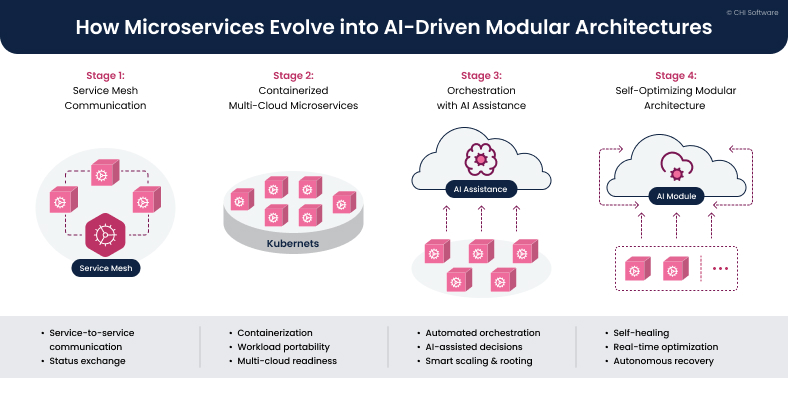
This diagram shows legacy application modernization trends through the evolution of microservices into AI-driven, self-optimizing modular architectures with automated orchestration and real-time recovery.
Building up to microservices may by itself be one of your modernization goals, but from there, you can go even further. Here is a new frontier you can look toward: according to the CNCF annual survey, 91% of companies are already using containers and Kubernetes, and 52% are training AI to automate how they move containers through the cloud. To get to this stage of automation, companies often go through a few evolutionary steps:
- First, they modernize their microservices to communicate via a service mesh: for example, a payment service confirming the customer’s purchase to the inventory service.
- Next, they upgrade to a multi-cloud architecture: Companies package diverse microservices’ components into containers to move them freely across clouds.
- Then comes the automation: cloud orchestration platforms (such as Kubernetes) guide containerized microservices, with AI advising the process.
- Finally, businesses fine-tune the observability settings: You can use AI to continuously monitor the entire system and automatically detect failing services or traffic that needs rerouting. The AI system can then alert the developers and start automatic root-cause analysis of the issue. By the time developers sync in the loop, the system will already be at work, offering a draft to fix the problem that is ready to test almost in real time when an issue arises.
Once everything is working in sync, your microservices can communicate on their statuses, recover, and self-optimize – all in the cloud and in real time.
Trend 7: Automated Modernization Tooling Reduces Migration Timelines
Legacy app modernization trends also expand to modernization instruments. Automated tools start supporting developers through the whole process, starting long before any important line of code is changed:
- AI tools can often be helpful during risk analysis. They help developers scan existing codebases and reveal tightly coupled components, unsupported libraries, or security gaps. Such areas are often among the highest in volume and the most likely to break first during a modernization process.
- Then come code transformation recommendations. Based on this scan, the tools can suggest the appropriate refactoring paths — for example, where it’s best to split your module into services and which parts need to be retired.
- Then, developers use AI to double-check dependencies within the platform so that no outdated connections will slow the system down in the future.
- Finally, automated tools help to generate tests, fill in documentation, or plan API development. Working with APIs usually takes developers 10 hours per week or more, according to the 2025 State of API Report. However, AI-driven automation can significantly reduce this time. 68% of the reports’ respondents said they use AI to improve code quality, and 41% said they use it to help with API documentation (41%).
Trend 8: Intelligent UX Modernization Overcomes Legacy Interfaces
Rigid legacy interfaces can often fall behind in meeting users’ expectations, and the requirements go far above fancy designs. Users expect high UX performance, and so legacy platform modernization trends tend to adapt accordingly with personalized interfaces, accessibility, and modern UI frameworks.
Personalized interfaces increasingly rely on behavioral analytics to support the user experience. With AI-driven recommendations, you can analyze users’ every click to learn how they are actually interacting with your content and menus. These insights will help you to develop a strategy for more user-friendly interfaces and improve the user experience on your platform.
In practice, businesses often address similar personalization challenges during large-scale modernization initiatives — for example, in financial management software modernization projects, where decoupling legacy UI logic enables more flexible, data-driven interfaces.
On a larger scale, users expect a reliable UX experience across all types of devices, so modern UX stacks are moving toward consistent support for diverse screen readers and layouts. This trend also extends to UI frameworks: legacy UIs are now being replaced with component-based design blocks. Businesses can personalize their application for specific audiences without reworking the entire codebase.
Understand where legacy interfaces limit user experience and how modern UX stacks remove those constraints.
Review your UX architecture
Trend 9: Vertical-Specific Modernization Paths Emerge
Legacy software powers banks, hospitals, classrooms, and factories — very different industries with different rules and risks. In recent years, modernization has started getting specific enough to meet the specific needs of each particular industry:
- Banking and FinTech: real-time fraud detection and strict compliance. Modern architectural designs often can process transactions instantly and monitor suspicious behavior.
- HealthTech: remote patient monitoring (RPM), seamless electronic health record (EHR) integration, and secure data flows between systems.
- EdTech: optimizing teachers’ workloads and addressing teacher shortages: more than 44 million additional primary and secondary teachers are needed by 2030.
At CHI Software, we have observed that the requirements of specific niches have narrowed over the past few years, largely due to stricter security regulations and more specialized business needs. For instance, a financial management system upgrade required us to operate in a highly regulated environment, while also accounting for the demands of the system’s large enterprise clients. The modernization helped the client scale the platform, but to do so, our engineers and project managers had to account for multiple industry-specific needs at once.
Trend 10: Sustainable Modernization and Long-Term Maintainability
Simply put, legacy application modernization trends replace risky “big bang” rewrites with gradually phased and therefore predictable upgrades. Businesses opt for aGe modernization roadmap more often so that they can plan modular designs and extensible architectures from the outset.
Vendors are catching on to the trend, understanding that their solutions should be vendor-neutral and must root deeply in customers’ scalability expectations and KPI goals so that a sustainable and maintainable modernization is carefully planned from the start and precisely documented in the process.
How to Approach System Modernization in 2026
The trends we’ve discussed here go hand in hand with best-practice legacy modernization techniques. Below we have collected the most important ones, coming from years of our modernization experience.
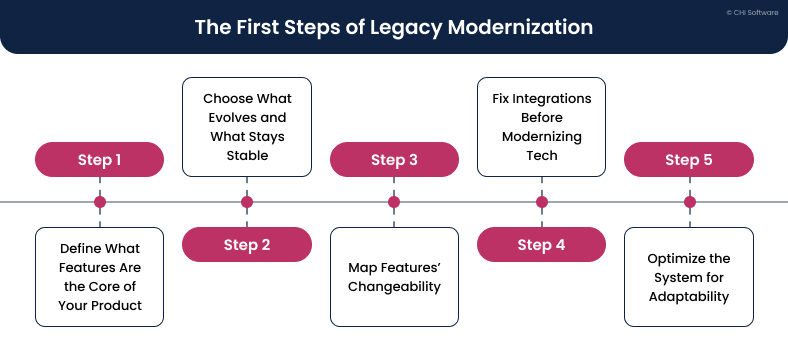
These less obvious tips can help you adapt faster to legacy software modernization trends.
Redraw the System’s Boundaries Before Touching the Code
Before anything else, define what features are the core of your product’s value. For a language-learning platform, this could include content and adaptive analytics modules. All other features, such as billing, messaging, and analytics, can shift to external SaaS platforms. If some features are simply dead weight, you may even consider retiring them.
We at CHI Software propose that the best way is to approach prioritization with business impact analysis or a business capability mapping framework. This mapping can show the actual value behind each function of your app, outline the dependencies between them, and show the risk tolerance for each module. To define which features are worth retirement, we recommend the Wardley Mapping method.
Decide Which Components Should Evolve Continuously, and Which Should Stay Stable
Not all components should and will grow equally within your product. To identify which features evolve most easily, developers often use change-frequency heatmaps. To name a few examples:
- Features like user onboarding flows, marketing processes, and payment triggers usually fall within a high-change zone.
- In contrast, the low-change zone often covers modules like authentication, compliance, and core transaction records — reliability and regulatory compliance here matter more than speed and updates.
This dual-speed architecture can actually make the modernization process more predictable for you, making it easier to align development timelines with your business priorities. Accurately dividing high-change and low-change zones also saves time by preventing unnecessary rewrites in the future.
Map Changeability Instead of Complexity
Along with change-frequency heatmaps, we also recommend mapping the changeability of features. Simply said, the map should show how closely the feature links with other parts of your operations and how easy and safe it is to change it. For a modernization process, it doesn’t matter much how complex the feature is on its own — what matters is whether a change can trigger a ripple effect that impacts the app’s efficiency.
For instance, in the oncology platform modernization case we worked on, laboratory test selection was not critically connected to the platform’s core functionality. This allowed us to automate it easily, and where the customer request for a scalable architecture involved a set of interconnected units, we could focus our efforts on working on an API.
Modernize Integration Logic Before Modernizing Technology
In legacy systems, everything sits inside one monolith. All operations are tied together through shared data formats, endpoints, timing, and rules. When one part changes, the rest of the system still expects the old behavior — and that’s why outdated service contracts often cause more trouble than the programming language itself.
APIs, cloud-orchestrated containers, and service mesh help redefine how parts of your new application communicate. That’s why modernizing integration logic is usually the best place to start.
Optimize the System for Adaptability
Modernization is not about a perfect architecture or a beautiful UX. The ultimate business goal is often to hold the ground in the market for the next decade and grow from there.
That’s why when you start modernizing, you need to plan thoroughly, accounting for long-term adaptability. Choose features, architectures, and technologies that are more likely to grow and evolve over the next decade. Based on what we see in the market and in our practice, it’s worth betting on AI agents, multi-cloud environments, and API-orchestrated workflows.
Conclusion
Legacy software modernization trends lead systems to better flexibility, AI-enabled intelligence, and faster product-to-market timelines. In 2026, the organizations that succeed will be those that move away from rigid monoliths, adopt modular APIs, automate transformation tasks, and ensure every new capability can evolve independently.
CHI Software’s engineering team regularly works on tasks like these. We guide clients from defining high-value components to implementing service-driven architecture — exactly the type of fieldwork that lays the foundation for emerging trends. If you wish to find out what your system is already capable of and how to strengthen that capacity through modernization, we are just a contact form away.
FAQs
-
How do we know whether our legacy system is worth modernizing or replacing entirely?

We advise you to look at both the technical and business symptoms. In most cases, it makes sense to replace the entire system only when you see the combination of:
- Maintenance costs rising faster than business growth;
- Core features becoming impossible to change without breaking something else;
- Security and compliance gaps that can’t be easily patched;
- Performance limits affecting customer experience (slow load times, downtime);
- Vendor lock-ins that are preventing the adoption of modern architecture or integrations.
However, if your system still delivers key business value and only falls short on performance, you may benefit more from modernization than from scrapping everything.
-
What is the realistic timeline for a modernization initiative, and which early signals show that the project is on track?
In our experience, timelines vary by scope, but most of our clients end up with 3 to 6 month projects for one major business-domain rebuild and around 12 to 18 months for full-scale transformation across the platform.
Once you start the modernization, the early success signs to expect will include:
- Clear decomposition of the first module into APIs and services;
- Automated CI/CD pipelines set up early in the project;
- First migrated component operates independently without regressions;
- Engineering velocity increases (fewer dependency blockers, less rework).
If these milestones happen within the first quarter, it’s a clear sign that the project is heading in the right direction.
-
How much internal engineering capacity do we need before starting modernization?
You don’t need a full-scale internal team to get a modernization effort started. In most cases, a core squad of 3 to 6 people is enough at the early stage. Product owners should have one or two senior engineers and about two more technical leads who can support discovery, documentation, and early technical decisions.
A product owner’s role is to prioritize functionality and validate results quickly, while internal engineers just need to be well-versed enough to understand your product’s value-driving features and architecture.
-
Are there modernization approaches that minimize downtime or avoid a “big bang” cutover?
Yes, there are such approaches. The ones we use most often at CHI Software are:
- Strangler Fig pattern: building new services around the legacy, replacing them gradually.
- Canary releases: releasing changes to a small user group first.
- Feature toggles: switching new capabilities on/off without redeploying.
- Parallel run: old and new systems operating together until the new logic is stable.
- API gateways: redirecting traffic to modern components without exposing backend changes.
-
Is it possible to modernize the only high-value components instead of the entire legacy platform?
Yes, you can do that with selective modernization by prioritizing modules tied to strategic capabilities like payments, customer onboarding or product catalog.
In practice, however, it can be more challenging for you to define high-value components within your platform than for us to modernize it. If that becomes your case, we can help by:
- Mapping business value to technical assets: aligning features, data flows, and dependencies with KPIs like revenue impact or operational cost.
- Running architectural discovery sessions: identifying core bottlenecks, as these are usually the highest-ROI modernization targets.
- Analyzing real production behavior: applying telemetry, logs, and user journeys to find out which services users depend on most.
- Proving value with a pilot modernization: detecting clear component-business correlations by extracting one component into a standalone service.
About the author
Ivan keeps a close eye on all engineering projects at CHI Software, making sure everything runs smoothly. The team performs at their best and always meets their deadlines under his watchful leadership. He creates a workplace where excellence and innovation thrive.
Yana oversees relationships between departments and defines strategies to achieve company goals. She focuses on project planning, coordinating the IT project lifecycle, and leading the development process. In their role, she ensures accurate risk assessment and management, with business analysis playing a key part in proposals and contract negotiations.
Rate this article
115 ratings, average: 4.93 out of 5









If you have modules that will likely evolve and drive your product value over the next three years, those are good candidates to become standalone services in a composable architecture.