At CHI Software, social responsibility grows from everyday choices: how we build technology, share knowledge, and stay connected to people. The world changes quickly, and technology often moves faster than understanding. Our CSR focus remains simple: help people learn, make informed decisions, and use innovation responsibly.
In 2024–2025, we continued to support communities that learn and create, both inside and outside the company. Two directions became central this year. FutureCode, our open platform for ethical and accessible AI, translates complex technology into clear guidance for educators, civic organizations, and small businesses.
The CHI Education Office connects people at every stage of growth, from students discovering IT to experienced engineers refining their skills. Together, these initiatives reflect one belief: progress is shared work, and knowledge has the most value when it is passed on.
FutureCode is a community initiative launched by CHI Software to spread knowledge about technology and ethical AI in education, public institutions, and culture.
The idea is simple and practical: to make complex technology clear, accessible, and valuable for people who build real projects in their communities. FutureCode operates as an independent platform of open expertise rather than a corporate showcase, serving developers, managers, educators, civic leaders, and policymakers with unbiased guidance and tools.
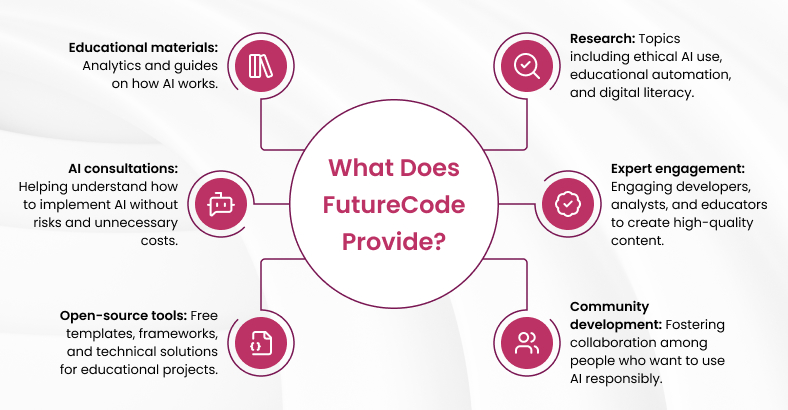
The mission is to humanize technology. Our team translates AI, data, and cloud topics into plain language, shares open templates and explainer materials, and offers consultations that help non-technical teams make grounded decisions without hype. The goal is to lower the barrier of entry to AI and give people at different levels of expertise a supportive starting point.
What FutureCode Does
FutureCode channels international CSR principles into hands-on formats that anyone can use. Core directions include:
Accessibility: Free consultations, open templates, and practical explainers for a broad audience.
Transparency: Sober analysis of AI’s capabilities and limits, plus research and white papers without exaggeration.
Inclusivity & Ethics: Programming for different audiences and a steady focus on data protection, model bias, and algorithmic clarity.
To bring these principles to life, FutureCode runs a compact set of public touchpoints:
Website: A hub for consultations, publications, templates, and simple technical tools.
Blog & knowledge base: Explainers, white papers, guides, and sector cases for socially important domains (the work is in progress now).
Open consultations: Online office hours, Q&A, and thematic reviews that convert common questions into public knowledge.
We built the content for non-specialists: short articles, infographics, checklists, and white papers organized by themes such as education, governance, institutional development, and culture. Each piece points to practical next steps and reduces the noise around fast-moving technologies.
Who It Serves
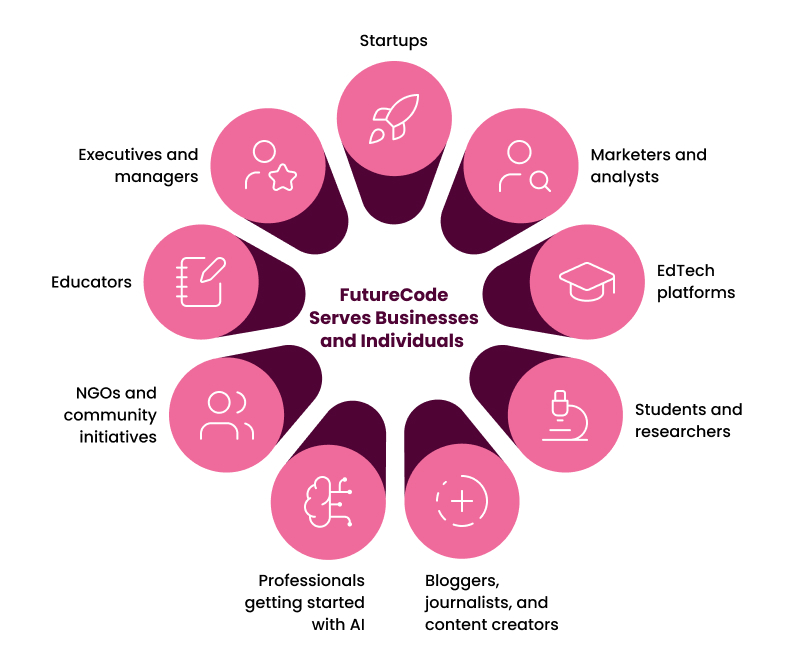
FutureCode supports professionals who rarely have budget or in-house expertise for high-quality tech advisory: educators, project leads, NGOs, municipalities, and small businesses. They look to the platform for pressure-free consultations, clear explanations, ready-to-use tools, honest analytics, and a sense of belonging to a responsible tech community.
For CHI Software, the initiative is real technological donor work: sharing expertise, setting transparent standards, and helping others avoid costly mistakes. It strengthens our reputation as a socially responsible technology partner who contributes more than code by elevating public capacity to work with AI.
Why It Matters Now
Many teams struggle to distinguish real AI capabilities from marketing promises, lack understandable tools and templates, and have limited awareness of ethical risks. FutureCode meets these gaps with unbiased guidance, open resources, and community formats that promote responsible, context-aware use of technology.
In short, FutureCode is how CHI Software translates expertise into public value: a human-centered platform where people gain clarity, confidence, and practical support to apply AI responsibly. Our team is committed to growing this space step by step, listening to real needs, publishing what helps, and staying focused on outcomes that matter to society.
Education for Growth and Inclusion
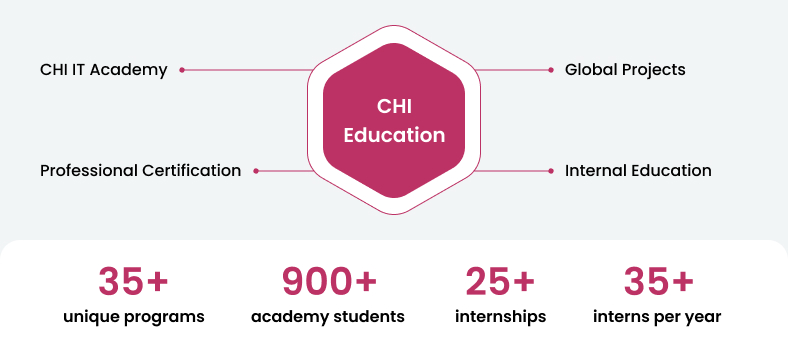
What started as a few internal workshops has evolved into a structured educational ecosystem that connects students, universities, and professionals at every stage of their journey. Today, the CHI Education Office manages several key directions:
CHI IT Academy: Beginner-friendly courses that introduce students and career switchers to real development practices.
Department internships: Hands-on mentoring inside technical teams.
Global internship projects: Internal training projects that simulate commercial development.
Internal Education: Tech talks, certification programs, and creative team competitions.
Together, these programs connect entry-level learning with real project experience and mentorship. In 2024–2025, over 900 students and 35 interns passed through our educational programs, gaining skills that open doors to the global tech market.
CHI IT Academy: Opening the Door to Technology
CHI IT Academy focuses on accessibility, where beginners can explore IT safely and systematically through structured online courses, live sessions with mentors, and direct feedback. In 2024–2025, the Academy hosted nine courses and taught 130 students. Out of them, 20 graduates successfully secured their first industry positions.
The courses cover both the fundamentals and the future of technology:
FullStack Developer (JavaScript + Node.js),
Python Developer,
ML Engineer Basics,
ML Engineer Advanced,
.NET Developer,
iOS Developer,
Agile: Scrum Framework.
The Machine Learning tracks (ML Engineer Basics and ML Engineer Advanced) became particularly popular, proving how deeply AI has entered the modern skillset.
Participants received practical assignments, live lectures, and a clear learning path. Those who completed over half of the coursework earned a certificate and were invited to apply for internships within CHI Software. For many, that next step turned out to be transformative.
Internships That Mirror Reality
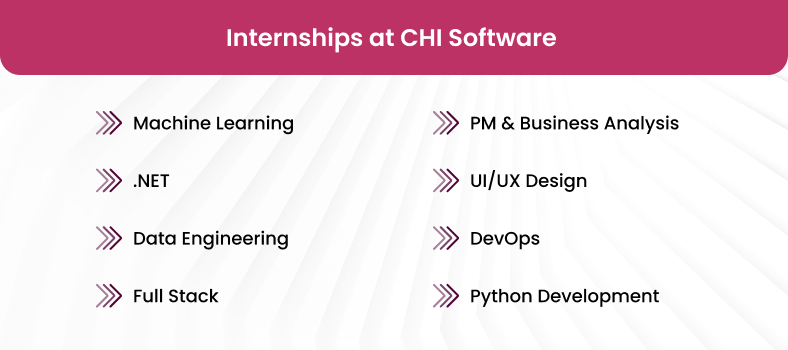
Internships at CHI Software are carefully designed six-month programs that combine theory, mentorship, and practical work. In 2024–2025, the company received 2,257 applications and accepted 39 interns, representing eight specializations:
The internship journey has two phases:
Department Internship (3 months): Each intern joins a real technical department and is guided by a dedicated mentor who tracks progress, reviews tasks, and provides detailed feedback.
Global Internship Project (3 months): Interns unite across departments (PMs, BAs, Designers, Developers, QAs) to build a full-cycle product under a Project Manager. They follow all Scrum ceremonies, conduct daily stand-ups in English, and present their demo at the end of the program.
The result is a fully simulated commercial experience where interns learn how to build projects in real life: how to communicate across roles, manage sprints, and meet deadlines without losing quality. Many describe it as a “safe copy of the professional world,” where they can experiment and grow without fear.
For CHI Software, these internships are an act of community building. Every intern who joins the company (or leaves with stronger skills) expands the collective knowledge base of the Ukrainian and global tech market.
Throughout the year, CHI Software experts participated in over a dozen lectures, workshops, and joint academic projects. These sessions connected hundreds of students with practitioners who speak the same language they aspire to master.
Workshop on DevOps, delivered by a CHI engineer for students of Kharkiv National University of Radio Electronics (HNURE) and other partner institutions.
A selective course in Mobile Development held from September to November 2024 at Poltava Polytechnic named after Kondratyuk, featuring 13 lectures and 10 practical assignments for 25 students (lecturer A. Pasarar, mentor P. Paronikyan).
Collaboration with Lviv IT Cluster and university academic commissions to update programs in Applied Mathematics and Computer Science, including participation in stakeholder and accreditation groups.
These events bring tangible results: students get direct access to current industry standards, while universities strengthen their academic programs through real-world input. CHI Software has also taken part in accreditation processes and co-authored recommendation letters for educational programs — a rare CSR contribution that shapes education policy from the inside out.
“We see university cooperation as a two-way street,” says Anna Tykhomyrova, Education Office Lead. “Students learn from us, but we also learn from their freshness, questions, and courage to think differently.”
Learning Through Play: Team Projects and Internal Education
Education at CHI Software doesn’t end with formal programs. Inside the company, we encourage experimentation, fun, and collective creativity. Two of our most memorable team competitions of 2024–2025 were called “Error 404: Comfort Zone Not Found” and “Spooky Scary Interface Quest”.
In the first project, teams were challenged to design a demo product from scratch in just a month, taking on new roles and recreating the energy of a startup sprint.
In the second, participants had to build a Halloween-themed application that was intentionally awkward in its design yet fully functional. The idea was to teach engineers and designers how to break patterns intentionally — an important lesson in user experience and creative thinking.
Behind the humor and the names, these projects carry serious educational value. They allow employees to experiment without risk, test new technologies, and discover how cross-departmental communication works in practice. For HR and mentorship teams, it’s also a way to identify emerging leaders and potential mentors for future courses.
Growing Expertise from Within
Continuous learning is part of CHI Software’s DNA. Through the Internal Education Program, our team members refine their skills, explore new technologies, and align with the company’s strategic directions. In 2024–2025, more than 500 employees participated in courses and workshops organized by the CHI Education Office.
The internal curriculum covers everything from software architecture and quality assurance to cybersecurity and artificial intelligence. Among the highlights were the Full Stack (Node.js) and AQA Python courses, AI Coding workshops, and the Pre-Sales Lead Cycle program — a new initiative that helps Lead Engineers master client communication and proposal design.
Compliance and digital ethics remained a priority, with sessions on GDPR and Data Protection and a Cybersecurity Webinar that addressed practical steps for a safer digital workspace.
AI education gained particular momentum. Employees joined hands-on sessions on AI Prompting Frameworks, AI Avatar Development, LLM App Development, and 3D Face Reconstruction, turning curiosity into applied innovation.
The impact goes beyond numbers. Internal education connects teams across departments, creates shared technical standards, and inspires senior engineers to take on the role of mentors and trainers. Through these programs, CHI Software builds an environment where professional growth is constant and collective expertise becomes one of our strongest assets.
Conclusion
Looking back at 2024–2025, we see not separate projects but a continuous movement: from education to ethics, from individual skill to collective awareness. FutureCode and the CHI Education Office grew in different directions yet share one goal — to make technology serve people with clarity and care.
Our team continues to act as both a developer and a teacher, sharing expertise openly and mentoring new professionals. This work is steady and human — it builds trust in technology and strengthens the communities around us.
In the year ahead, we’ll keep expanding these efforts, deepening AI education, and creating more open materials that help others act responsibly in the digital space. For CHI Software, social responsibility is a way of working: when people grow, innovation becomes sustainable.
Polina is a curious writer who strongly believes in the power of quality content. She loves telling stories about trending innovations and making them understandable for the reader. Her favorite subjects include AI, AR, VR, IoT, design, and management.
Two years ago, AI was something we were all figuring out collectively. Just a few days ago, we brought together 20+ tech leaders, founders, and CTOs at our Barcelona office to answer a crucial question: What comes after the experiments? Our closed-format session, “From AI Engineers to AI-Native Company,” was built around turning isolated AI tools into a core operational...
What Are AI Outsourcing Services? In a nutshell, AI outsourcing services involve outsourcing the development, integration, automation, data engineering, MLOps, and AI agent work to a third-party tech company rather than building these internally. You will notice this offered under multiple guises. Some brands will market this as AI development outsourcing services, others as AI software outsourcing, yet another 'outsource...
Two different people may hold the title of “engineer” and yet have virtually nothing in common. This discrepancy is the key to the forward deployed engineer versus software engineer conflict, and the subject is increasingly important given how AI and modernization initiatives are getting stuck. So, here’s a breakdown of exactly what roles own and share and why you should...
We use cookies to give you a more personalised and efficient online experience.
Read more. Cookies allow us to monitor site usage and performance, provide more relevant content, and develop new products. You can accept these cookies by clicking “Accept” or reject them by clicking “Reject”. For more information, please visit our Privacy Notice