Every CIO, CTO, and CEO eventually faces the same crossroads: the business is slowing, legacy systems are eating up the budget, and the board wants answers. Two paths appear on the whiteboard — digital transformation and digital modernization. They sound similar. They are not.
Picking the wrong one will result in a capital drain, increased time-to-market, and give your competitor an open door. This guide goes through each strategy, the circumstances in which to use them, and how to determine the correct choice.
Digital Transformation Vs Modernization At A Glance
Before diving deep, here is a fast side-by-side comparison across the dimensions that matter most to technical and economic buyers.
| Category |
Digital Modernization |
Digital Transformation |
| Goal |
Reduce technical debt, improve stability |
Reinvent how the business creates value |
| Scope |
Existing systems and infrastructure |
Business model, processes, and customer experience |
| Business impact |
Lower risk, measurable efficiency gains |
New revenue streams, market expansion |
| Delivery risk |
Moderate and contained |
High; requires organizational change |
| Budget profile |
Predictable, phased investment |
Larger, longer-horizon commitment |
| Timeline |
Months to 1–2 years per workstream |
2–5 years across the organization |
| AI readiness |
Unlocks AI/ML integrations |
Builds AI-native products and models |
McKinsey research links modernized platforms directly to stronger engineering productivity and better ROI from enterprise technology investments. In contrast, companies sitting in the bottom 20% by technical debt level are 40% more likely to have failed or abandoned IT modernization projects entirely.
Choosing between digital transformation and modernization is one of the most consequential decisions a business can make. The wrong path wastes budget, delays growth, and leaves competitive gaps wide open. Before committing to a direction, make sure your technology strategy is built on the right diagnosis.
Get a Free Digital Strategy Assessment
What Is Digital Transformation For Growth?
Digital transformation changes how the business creates value, not just the tools it uses to do so. It is a business-led change that reshapes operating models, customer experiences, revenue logic, and organizational structures. The technology stack is one component; it is not the outcome.
McKinsey connects AI-era budget pressure to exactly this point: companies that want to fund transformation must first simplify their technology and retire legacy systems. Transformation cannot run efficiently on a fragile foundation.
A Business-Led Change, Not Just A Tech Upgrade
Digital transformation begins with a strategic question, not a technology decision: Are we creating new value, or are we protecting existing value? If the answer is the former, transformation may be the right lever. Leaders in SaaS, FinTech, and enterprise software who face shifting customer expectations, competitive disruption, or new market opportunities are the typical drivers of transformation initiatives.
What Changes During Transformation
Transformation typically touches business processes, customer journey design, revenue and pricing models, organizational structure, and the role of data in decision-making. Technology enables these changes, but it does not define them. CEOs and COOs should own transformation decisions; CTOs and VP Engineers execute them. The misalignment between these layers is one of the most common reasons transformation programs fail.
What Is Digital Modernization For Lower Risk?
Digital modernization upgrades legacy systems, cloud infrastructure, architecture patterns, and delivery pipelines without necessarily changing the business model. Its purpose is to eliminate the drag that existing systems create, the technical debt that McKinsey estimates represents 20–40% of a technology asset’s value before depreciation.
Why Modernization Starts With Legacy
According to the 2024 SnapLogic research, 96% of enterprises rely on legacy technology in their technology stacks. On average, these legacy systems cost 2.9 million dollars a year to maintain – and at the same time, 65% of organizations now spend more than $2 million annually to support their legacy systems, double the number from 5 years prior. This is not a maintenance expense but a strategic burden in the minds of the CTO and VP of engineering, one that grows exponentially each quarter.
Many organizations facing these challenges look at proven legacy modernization examples before defining their strategy. With only around 32% of these legacy systems being capable of integration with AI, modernization is the enabling step towards AI implementation.
What Digital Modernization Includes
Digital modernization encompasses cloud migration, refactoring a monolithic codebase to microservices, adopting CI/CD pipelines and DevOps, strengthening the security posture and compliance with GDPR, NIS2, and SOC 2, and transforming the data architecture in line with current legacy modernization trends.
Key Differences Between Digital Transformation and Modernization
Understanding digital transformation vs IT modernization in the abstract is useful. Understanding it through the lens of scope, risk, and investment is actionable.

Scope: Lower-Risk Improvement Vs Reinvention
Modernization operates within the current business model. It improves how the business works today. Transformation redefines what the business is: the products it sells, the customers it serves, and the economics it operates under. Scope is the single most important dimension when choosing between the two approaches.
Business Model: Support The Current Model Vs Create New Value
Modernization preserves and strengthens existing revenue streams by enabling faster, cheaper, and more reliable delivery. Transformation creates new revenue streams, often by productizing capabilities that previously existed only as internal processes, or by entering markets that legacy architecture made inaccessible.
Technology Role: Stack Upgrade Vs Business Rethink
In modernization, technology is the primary subject of change. In transformation, technology is a vehicle for business change. This distinction matters enormously for how initiatives are governed, funded, and measured. Economic buyers, CEOs, CFOs, and COOs should understand which mode they are funding before approving a budget.
Change Management: Targeted Change Vs Enterprise-Wide Change
Change management for modernization needs to focus on team reskilling in tooling, meticulous data migration, and controlled deployment risk. Change management for transformation must encompass the whole enterprise, with new job roles, new workflows, new incentives, and strong executive sponsorship. The DORA 2025 study (5,000 survey responses) supports the conclusion that solid technical foundations are the deciding factor in whether AI-era delivery gains yield value or further chaos. Transformation without foundation is one of the costliest blunders in enterprise technology.
Timeline, Budget, and Delivery Risk
The timelines for modernization are typically measured in months per workstream, with phased budgets and milestone-based delivery. Structured modernization improves deployment frequency and reduces change failure rate, strengthening DORA metrics before broader transformation begins. Transformation programs span years, require greater investment, and offer higher upside with greater risk, while modernization delivers a more predictable ROI.
Technical debt that slows delivery cycles is a strategic liability. We work with CTOs and VP Engineers to modernize legacy codebases, migrate to cloud-based infrastructure, and build delivery foundations that support scale and eliminate the cost of repeated rework.
Talk to Our Engineering Team
When To Choose Digital Modernization
Modernization is the right path when the business model is sound, but technology is creating operational drag, compliance exposure, or growth blockers.
Stable Core Systems Still Hold You Back
If your engineers spend more than 25% of their sprint capacity on maintenance, patching, and firefighting, you are experiencing technical debt as a strategic problem, not a technical one. McKinsey’s research shows that companies actively managing technical debt can free up to 50% more engineering time for business-facing work.
Need Lower Risk And Faster Gains
Modernization allows less disruption to operations for those who cannot afford large operational impacts, regulated industries, companies on the eve of M&A, and those halfway through their current financing rounds. Blue/Green deployments, Canary releases, and Feature Toggles enable you to move business-critical systems while maintaining 99.9% uptime.
Need Better Performance, Security, or Scale
If the issue is infrastructure performance, security posture, or the inability to pass Enterprise security reviews, modernization is the appropriate response. Compliance-by-design architecture, building GDPR, NIS2, or HIPAA alignment into the system from the start, is a modernization outcome that unlocks new markets and larger deal sizes, without requiring a full business model change.
When To Choose Digital Transformation
Transformation is the right investment when the existing business model is structurally strained, or when growth depends on capacity that cannot be built within the existing architecture.
Market Customers or Revenue Model Is Changing
Transformation may be required if customer expectations have changed, the nature of competition is shifting, or regulation is imposing new limitations on business operations. This is particularly applicable in FinTech, HealthTech, and EdTech, where market structures are being established at a pace that legacy platforms cannot keep up with.
Need New Digital Products or Experiences
New digital products, AI-native features, data products, embedded finance capabilities, or personalized customer journeys will usually require a transformation-level investment: they cannot be “patched” onto the existing infrastructure. A new architecture is needed, new data models, and, most likely, new organizational skills.
Solving A Strategic, Not Technical, Problem
The clearest signal that transformation is required: the leadership team is debating the future of the business model, not the performance of the technology stack. When the problem is strategic- entering a new market, defending against a disruptive competitor, or building a new revenue category- the solution needs to match that scope.
Navigating the line between transformation and modernization can be complex. Our team helps CIOs map the right path, from legacy systems audit to a prioritized digital roadmap, so technology strategy aligns with long-term growth goals.
Book a Free Digital Strategy Call
Can A Business Do Both?
Yes, but CIOs must balance run vs. change: operational stability and business transformation. The key is sequencing and governance.
The Hybrid Path: Modernize, Then Transform
The most defensible pattern is to modernize first: reduce technical debt, migrate to cloud-based infrastructure, and establish reliable delivery foundations, following a structured application modernization roadmap. Then use those foundations to accelerate transformation. DORA’s platform engineering research supports this approach directly — stronger delivery foundations make larger transformation moves safer, faster, and more scalable.
Run Both In Parallel
For larger organizations with distinct business units, running modernization and transformation in parallel is viable, provided they are governed as separate programs with separate budgets, teams, and success metrics. Treating them as a single initiative is where parallel execution typically breaks down.
Avoid Overlap, Budget Drift, and Rework
Hybrid approach, most frequent failure mode: the transformation team builds on the system where the modernization team is migrating at the same time. Rework, overrun, and unstable delivery. The architectural decision record clearly stated, with visibility into the roadmap for both programs.
A Decision Framework For ROI And Risk
McKinsey links modernization choices directly to enterprise ROI: organizations that retire legacy drag before funding transformation consistently outperform those that skip the sequencing step. Well-executed modernization programs also commonly deliver 30–50% lower IT maintenance costs, ROI within 12–18 months, and measurable EBITDA gains within the first year.
Ask These Questions Before You Choose
Before committing to either path, leadership should work through five diagnostic questions.
- What problem are you really solving?
Slow delivery and high maintenance costs point to the need for modernization. Inability to compete on new dimensions of value points to the need for transformation.
- Are you improving the current business or changing how it works?
Modernization improves business operations and efficiency without redesigning how value is created. Transformation redefines business processes, customer experience, and often the organization itself.
- How much change, risk, and investment can you realistically support?
Be honest about organizational readiness. DORA 2025 is unambiguous: AI and transformation amplify existing strengths; they also amplify existing weaknesses. Teams without strong DevOps and delivery foundations get more instability, not less, when they attempt large-scale change.
Understanding the difference between transformation and modernization is only half the equation. The other half is knowing which path delivers the right ROI for your specific risk profile, market position, and operational maturity. A structured decision framework removes the guesswork and gives leadership a clear, defensible path forward.
Get a Free ROI and Risk Assessment
Modernization And Transformation Example Scenarios
Regional bank on aging core infrastructure
The ESAs’ 2026 Work Programme prioritizes digital operational resilience and ICT third-party oversight, making legacy core systems with undocumented vendor dependencies a board-level compliance issue. The right move is modernization: cloud-based infrastructure, reduced third-party concentration risk, and documented ICT controls. The business model remains intact, but the risk profile drops.
InsurTech platform losing market share
The core system works. The business model doesn’t. New distribution channels require an API-first architecture the current stack cannot support. Modernizing existing systems extends their life but doesn’t open new revenue streams. This is a transformation problem.
Mid-market manufacturer adding IoT
Operations need to support new data volumes and real-time performance monitoring, not a new business model. Modernization delivers this. Transformation would introduce unnecessary organizational change for a fundamentally operational problem.
PE-backed healthcare group post-acquisition
The CFO needs unified operations across three entities running different systems. Modernization, consolidating onto a single cloud-based platform with standardized business processes, is the correct path. Transformation is a separate, longer-horizon program that cannot safely run in parallel with integration.
Common Mistakes In Transformation And Modernization
Treating Modernization As Full Transformation
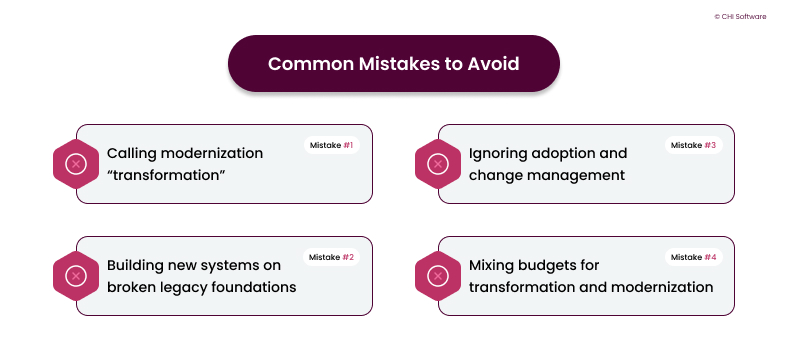
Replatforming a monolith to microservices is modernization — it is not transformation. Calling it a transformation creates misaligned executive expectations, inflated business cases, and the wrong governance model. Label initiatives accurately from the start.
Starting Transformation On Top Of Broken Legacy
Transformation programs that attempt to build new business capabilities on top of unstable, high-debt legacy systems consistently underdeliver. GitClear’s analysis of 211 million lines of code found that AI-assisted development in 2024 produced 8x more duplicated code blocks compared to prior years — without structured review processes, new development accelerates the accumulation of technical debt, not its reduction. Fix the foundation before building the future on top of it.
Focusing On Technology Without Adoption
Both modernization and transformation fail when adoption is treated as an afterthought. New cloud infrastructure that engineers do not trust to deploy on, or new digital products that customers do not use, deliver zero business value regardless of technical quality. Change management is not a soft skill in this context; it is a delivery requirement.
Underestimating Change Management
You cannot achieve transformation at the enterprise level without executive sponsorship, accountability for change, and consistent communication. The Anthropic Code Modernization Playbook is crystal clear on this: “The most frequently occurring reason for modernization to fail is not lack of appropriate technology: it is lack of strategic thinking, and a lack of realistic, truthful readiness evaluation of the organization.”
Final Takeaway: Modernization and Transformation Are Not Competitors
If leadership teams want to change the way they think about Modernization and Transformation, the one reframe that’s critical is this: they’re not a choice. They are different, and consecutive, layers of the same strategic capability-building.
Modernization lays the reliable, performant, AI-ready bedrock that Transformation requires. Transformation builds business value that justifies the investment in Modernization. The two DORA and GitClear research reports offer a convergent practical recommendation to tech leaders: A strong foundation yields great outcomes; a poor foundation exponentially increases the risk in both delivery and code quality – irrespective of how transformative the underlying strategy may be.
It’s not the business that takes the most ambitious path that ultimately triumphs. It’s the one that takes the path that’s right for them, at the right time, with the right partner.
FAQs
-
Is digital modernization part of digital transformation?

Digital modernization will enable transformation, but it's not the same. Modernization is updating current systems and infrastructure; transformation is about changing the way the business adds value. Many transformation journeys start with modernization.
-
What is the main difference between digital transformation and modernization?
Modernization involves improving existing systems and minimizing technical debt by upgrading and migrating to the cloud. Transformation affects the business model, customer experience, and value generation. Modernization gives results more rapidly and with less risk. Transformation is broader in scope.
-
Which is less risky: digital transformation or modernization?
Digital modernization has lower delivery risk. It can be executed in workstreams and delivers results in months. Digital transformation requires enterprise-wide change over the years and full executive alignment. For predictable outcomes, modernization is the safer first step.
About the author
Yana oversees relationships between departments and defines strategies to achieve company goals. She focuses on project planning, coordinating the IT project lifecycle, and leading the development process. In their role, she ensures accurate risk assessment and management, with business analysis playing a key part in proposals and contract negotiations.
Rate this article
27 ratings, average: 4.8 out of 5