Even in 2026, most companies still run their core systems with old-school monolithic architecture. For years, that actually made sense — it’s easier to manage everything in one place, and deploying changes used to be pretty straightforward. But once these systems start to grow, things get messy fast.
Releases drag on forever, scaling turns into a headache, and the cost of fixing bugs keeps climbing. Even simple updates can stretch out for weeks, bringing onboarding and innovation pretty much to a crawl. No wonder so many organizations are making the switch to microservices.
Gartner Research says around 74% are already using microservices architecture, and another 23% are gearing up for it. So, here’s what you can expect — we’re breaking down a practical, hands-on playbook for moving from monolithic to microservices, all based on real challenges and lessons we’ve seen.
What Is a Monolithic Architecture?
Monolithic architecture pulls everything — business logic, data access, user interface, and technical stuff — into one big package. The whole application runs from a single codebase, taps into the same database, and all the parts are pretty tightly linked together.
Whenever you want to make a change, you have to rebuild and redeploy the entire thing. You still see monolithic setups all over big companies, especially where legacy systems and critical business jobs are involved.
Think about ERP giants like SAP, which roll finance, HR, and supply chain into one massive platform. Then there are banking systems that handle accounts, transactions, and reporting all in the same monolithic structure. Even those enterprise portals — where HR, IT support, and collaboration tools live—are often bundled as one solid monolithic app.
Why Monoliths Were the Standard for Years
Monolithic architecture really speeds up development since you’re working with a single codebase. Everything sits together, which makes managing rules, security, and audits way simpler — you’re dealing with one big monolithic system, not a patchwork of multiple services.
That simplicity had real value, and for certain systems, such as internal tools, early-stage products, and greenfield development, it still does.
Why Enterprises Are Moving Toward Microservices
The path from monolith to microservices is driven by both business and technical forces. Understanding both is essential before committing to a microservices architecture implementation strategy.
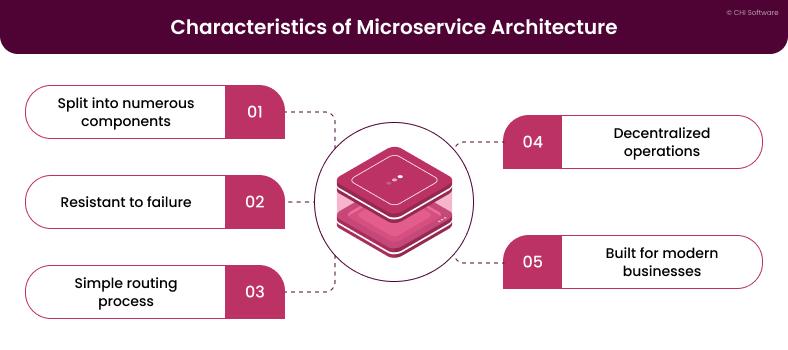
Business Drivers Behind Migration
Modern business demands agility. The ability to ship new features without disrupting core operations is now a competitive requirement.
Key business drivers include:
Get products out faster. With a microservices-based architecture, teams can roll out new features or updates independently, without waiting for the entire application to be rebuilt.
You also get smoother integration. Every service comes with its own deployment pipeline, so continuous integration just works better and feels way more manageable.
Want to experiment? Go for it. Teams can test, tweak, or even roll back new features without messing up other parts of the system. It keeps things safe and separate.
Switching from a monolithic setup to microservices helps companies move more quickly and adapt more easily to whatever modern business demands next. It’s a big part of digital transformation.
Technical Drivers Behind Migration
Microservices are just better at targeted performance boosts. If one part of your app blows up with traffic, scale only that part; there’s no need to go big on everything else.
Also, you’re not locked into one language or tool either. Teams can pick whatever programming language or technology fits best for each service.
And if you’re stuck with old code, switching from a monolith to microservices lets you modernize gradually. No need to tear it all down and start from scratch — you can update things bit by bit.
Signs Your Monolith Is Holding the Business Back
Before you jump into migrating, it’s good to really ask yourself: Is the monolithic setup actually holding your business back?
Here’s how you can tell:
If your releases drag on for weeks, sometimes months, because every deployment needs tons of coordination and full-system tests, that’s a big warning sign.
When even a tiny update means rebuilding and redeploying the entire application, things get frustrating fast.
Bringing new developers on board feels like a slog. They spend months just figuring out the monolithic database and all technical components before they can actually contribute.
Scaling isn’t efficient either. Say one part of the entire system gets hit with heavy traffic — suddenly, you have to scale everything, and your cloud costs shoot up.
You’ll notice dependencies get messy. Change something over here, and something totally unrelated breaks over there. That unpredictability wastes time and energy.
And if your team keeps running into bottlenecks — sharing code, dealing with merge conflicts, and constantly coordinating — progress slows down for everyone.
Monolith vs. Microservices: Key Architectural Differences
Understanding the architectural differences between monolithic and microservices approaches helps development teams make informed decisions and set realistic expectations.
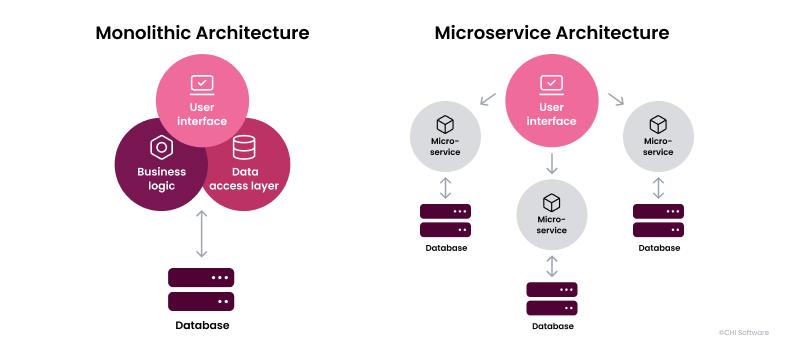
Deployment: Changing anything in a monolith usually means you have to redeploy the whole thing, even for a tiny update. With microservices, teams just push updates for the service they care about. No need to touch the rest.
Scalability: If one feature in a monolith gets slammed, you have to scale the entire app. Microservices make it easier—you only scale the parts that need it and leave everything else alone.
Team ownership: When you work with a monolith, everyone ends up sharing the same giant codebase. Microservices break things up so each team owns its service. There’s more clarity, more autonomy, and people actually get to share what they know.
Data management: Monoliths usually stick with one shared database. It works—until it doesn’t. Microservices split things up, so each service handles its own data. That keeps things independent, but yeah, connecting all those pieces gets tricky.
Fault isolation: Monoliths are risky. One bad deployment can bring the whole thing down. With microservices, if a service fails, the rest keep going. The trouble stays put.
The Risks of Migrating Too Fast
Microservices definitely fix some big headaches, but they’re not a magic bullet. Once you move away from monolithic architecture, you’ve got a whole bunch of new challenges that you can’t ignore.
First off, splitting everything into different services means you’re dealing with complicated interactions—stuff you never had to worry about with a single monolithic app.
Every service now needs its own deployment setup, automated tests, and monitoring. If your DevOps isn’t strong, all this extra work can turn into a nightmare fast.
Data gets tricky, too. With monoliths, everything’s in one database, so keeping it consistent isn’t too hard. With microservices, making sure data stays in sync across all those services is a much bigger pain.
And don’t forget the cost. Running lots of separate services means higher bills for cloud infrastructure and more spending on orchestration tools.
Honestly, if your team isn’t already good with automated testing, continuous deployment, containers, and orchestration, the move to microservices will be rough—even if your service architecture looks perfect on paper.
A Practical Migration Playbook: Step-by-Step
Enterprises rarely perform a complete monolith-to-microservices rewrite. The most successful migrations from monolith to microservices happen incrementally, extracting one service at a time while keeping the existing monolith running in production.
Here is a proven step-by-step framework.
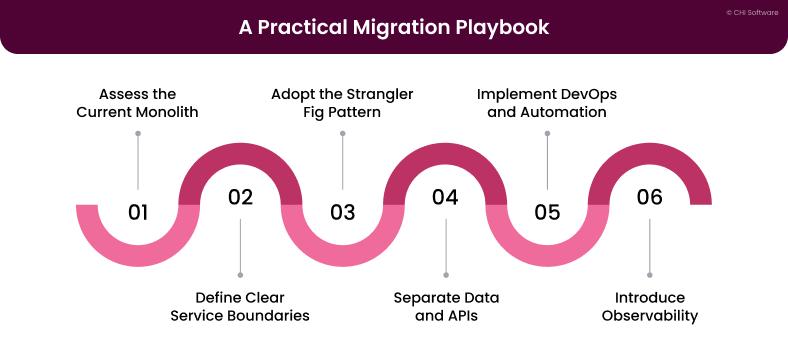
Step 1: Assess the Current Monolith
Start by digging into your codebase. Look for spots where you could split services, check how everything’s connected, and figure out which parts get updated the most.
After that, follow the trail of your data stores. Who’s sharing them? Which modules poke at which tables, reading or writing? If you miss something here, it can come back to haunt you.
As you go, flag cross-cutting concerns like logging, authentication, and configuration. These touch every part of your system and need extra attention if you switch to microservices.
Wrap up by checking performance. Services that use a lot of resources or have unique traffic spikes are usually good picks to carve out first.
Step 2: Define Clear Service Boundaries
Service boundaries are the most consequential decisions in any migration. Get them wrong, and you end up with microservice applications more tightly coupled than the monolith you started with.
Use Domain-Driven Design to identify domain boundaries, where a team owns a complete single business capability. Services should map to business functions such as “Order Management” or “Customer Profile,” not to technical layers.
Give each team total ownership of a service, not just a slice.
Step 3: Adopt the Strangler Fig Pattern
The Strangler Fig Pattern is the most widely proven approach for a successful technical migration from monolithic to microservices without a complete rewrite.
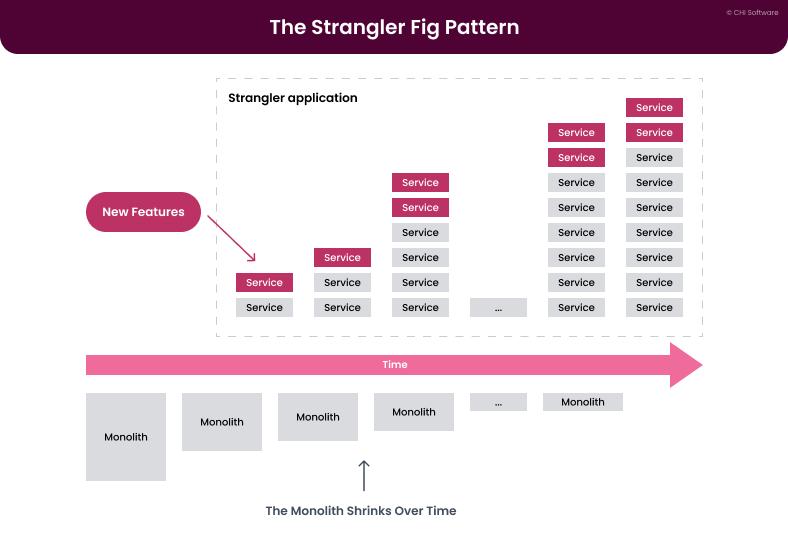
Add a new microservices architecture alongside the old monolith, then gradually route traffic from the monolith to the new services. Choose something simple as your first extract, something with clear boundaries and minimum dependencies.
The monolithic application keeps running while you peel away a new part, and eventually sunset old code.
Step 4: Separate Data and APIs
Shared data stores tightly couple components. Each service should own a service-specific database and communicate with other services via an API gateway.
For asynchronous communication, event-driven architectures are key. Services publish events when data changes, and others subscribe via message queues or event streams (like Kafka).
Process keeps loosely coupled services resilient and independent, and avoids complex transactional boundaries spanning a single database.
Step 5: Implement DevOps and Automation
As the number of services grows, automation ceases to be a best practice and becomes a hard requirement. All services need their own independently deployable CI/CD pipeline
Containerization with Docker gives each service a consistent, portable runtime environment. Kubernetes handles the rest: orchestrating deployments, managing scaling, and keeping services running across infrastructure.
Step 6: Introduce Observability
A growing web of services means tracking down issues gets way harder. Set up observability from the start and centralize logs.
Use distributed tracing to track requests as they hop across services. Monitor metrics for early warning signs — latency spikes, errors, or unexpected behaviour.
Common Migration Pitfalls (And How to Avoid Them)
Too many services, too quickly? Start broad: break off the legacy monolith into larger chunks, split further only when things are running smoothly.
Ignoring how transactions work? You’ll find data consistency isn’t automatic anymore. Plan how to keep things in sync in overall system.
Skipping integration testing? Sooner or later, things will break, usually for your users. Do continuous integration testing to see how services work together, not just in isolation.
Service ownership unclear? Microservices fall apart just as fast as monoliths if nobody’s in charge. Every service needs a team that owns every piece of it, from the deployment pipeline to production incidents.
Letting teams silo off? Don’t lose track of knowledge sharing, so make documentation and standards a habit, or things get fragmented fast.
Tools and Technologies That Support Microservices Migration
To manage the complexity of microservices architecture, enterprises rely on specific categories of tools. These technologies facilitate the transition from monolith to microservices by automating the migration process.
Containerization Platforms: Docker and Kubernetes are the foundation of microservices deployment. They allow services to be independently deployable and portable across any technology stack.
API Gateways: An API gateway acts as a single entry point, managing service-to-service communication, authentication, and request routing between the existing monolith and new service instances.
Service Meshes: Tools like Istio provide a dedicated infrastructure layer for service discovery, security, and observability, simplifying how different services talk to each other.
Event Streaming Platforms: For loosely coupled services, platforms like Kafka or RabbitMQ enable asynchronous communication via messaging queues, ensuring individual services don’t depend on each other’s availability.
Observability Tools: To debug distributed systems, you need monitoring solutions that provide distributed tracing and centralized logging, tracking requests as they move through other components.
Real-World Enterprise Migration Example
A compelling example of a successful migration strategy is the modernization of a US-based oncology decision support platform.
One of our clients—a US-based oncology decision support company—had a stable platform built over six years. But the monolith just wouldn’t scale anymore. Each new integration brought new data formats and headaches, turning simple workflows into slow, messy processes.
We helped migrate their legacy core to microservices, carefully extracting key business functions while maintaining compatibility with the old monolith. The end result? Decisions were made 40% faster, and the system scaled 25% better, all while clinical operations kept humming.
Is Microservices Migration Worth It for Every Enterprise?
Before committing to a monolithic to microservices transition, you must decide whether it aligns with your business capabilities. Staying with a modular monolith might be better if:
- You have smaller development teams overwhelmed by service overhead.
- Your legacy systems are stable and don’t require frequent new features.
- You have limited DevOps maturity and lack an automated testing culture.
Strategic decisions should be based on business logic, not trends. Sometimes, refining the monolithic system is a more cost-effective migration effort.
Modernizing Enterprise Architecture Without Disruption
Monolithic to microservices modernization is as much about strategy and culture as it is about technology.
- Migration should be gradual: Use an incremental approach to ensure minimal disruption.
- Backward Compatibility is essential: Ensure the new service maintains backward compatibility with the existing system to avoid a “big bang” failure.
- Architecture must align with goals: Your service boundaries must reflect your business capabilities.
If you’re feeling stuck or just want to know where to start, partnering with a team that’s been there helps. We’ve walked through these migrations, from first assessment through extracting the service boundaries.
About the author
Ivan keeps a close eye on all engineering projects at CHI Software, making sure everything runs smoothly. The team performs at their best and always meets their deadlines under his watchful leadership. He creates a workplace where excellence and innovation thrive.
Rate this article
28 ratings, average: 4.81 out of 5