Are you wondering how much it’ll cost to add a chatbot solution to your business? You’re not alone. As AI gets more competent, more companies are thinking about jumping on the chatbot bandwagon to boost their customer service and streamline operations. But let’s face it – chatbot development costs can be as clear as mud.
Whether you’re a tech whiz or a business guru, figuring out the bottom line for chatbot development services isn’t always straightforward. Don’t sweat it, though. We’ve done the legwork and rounded up real-world examples to give you the scoop on AI chatbot budgets. Ready to see how the numbers stack up for your industry? Let’s demystify chatbot development budgets together.
Article Highlights:
- AI chatbot development is now accessible to any business with ChatGPT integration services. You can add ChatGPT features without customization for USD 2,000;
- CHI Software has developed two chatbot budgeting options for our clients – basic and customized. The basic chatbot option would cost you around USD 3,000;
- When talking to different vendors, you should keep in mind that there could be hidden costs, such as additional optimization, continuous support, third-party tools, and more;
- Don’t hesitate to ask development specialists about the techniques they intend to use for reducing chatbot development costs. At CHI Software, we pay special attention to efficient project management, productive communication with clients, and reusable development tools.
Chatbot Pricing Models with Examples
This section explains real-world examples of average chatbot prices to help you determine the best fit for your organization.
| Pricing Model |
Pros |
Cons |
| Pay per use |
- Cost efficiency
- Scalability
- Flexibility
|
- Unpredictable costs
- Limited features
- Inconsistent expenses
|
| Subscription |
- Predictable costs
- All-inclusive features
- Scalability
|
- Unused capacity
- Inflexibility
- Contract commitment
|
| Hybrid |
- Cost control
- Scalable for varying usage
- More tailored pricing
|
- Complexity
- Unexpected costs
- Potential overpayment
|
| Custom development |
- Tailored solution
- Ownership and control
- Long-term investment
|
- Possible high upfront cost
- Development time
- Ongoing maintenance
|
Pay-Per-Use Model
One of the most flexible options is the pay-per-use model. This approach allows you to pay based on the actual usage of your chatbot, which can be particularly beneficial for businesses with fluctuating demand.
For instance, a mid-sized e-commerce company might opt for this model, paying USD 0.0025 per message exchanged. During peak seasons like Black Friday, the chatbot might see 100,000 interactions, adding up to a cost of USD 250 for that period. In slower months, with only 20,000 interactions, the cost would drop to USD 50.
Top Chatbot Use Cases for Different Industries
Read more
Subscription-Based Model
Many chatbot providers offer subscription-based pricing, which can be an excellent choice for businesses seeking predictable costs. This chatbot pricing model typically includes different tiers based on features and usage limits.
Consider a healthcare provider implementing an AI chatbot for handling patient inquiries. They might choose a plan costing USD 500 per month, allowing up to 50,000 interactions. This fixed cost helps with budgeting and provides access to advanced features like multi-language support and integration with electronic health records.
Hybrid Models
Some providers offer hybrid chatbot prices, combining elements of subscription and pay-per-use. This option can be ideal for businesses looking for a balance between predictability and flexibility.
Imagine a travel agency using a chatbot for booking inquiries. They might pay a monthly base subscription of USD 200 for core features and an additional USD 0.01 per interaction beyond a fixed limit. This mix allows them to handle routine volume efficiently while accommodating seasonal spikes without breaking the bank.
Custom Chatbot Development vs. Ready-Made Assistants: Pros and Cons for Businesses
Read more
Custom Development Pricing
For businesses with unique requirements, custom AI assistant development services might be the way to go. In this case, the cost to build a chatbot depends on complexity and the number of features.
A large financial enterprise, for example, might invest in a custom AI chatbot to handle customer service and transactions. The initial development could cost anywhere from USD 30,000 to USD 50,000, depending on which AI and machine learning algorithms are used, security features, and integration with existing systems.
Yet, CHI Software’s practice shows that chatbot implementation with no regular fees is accessible to businesses of any size. For example, a simple ChatGPT (OpenAI API) integration may cost you USD 2,000, and that’s it.
The philosophy behind our work is to prove that modern AI features should be accessible to everyone. Sure, more complex features will cost you more money, but you can get started small and still offer your customers a great experience with the help of our ChatGPT developers. You may be surprised to learn that it’s possible to do it in just a couple of weeks!
With this chatbot pricing comparison, you can make an informed decision about a chatbot platform or team of experts, aligning with your goals and budget. Whenever looking at ready-made chatbot options or comparing different development providers, always consider your chatbot implementation’s long-term value and potential ROI.
Factors That Influence AI Chatbot Pricing
When considering chatbot creation, several crucial factors come into play. Understanding these elements is key to answering the question, “how much does it cost to implement a chatbot?” This knowledge can help you estimate the potential investment and make informed decisions about your chatbot implementation.
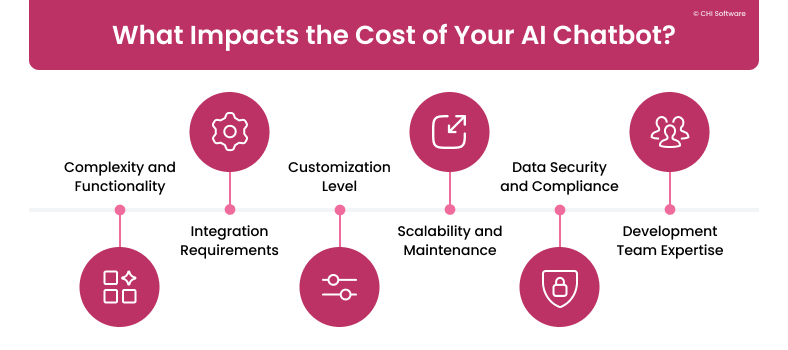
The most important factors that impact the chatbot’s cost
Complexity and Functionality
A simple rule-based chatbot that answers basic queries is typically much more affordable than an AI-powered assistant for business-specific tasks. The latter can understand context, interpret natural language, and support more advanced use cases for ChatGPT, such as personalized recommendations or smart workflow handling, which naturally increases the overall development cost.
When it comes to chatbots cost, the more advanced features you want the bigger budget you should be ready to invest. Your estimated expenses will also depend on the framework used and how well it fits your overall system architecture.
Integration Requirements
Your existing tech stack plays a crucial role in determining custom chatbot pricing. Integrating chatbots for workplace support with various systems like your CRM, payment gateways, or inventory management software will likely increase the development time and cost.
AI Chatbots for Sales: How AI Assistants Boost Conversion
Read more
Customization Level
Off-the-shelf solutions are generally cheaper but may not meet your specific needs. On the other hand, custom-built chatbots tailored to your brand voice and unique business processes will push up the price. The level of customization required can significantly impact the final budget.
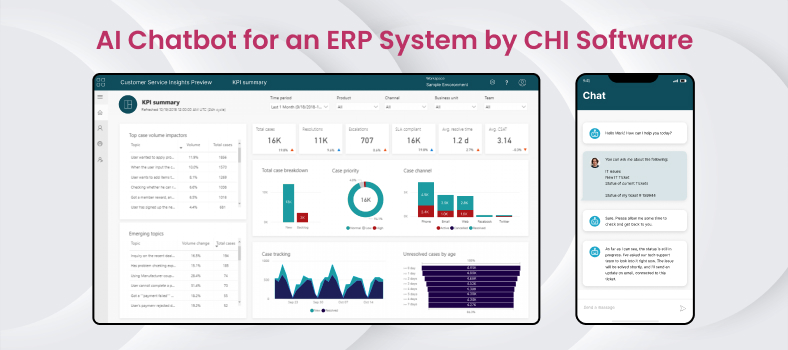
We built this chatbot to help our client optimize internal operations.
Check out more about this chatbot case study via the link.
Scalability and Maintenance
Consider not just the initial chatbot development costs, but also ongoing expenses. As your business grows, you’ll want a chatbot that can handle increased traffic without performance issues.
Regular updates and maintenance are crucial for keeping your system relevant and effective. Keep in mind that support and upgrade rates may vary depending on your provider and the complexity of your chatbot solution.
Data Security and Compliance
If your solution handles sensitive customer information, you need to invest in robust AI chatbot security. Compliance with regulations like GDPR or HIPAA can add to the cost of a chatbot, but this investment is crucial for protecting your customers and your business reputation.
Working with skilled specialists during the discovery phase can help you identify potential risks early and build a solution that meets all necessary compliance standards.
Development Team Expertise
The skill level and location of your development team can significantly influence the cost of AI chatbots. Hiring a top-tier vendor will be more expensive than working with a junior developer or using DIY platforms. Naturally, experienced engineers can create more efficient solutions that provide better long-term value.
Remember, while finding a solution that fits your budget is important, focusing solely on the cheapest option may not provide the best return on investment. Instead, aim for a balance between cost and quality to achieve your goals faster, without wasting your time and money on a sub-par solution.
Hidden Costs in Chatbot Development
How much does it cost to develop a chatbot? Many businesses focus solely on the initial implementation expenses when answering this question. However, several hidden costs can significantly impact the overall chatbot software pricing. Let’s dive into these often-overlooked aspects.
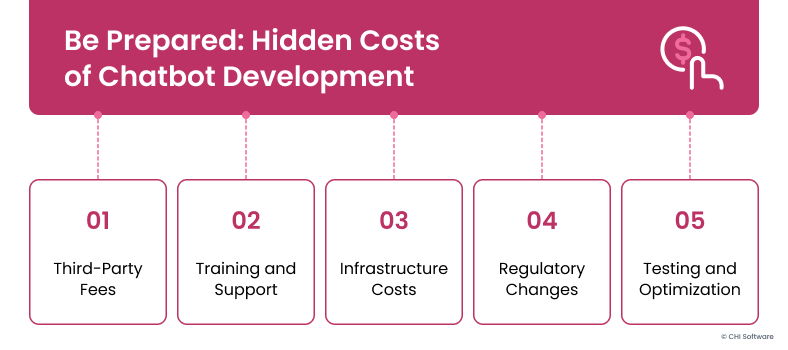
What they don’t tell you about AI chatbot pricing
Third-Party Fees
A wide variety of tools can be used in generative AI development services, such as natural language processing services (IBM Watson or Dialogflow), analytics tools (Google Analytics or Mixpanel), or integration platforms like Zapier.
Some tools may have usage limits that, when exceeded, result in additional charges. Moreover, integrating these tools with the chatbot may require customization, which can significantly impact the cost of building a chatbot due to added development efforts. Depending on the types of integrations and the complexity involved, even a single development hour can influence your final budget.
Training and Support
Training sessions for users to engage with the chatbot, address common queries, and provide technical support all contribute to the overall expense. Furthermore, continuous training and support become imperative as user interactions evolve, impacting the budget over time.
Infrastructure Costs
Hosting the chatbot on servers or through cloud-based services can often come with hidden expenses such as server maintenance, data storage fees, and bandwidth usage charges. These infrastructure costs can escalate significantly depending on your chatbot’s scale and complexity.
Building AI Chatbots for E-Commerce: What to Consider in 2025
Read more
Regulatory Changes
Staying compliant with privacy laws, such as GDPR or CCPA, requires continual monitoring and adjustments, which may necessitate chatbot architecture or process updates. Failing to address regulatory changes promptly can result in penalties or legal repercussions.
Testing and Optimization
A/B testing different chatbot functionalities, analyzing user feedback, and making iterative improvements are all smart ways to keep improving your business – but they can also involve hidden costs. These ongoing enhancements are often not reflected in standard chatbot agency pricing, yet they’re essential for maximizing your chatbot’s effectiveness.
Starting with an MVP and gradually expanding functionality allows for more control over your investment. Prioritizing these upgrades in the right order can also help you manage costs more strategically.
But you don’t need to worry about such pitfalls – CHI Software’s engineers are well versed in every scenario when it comes to expenses and can warn you about them. Here’s what we do to make budgeting crystal clear:
-
Conduct a detailed analysis of the project requirements upfront to identify all its potential features, integrations, and functionalities needed;
-
Choose a technology stack that aligns with the project’s requirements and scalability needs. Opting for well-supported and widely-used tools and frameworks often reduces the risk of unexpected costs;
-
Implement a robust testing and QA process throughout the development lifecycle to detect and address issues early on;
-
Maintain open communication channels with stakeholders, including clients, developers, designers, and end-users. Regular updates, feedback loops, and collaboration help address issues promptly and reduce the risk of costly misunderstandings or delays;
-
Design the chatbot with scalability in mind to accommodate future growth and changes in user demand. Building a flexible and extensible architecture can help avoid substantial reengineering costs as the chatbot evolves over time;
-
We make sure that the chatbot complies with relevant data privacy and security regulations to avoid potential fines or legal consequences.
Do you want to see more successful business stories before making the final decision? Just check our case studies!
Visit CHI's portfolio
How Much Does It Cost to Build a Chatbot with CHI Software?
Estimating AI app development costs can be tricky – especially with such a wide range of experimental and customization options available. Fortunately, we can guide you through every step of project estimation and development.
CHI Software has developed two AI chatbot pricing approaches that simplify estimation and decision-making for your team.
| Basic AI Assistant Features |
Customized AI Assistant Features |
| User management |
Extended AI assistant setup and training |
| Website setup and training |
Omnichannel interaction |
| Training using Word, Excel, PDF, and other document formats |
External data source integration |
| Response tracking |
2D and 3D avatars |
| Custom responses |
Integration with ERP and CRM systems |
| Process analysis |
Handling specific interaction scenarios |
| Branded design |
Support and maintenance |
| USD 3,000 |
USD 3,000+ |
Features of the Basic AI Chatbots Developed by CHI Software
- User management lets your chatbot keep track of who interacts with it. The tool can store information about users like their names, preferences, or previous conversations to provide a more personalized experience.
- Website setup and training involve configuring the initial chatbot and teaching it how to respond to different questions. During setup, a chatbot is given the rules, workflows, and information it needs to function correctly.
- Training using Word, Excel, PDF, and other document formats allows the chatbot to learn from existing documents, extract meaningful information, and use it to answer questions or provide support.
- Response tracking helps a chatbot monitor and record users’ answers or actions so that it can better understand user behavior and improve future interactions.
- Custom responses let a chatbot provide specific replies tailored to different questions or situations. Instead of giving generic answers, it can respond with more relevant or personalized information based on the user’s query.
- Process analysis involves analyzing how well the chatbot is performing by looking at its interactions. Your chatbot can review how many users it has helped, how long those conversations took, or whether the chatbot provided the correct answers.
- Branded design lets the chatbot match a company’s style with custom colors, logos, and design, ensuring it looks and feels consistent with the brand.
Finalized AI chatbot solutions with this feature set typically cost USD 3,000.
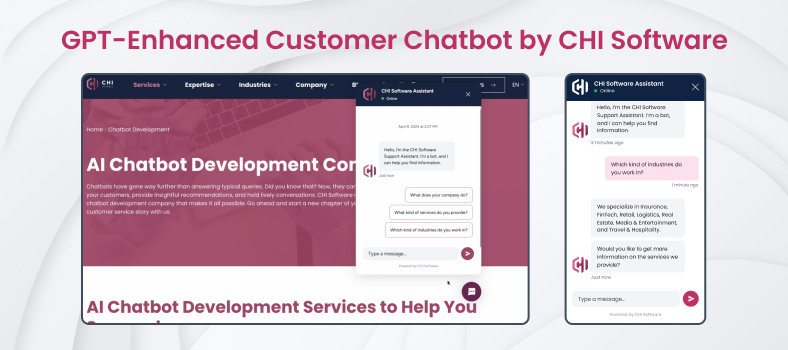
Such a chatbot can offer personalized recommendations and help customers with a wide range of queries.
Follow the link to find out more about this case study, our workflow, and implementation stage.
Features of the Customized AI Chatbots Developed by CHI Software
Our customized chatbots include all the basic features plus the following:
- Extended AI assistant setup and training involve an in-depth setup process, where an AI assistant is trained to handle complex tasks and learn specific functions tailored to your business needs;
- Omnichannel interaction means an AI assistant can communicate with users across multiple platforms, such as websites, mobile apps, social media, or messaging apps, providing a smooth experience no matter where the interaction occurs;
- With external data sources integration, a chatbot can pull in data from outside sources, like databases, online systems, or third-party services, to provide more informed and accurate responses;
- 2D and 3D avatars visually represent an AI assistant, giving it a more human-like appearance for a more engaging user experience;
- Integration with ERP and CRM systems helps you automate tasks and access important customer or business data;
- Handling specific interaction scenarios make conversations with a chatbot more targeted and efficient;
- Unlimited support and maintenance allow an AI assistant to run smoothly, with regular maintenance to fix issues and improve performance.
You can pick just one or several features from this list, making your chatbot even more helpful for every aspect of your daily workflow. Depending on the number of features and your individual requirements, the customized chatbot’s cost starts from USD 3,000.
How to Reduce the Cost of Chatbots [Based on Our Experience]
We’ve employed several strategies to keep the cost of chatbot implementation down, without sacrificing quality. All of our tips are tested with experience and can work for businesses of any size and industry.
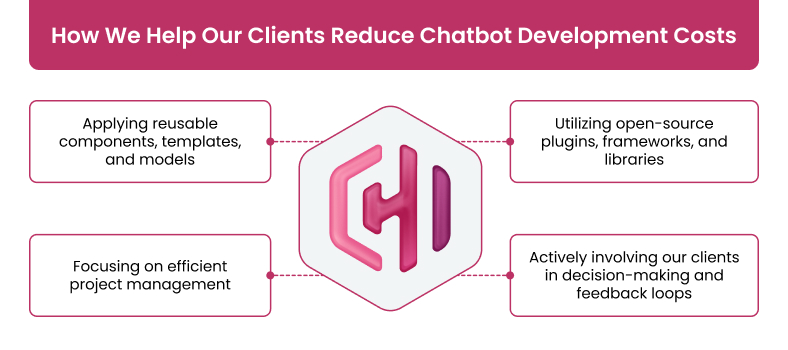
These techniques help us optimize the cost of our chatbot development services.
Applying Standardized Solutions
We build reusable components, templates, or modules that can be adapted for multiple projects. By leveraging standardized solutions, CHI Software can streamline the workflow and reduce the time and effort required for each new chatbot implementation.
Focusing on Efficient Project Management
We’ve put in work to implement efficient project management practices for optimizing resource allocation, minimizing idle time, and offering timely delivery. By improving project efficiency, CHI Software can reduce overhead costs and provide competitive chatbot development costs to all businesses, including yours.
From Generic to Specific: The Art of Training GPT to Suit Your Business
Read more
Utilizing Open-Source Tools
Our developers leverage open-source frameworks, libraries, and plugins to reduce development costs without compromising quality. Open-source solutions can provide a cost-effective alternative to proprietary software and help CHI Software deliver value to clients at a lower cost of chatbot implementation.
Building Up Client Collaboration and Involvement
While we don’t follow a fixed price list, we provide transparent estimates tailored to each project. Some companies hire us for full-scale development, others begin with a smaller scope and expand over time – in both cases, CHI Software helps optimize chatbot development costs without compromising on quality.
Boost Customer Service with AI Chatbots
Read more
Implementing these strategies helps us navigate the complexities of chatbot cost savings and provides our clients with the best value for their investment. Our goal is to create chatbots that not only fit your budget but also deliver tangible benefits to your business and customers.
Chatbot Development Timeline Estimates
One of the most common questions we get from clients is: “How long will it take to build my chatbot?” And the honest answer is it depends on what kind of solution you need – a quick integration or a fully customized assistant. Here’s what you can expect based on real cases from CHI Software:

Here’s a rough time estimate for chatbot development, but each case is unique so don’t hesitate to message our team to get an individual roadmap.
ChatGPT Integration: 1-2 Weeks
If you need a simple way to boost your website or app with AI features but minimize the cost of chatbot development, ChatGPT integration is the fastest and most affordable option. It requires no customization and can be implemented in just a couple of weeks, perfect for businesses testing the waters.
Basic AI Chatbot: 4-8 Weeks
This version is a great fit for companies that want more control over chatbot behavior without needing to manage complex setups. Most of the work in this case involves configuring workflows, creating rules, and testing for accuracy.
Customized AI Assistant: 3-6 Months
Advanced assistants require in-depth setup, rigorous testing, and alignment with your internal systems – that is why development can take several months.
As you can see, chatbot timelines are as unique as the businesses behind them. From plug-and-play ChatGPT features to AI assistants that feel almost human, the timeline grows in tandem with your ambitions.
Conclusion
The question, “How much does it cost to run a chatbot?” is finally getting some clear answers. Whether you’re looking at a simple conversational tool or a feature-packed AI-powered assistant, you now have a better idea of average chatbot pricing. Remember, the investment can seriously pay off in the form of happier customers and streamlined operations. Don’t be afraid to start small and scale up as you see results.
With the tech world moving at lightning speed, who knows what new chatbot features might be just around the corner? Keep your eyes peeled, stay flexible, and you’ll be chatting your way to success in no time. Ready to take the plunge? Your perfect chatbot solution is waiting – just fill in this contact form!
FAQs
-
What factors influence the cost of chatbot development?

We’d like to focus on these factors:
- Complexity and functionality, such as whether the bot is rule-based or AI-powered, with advanced features that require a larger budget;
- Integration needs like connecting with CRM or payment systems can also drive up costs due to increased development time;
- Customization raises costs compared to off-the-shelf solutions, especially if tailored to specific brand requirements;
- Scalability and maintenance are ongoing expenses to keep the chatbot effective;
- Data security and developers’ expertise ensure more reliable performance.
-
How does the complexity of the chatbot affect the overall development cost?
The final answer will depend on the features you want to add to a basic AI assistant. Chatbot development can be highly flexible and give you an opportunity to add new features as you go. Thus, building a chatbot with basic AI functionality will cost USD 20,000. You can add just one more feature to the basic solution (for example, integration with your CRM), which will cost you a couple of thousand more.
You can get back to the CHI Software team later for, let’s say, a 2D avatar – we’ll initiate a new project focusing only on this addition. It’d be better if you talk to our engineers directly – so leave your request in the contact form below.
-
How much does a chatbot cost for a company with a limited budget?
If your budget is limited, we recommend starting with a simpler chatbot that addresses essential needs and can grow over time – for example, a solution with basic features for USD 20,000. Entry-level chatbots can start from as low as USD 2,000 for a simple integration of ChatGPT features without customization.
Of course, our team will work with you to find the best balance between functionality and cost, developing a solution that meets both your needs and your budget. Leave a message in our contact form, and we’ll get back to you with a project estimate.
-
Do I need to have technical knowledge to launch a chatbot with CHI Software?
Not at all. Most of our clients aren’t developers, and they don’t have to be. At CHI Software, we handle the technical side from start to finish – you just need to tell us what your chatbot should do and what kind of experience you want for your users.
We’ll guide you through the process in plain language, without jargon or tech overwhelm. Plus, you’ll always have a dedicated manager to keep things clear and moving forward.
-
How does CHI Software safeguard data security in chatbot development?
CHI Software’s engineers use strong encryption and strict access controls, follow an industry-leading ISO standard, and regularly run security checks. This way, we make sure your data stays protected from unauthorized access or breaches, giving you peace of mind while using our solutions.
About the author
Olha boasts a decade-long journey in NLP, currently serving as a researcher at Jena University and a Consulting ML/NLP Engineer at CHI Software. Her expertise extends to various realms of NLP, including text summarization, named entity recognition, and keyword extraction. Olha's Ph.D. thesis explored knowledge representations and information retrieval in librarian systems.
Yana oversees relationships between departments and defines strategies to achieve company goals. She focuses on project planning, coordinating the IT project lifecycle, and leading the development process. In their role, she ensures accurate risk assessment and management, with business analysis playing a key part in proposals and contract negotiations.
Rate this article
147 ratings, average: 4.96 out of 5