An AI agent that issues refunds, updates customer records, or reprices orders isn’t just producing text anymore. It’s taking actions inside real systems. And once that happens, the question that usually comes up from leadership is pretty simple — who approved that, and can you prove it?
That’s really where agentic AI compliance starts to matter. It’s less about documents written once and stored away, and more about what the system is doing in production day to day. This article is aimed at the people running those systems — CIOs and CTOs, who ultimately become responsible for answering those questions. It looks at the risks, the rules that will matter in 2026, and the technical controls that hold up when things get real.
What Agentic AI Regulatory Compliance Means
Traditional AI governance focused mostly on the model itself. You documented the training data, ran bias and performance tests, created a model card, and checked the compliance box. Agentic AI regulatory compliance asks for something harder. When AI agents plan a task, pick a tool, call an API, and change a live record — the primary risk no longer lies in the model’s weights, but in the agent’s actions.
This changes the requirements regarding exactly what regulators and internal auditors need to see. The focus of the conversation shifts from the question of “how we developed and evaluated the model” to far more practical aspects: “show us every action taken by the agent, explain why it made that specific decision, what authority it held at the time, and at exactly which stage human oversight could have intervened.”
The European Commission organizes the EU AI Act around a clear separation between those who develop AI systems and those who apply them, assigning stricter responsibilities to how these tools function in real-world environments. McKinsey’s 2026 research on AI trust highlights the business reality — in the agentic era, trust is no longer just compliance work but the basis for scaling effectively.
For boards and transformation leaders, agentic AI is no longer just a capability question; it’s a financial exposure question. Under the EU AI Act, regulators can impose fines of up to €35 million or 7% of global annual turnover for prohibited AI practices, whichever is higher. When autonomous agents act across tools and workflows without documented controls, this exposure becomes operational, not theoretical.
Why Traditional AI Controls No Longer Fit
Looking at a model in isolation doesn’t really tell you much about what happens once an agent is running. You might approve it on Monday, and by Thursday, it’s already made a few tool calls that no one has actually looked at. Part of the issue is that agents often end up with more access than they really need. That means a single wrong instruction can open up systems that were never part of the original decision. Checking things once at the point of approval just isn’t enough anymore. What you really need is visibility over time — logs tied to identities, permissions that match the task, and some kind of record of what the agent actually did.
Why Agentic AI In Compliance Matters Now
At the same time, organizations were dealing with three growing pressures. Budgets got tighter, expectations around delivery increased, and regulators stopped viewing AI as something that could be addressed later. McKinsey’s 2026 guidance on technology spending argues that AI investment should go toward initiatives with measurable business impact, rather than pilots that never move forward. Around the same period, the DORA AI Capabilities Model, based on nearly 5,000 practitioners, showed something important: AI does not improve weak teams by itself. Instead, it tends to amplify whatever capabilities already exist inside organizations.
This conclusion is the primary driver for agentic AI in compliance. Agents raise the stakes of this dynamic. A team with robust version control, rapid rollback capabilities, and clear ownership can allow agents to act while still demonstrating control after the fact. A team lacking these practices cedes autonomy to software it cannot yet fully account for — and this gap only comes to light during an audit.
Liability, Trust, And Operational Risk
When an automated agent is in operation, someone bears responsibility — and it is never the agent itself. If an autonomous workflow processes a wave of erroneous refunds or moves a record it should not have touched, the liability falls on the person who implemented it. The board’s trust is undermined the moment management learns of the incident from a client rather than from a dashboard. Operational risk is insidious in its invisibility: an agent silently repeating a failed action can turn a single error into a flood of incorrect transactions before a human even notices.
Core Agentic AI Compliance Risks
The OWASP Top 10 for Agentic Applications, released for 2026, is the clearest map of where this breaks. Its top entries read like a compliance officer’s bad dream: goal hijacking, tool misuse, and identity and privilege abuse sit right at the head of the list. The Cloud Security Alliance’s 2026 work on the agent accountability gap adds the part that auditors care about most. When something goes wrong, weak attribution makes it hard to say which agent did what, and under whose authority.
Cascading Failures Across Tools And Workflows
OWASP names cascading agent failures as its own risk for good reason. One small error — a hallucinated endpoint, or a mislabeled field, gets written to memory or passed to the next agent, and the mistake compounds down the chain. In a multi-agent setup, false data planted in one spot can ripple through every decision that follows. A single wrong output quietly becomes a pattern before any human sees it.
Explainability Gaps Slow Audits And Accountability
If you are unable to reconstruct the reasons for an agent choosing a particular action, then your audit is stymied. The latter is not enough to satisfy any regulator, and more and more, they are calling for a traceable reason for decisions that have a consequential impact. Here, the explanation isn’t philosophical but rather practical: make sure that the decision path, the inputs, the calls to various tools, and checks on the policy itself can be followed by a user who is reading the code months after the original engineer has left.
Data Privacy And Nonhuman Identity Risks
Agents are non-human identities (NHIs) that operate using real-world credentials. When a single agent holds tokens for a CRM, data warehouse, and email system, it becomes a single point where many permissions are aggregated. Weak data access controls quickly lead to data privacy issues, as an agent can read and move personal data between systems that should never have come into contact. In regulated industries, this is where fines start to pile up.
EU AI Act, NIST, And GDPR Priorities
Here is what applies right now, and what is close behind. Most of the EU AI Act became applicable on 2 August 2026, including the Article 50 transparency duties — people must be told when they are dealing with an AI system, and AI-generated content has to be labeled. The high-risk obligations under Annex III were pushed out. After the Digital Omnibus agreement, those use-based high-risk systems now have until 2 December 2027, and product-embedded high-risk systems until 2 August 2028. The extra runway is not permission to wait, because conformity assessments, technical documentation, and post-market monitoring all take longer to stand up than teams expect.
National Institute of Standards and Technology’s (NIST) AI 800-4, released in early 2026, addresses the exact challenge agents introduce — how to maintain human oversight and effective monitoring when systems scale faster than people can realistically review them. Its companion initiative, the COSAiS control overlays, expands the familiar SP 800-53 catalog for single-agent and multi-agent deployments, allowing teams already working with SP 800-53 to map agent controls onto a familiar environment.
As for privacy, GDPR remains applicable to any automated decision-making process that involves personal data, and in the USA, the healthcare HIPAA applies to protected health information. No matter how the agent is constructed, consent, data minimization, and human review of human rights remain in play. These rules do not supersede an internal compliance framework. They establish the bottom line for the program to meet.
Technical Controls For Agentic AI Compliance Monitoring
Policy slides do not stop a misbehaving agent. Controls do. Real agentic AI compliance monitoring is built into the architecture rather than bolted on at launch, and it comes down to five things a team can actually ship.

Least Privilege For Agents And Tools
OWASP’s 2026 guidance sharpened an old idea into a new one — least agency, not just least privilege. The point is not only what an agent can reach, but how much freedom it has to act without checking back with a human. Scope each agent to a single task, give it the narrowest role-based access controls needed to finish, and treat broad autonomy as something an agent earns over time, never a default it starts with. Shift-left compliance reinforces this approach by ensuring that policy checks, least-privilege validation, and audit logging execute before agents are allowed to run — not after incidents appear in production.
Real-Time Monitoring And Audit Trails
Every agent action should write an immutable log line: what was called, what was returned, who performed the action, and what policy authorized it. Real-time monitoring makes that stream an alert when an agent goes outside the lane. Records also serve as Audit evidence. The logs that successfully capture a live problem on Tuesday will be handed to the auditor next quarter, and so it makes sense that if it’s captured well the first time, no second-thought effort will be needed in the future.
At CHI Software, we see one of the biggest enterprise challenges as fragmented security and compliance toolchains. Rather than introducing another standalone governance platform, compliance controls should integrate with the tools organizations already rely on — such as Terraform for infrastructure provisioning, SonarQube for code quality, Snyk for vulnerability management, GitHub Actions for CI/CD automation, and existing SIEM, IAM, and observability platforms.
Guardrails, Policy Engines, And Interceptors
Place a barrier between an agent’s action and his intent. Before any calls go to a production system, a policy engine examines each proposed tool call and denies access to any tool that violates your rules. In the case of high-value actions such as transferring money or deleting information, interceptors can require a second signal, a confirmation, or an approval in signature before the action is carried out. CI/CD pipeline integration extends these guardrails beyond runtime by embedding policy validation, security checks, and compliance enforcement directly into the software delivery process. Guardrails are only effective if the agent’s body cannot go around them.
MLOps Controls For Drift And Rollbacks
The DORA research is blunt that version control and fast rollback matter more, not less, once AI raises the volume of change. Agent behavior drifts as models and prompts change underneath it, so you need to pin versions, detect that drift, and revert a bad agent release the way you would revert bad code. A rollback that takes an afternoon of manual work is not a rollback; it is a hope.
Human Oversight For High-Risk Actions
Not every action requires human involvement, but those with significant consequences do. Determine which decisions require human engagement, and then design the control mechanism to handle the workload. The NIST AI 800-4 document identifies scaling the human-in-the-loop verification process as a truly challenging task: a human intervention capability that functions only under low workloads is a control that exists merely on paper, not in actual operation.
How Agentic AI Compliance Automation Works
Used well, agentic AI for compliance flips the usual burden. Instead of people constantly pulling evidence from different systems, a lot of that starts to come out of the system itself. Agentic AI compliance automation takes on the repetitive, high-volume work, watching regulations, testing controls, collecting proof — while people stay focused on decisions that actually need judgment. The trap to avoid is pretending accountability gets automated, too. Every automated stage still requires a designated person responsible, a verification step, and a clear escalation mechanism.
Continuous Regulatory Monitoring
Rules shift constantly across jurisdictions. An agent can track those updates in the regions you operate in, flag the ones that touch your systems, and open a ticket for the right owner, so a change to a reporting deadline reaches a human weeks before it becomes a missed filing rather than the morning after.
Proactive Auditing Without Manual Review
Instead of selectively checking controls on a quarterly basis, agents can test them continuously — checking whether encryption is enabled, permissions are correctly defined, or if an account has deviated from policy overnight. This is what proactive risk management looks like in practice: issues surface as minor deviations the day they occur, rather than as a list of findings six months later, when remediation is costly.
Evidence Collection Across Logs And Systems
The slowest part of any audit is gathering evidence from disparate systems. Agents excel at precisely this task: extracting logs, mapping each one to the corresponding control, and compiling a package that your legal and procurement teams can review before launch. Robust data management, consistent formats, and clear retention policies are what make this evidence resilient to scrutiny.
One structured engagement maps your agent inventory, ownership, and escalation paths and delivers audit evidence your legal and procurement teams can review before go-live.
Request an Agentic AI Compliance Roadmap
Build Your Agentic AI Compliance Roadmap
You do not reach audit-ready in one leap. A workable plan moves in stages, and each stage produces something you can put in front of a skeptic, whether that is your board, an auditor, or a nervous enterprise buyer.
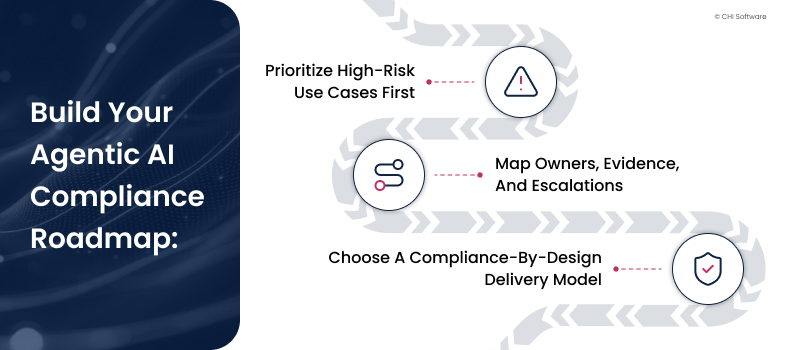
Prioritize High-Risk Use Cases First
Start where an agent touches money, health data, or a regulated decision. Map the data flows before you write a line of agent code, because you cannot protect a path you have not drawn. For teams whose legacy systems block clean data flows, that mapping usually surfaces modernization work first. CHI approaches that as a legacy software modernization company, clearing the ground before any agent is layered on top.
Map Owners, Evidence, And Escalations
For every agent, write down three things: who owns it, what evidence it generates, and who gets called when it misbehaves. This is unglamorous agent management, and it is the part most teams skip in the rush to ship. It is also the first thing an auditor or an enterprise security reviewer asks to see, so the teams that do it early move through procurement faster.
Choose A Compliance-By-Design Delivery Model
Retrofitting controls after launch costs more and proves less. Building them in from the first sprint is cheaper and produces evidence as a by-product of normal work. This is where a delivery partner earns its place. CHI can bring software modernization, AI, and generative AI development, cloud and data engineering, and DevOps and MLOps into a single plan, drawing on its machine learning development company track record and its agentic AI development services. Teams planning broader change often fold this into a wider AI transformation consulting services engagement, so the compliance work and the modernization work share one roadmap.
CHI holds ISO 27001 certification and brings enterprise-grade security, governance, and delivery standards to agentic AI projects, with a security and governance package available before any engagement starts.
Request the Security and Governance Package
FAQs
-
How do you audit an AI agent’s decisions?

You review the trail, not the intention. Every action should leave a log linking the agent’s identity, the tool it used, the data it accessed, and the policy that permitted it. When those records can rebuild the decision path from start to finish, audits become fairly simple. When they are missing, no explanation given afterward will ever satisfy a regulator.
-
Can a small or mid-sized company implement agentic AI compliance?
Yes, and this is often easier to implement on a smaller scale. Select one key use case, apply the principle of least privilege and full logging for the relevant agent, and properly establish a responsibility and escalation model before scaling the solution. A mid-sized team acting deliberately often maintains better control than a large team that deploys agents everywhere first and only later begins to sort out the nuances.
-
What happens if an AI agent violates a compliance rule autonomously?
Your policy engine should stop the action before it completes, log the attempt, and alert the owner. Should a violation occur nonetheless, that same audit log enables you to assess the extent of the damage, revoke the agent's access, and demonstrate to regulators that you identified and contained the issue. Responsibility ultimately rests with the person performing the deployment, which is why the human accountability model is more important than the accompanying automation.
-
What is the difference between AI governance and agentic AI compliance?
AI governance is the broad set of policies and principles for how your organization uses artificial intelligence. Agentic compliance is the operational layer that proves those policies actually hold at runtime, for autonomous agents, action by action. Governance states what should happen; agentic AI compliance shows that it did.
About the author
Yana oversees relationships between departments and defines strategies to achieve company goals. She focuses on project planning, coordinating the IT project lifecycle, and leading the development process. In their role, she ensures accurate risk assessment and management, with business analysis playing a key part in proposals and contract negotiations.
Rate this article
40 ratings, average: 4.9 out of 5