Mobile learning is about using devices like smartphones and tablets to give employees a chance to learn wherever they are. For companies, it is not about what mobile learning means; it is about what’s really happening: employees are already using their mobile phones a lot. The question is, are you teaching them where they are already spending their time?
This article is going to talk about the mobile learning trends that are changing the way companies train their employees and why the people in charge of learning and development and human resources need to pay attention. We are seeing more and more companies wanting these kinds of solutions because they need to be able to move and reach their employees from anywhere.
Key Trends in Mobile Learning
The important trend is designing things for mobile devices first. It does not work to design something for a desktop computer. Then just hope it works on a mobile phone. More people are using devices than desktop computers now, and if something feels like it was made for a desktop, people will stop using it on their mobile device. So you should start by thinking about how something will look on a screen and then make it work for bigger screens too.
Mobile learning works well when it is broken up into pieces. Employees are very busy. Usually, they do not have a lot of free time, but they can spare a few minutes here and there. If you make learning modules that people can do in a few minutes and then come back to later, they will remember more of what they learned. For example, Moodle is a platform that supports this kind of learning, so teachers can make activities and content that are perfect for mobile devices.
Another important thing is to make sure the learning experience is personalized for each employee. Some platforms use intelligence to track how employees are doing and what kind of learning style they have, and then they create a personalized plan just for them. When employees get content that’s relevant to them and fits their learning style, they are more likely to pay attention, remember what they learned, and actually use their new skills.
Finally, it is important to make the learning experience interactive and fun. Just watching videos is not enough. You need to have things like quizzes, games, and real-time feedback to keep employees engaged. If you add some features, employees will actually want to do their training instead of putting it off.
Augmented Reality (AR) and Immersive Learning
Augmented reality (AR) and virtual reality (VR) deliver immersive experiences for corporate training. We are seeing a significant increase in demand in manufacturing and healthcare for these technologies.
- Augmented reality (AR) for equipment handling and customer interactions.
- Virtual reality (VR) for safety drills and scenario-based learning.
Mobile apps can include simulations, step-by-step tutorials, and specific learning module sets. Success in mobile learning is measured by engagement and improved performance.
Mobile Devices and Device Strategy
Companies must decide between BYOD and corporate-managed mobile learning devices:
- BYOD increases convenience but requires attention to security and mobile technology.
- Managed devices allow full control, delivering content, offline access, and compliance.
Many training strategies combine the two: flexibility for general employees and managed devices for critical training content, ensuring a faster mobile learning experience.
Benefits of Mobile Learning for Corporate Training
Let’s take a closer look at the key advantages of mobile learning for corporate training materials:
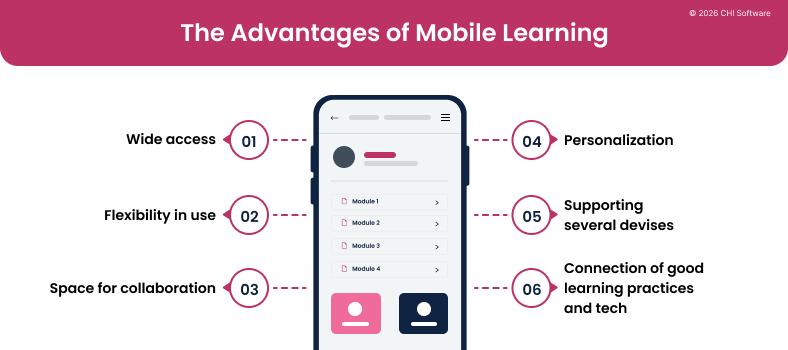
The benefits of mobile platforms include removing scheduling barriers, allowing employees in remote areas, field teams, or shift work to learn anytime, even without an internet connection. Offline learning ensures training continues without internet access, while just-in-time delivery turns course content into a performance support tool.
Completion rates for courses often exceed desktop equivalents. Spaced microquizzes, real-time feedback, and interactive content boost the learning process. Once built, training materials scale globally at near-zero marginal cost, creating a significant impact on ROI.
Social learning multiplies the value of education. Discussion boards and knowledge sharing integrate learning online into daily workflows. By providing self-paced learning paths, corporate training becomes truly inclusive for those with busy schedules.
Interactive Content and Collaborative Learning
Prioritize interactive content like quizzes and scenario simulations to boost engagement. Use gamification to drive completion rates. Technology advances like wearable devices may soon play a role, but currently, mobile users benefit most from social learning. Combining collaborative learning, interactivity, and real-time feedback makes corporate training more engaging.
Mobile E-Learning, Assessments, and Offline Access
Design mobile-first assessments and a learning module structure that provides real-time feedback. Enable offline access and offline learning capabilities by allowing content download. This ensures employees can have remote learning or even distance education, keeping completion rates high across all courses.
AI, Chatbots, and Personalization
Artificial intelligence is reshaping the mobile learning strategy. For content production, generative AI accelerates the instructional designer’s workflow, converting compliance documents into a learning module, generating course materials, and refreshing training materials. This automation helps meet the growing demand for up-to-date compliance and product training.
For the learner, AI chatbots deliver on-demand coaching and impactful learning experiences. These learning apps adapt to each learner’s evolving personalized learning profile, ensuring they receive the same content structure but tailored to their needs.
Implementation Roadmap and Mobile Learning Strategy
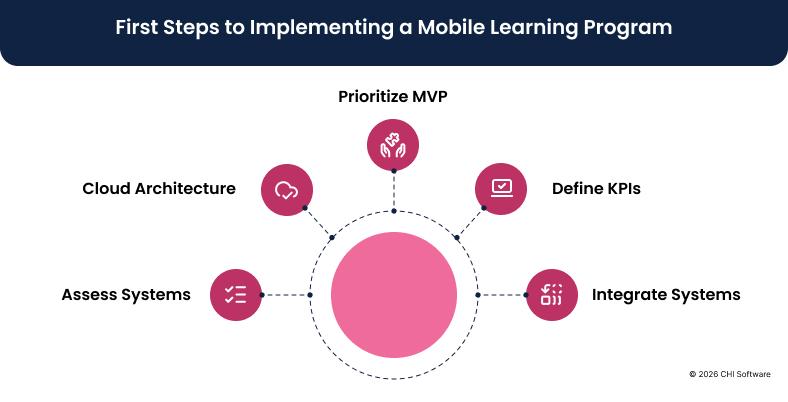
- Assess Systems – Review legacy e-learning platforms.
- Cloud Architecture – Design a scalable mobile learning setup.
- Prioritize MVP – Focus on focused learning modules designed for a fast pilot.
- Define KPIs – Track learning outcomes and training effectiveness.
- Integrate Systems – Connect your mobile learning platform with HR systems, LMS, and internal tools.
Security, Compliance, and Mobile Device Management
Ensure your mobile learning strategy is secure. Define management policies for mobile devices, enforce data protection for educational content, and implement role-based access. This guarantees a safe learning environment for all mobile users.
Measuring Success and Key Metrics
To evaluate the effectiveness of mobile learning, define engagement KPIs. Set learning outcome indicators to track skill improvement. Establish an A/B testing cadence for interactive content to continuously optimize the learning experience. This approach helps education leaders stay ahead of learning trends.
Case Studies and Industry Use Cases
A U.S.-based EdTech company strategically migrated its web platform to mobile devices to capture mobile learning trends. Their mobile learning courses were designed with interactive content, personalized learning paths, and offline learning capabilities.
Key metrics showed longer user sessions and 40% audience growth, proving the strategic advantage of mobile learning for professional development. Much like the Duolingo language-learning app, success came from using mobile devices to fit learning into daily habits for students.
Recommendations for CHI Software Clients
Your team is trying to learn new skills, but they’re stuck on old e-learning systems. They’re reaching for their mobile phones, but the training doesn’t fit. That’s where modernizing your mobile learning strategy comes in. As market dynamics evolve, you will experience an increased demand for faster, more agile upskilling from your workforce.
By utilizing an instructional designer and AI, you can create content and impactful learning experiences that offer real-time feedback. Whether it’s through mobile apps or focused learning modules designed for busy schedules, we help you deliver learning materials that fit different learning styles.
Conclusion and Next Steps
Learning at work doesn’t have to be a chore. With mobile learning, your team can study offline learning modules, dive into interactive content, and progress at their own pace. Companies that embrace these mobile learning trends see higher engagement and knowledge retention.
At CHI Software, we turn this mobile learning strategy into reality. Whether it is improving completion rates or building personalized learning paths, we ensure a seamless learning experience. Ready to see how mobile learning can transform your corporate training? Let’s make it happen.
About the author
Yana oversees relationships between departments and defines strategies to achieve company goals. She focuses on project planning, coordinating the IT project lifecycle, and leading the development process. In their role, she ensures accurate risk assessment and management, with business analysis playing a key part in proposals and contract negotiations.
Rate this article
28 ratings, average: 4.81 out of 5