Two different people may hold the title of “engineer” and yet have virtually nothing in common. This discrepancy is the key to the forward deployed engineer versus software engineer conflict, and the subject is increasingly important given how AI and modernization initiatives are getting stuck. So, here’s a breakdown of exactly what roles own and share and why you should determine where your project lands.
Forward Deployed Engineer vs Software Engineer Differences
Initially, ask who will own the resulting artifact. Software engineers build and maintain the actual product itself: the features, services, and systems people rely on. They are evaluated on product reliability, code quality, and the overall endurance of shipped software. Only at the point when there is a concrete, identified customer does the distinction between a forward-deployed engineer and a software engineer arise:
A forward deployed engineer operates with high customer proximity. An FDE sits on-site within their client’s systems, understands the quirks, and owns a problem from inception of discussion to a customer’s quantifiable impact: while a software engineer might ship a completed feature to customer success, a forward deployed engineer is accountable for whether the integration actually moved the customer’s number and whether it performs in production.
Often, people talk about this as a forward-deployed engineer versus an engineer, as if it’s a career ladder. The divide is really between proximity and accountability. It’s the difference between taking the product on behalf of everybody and keeping the product pure for everybody, versus getting something working for one pushy customer, with all the custom configuration and gnarly, dirty operational reality that a real deployment has to deal with.
FDE vs SWE at a Glance
So, how do you know which one your team actually needs?
If you’re a CTO or VP of Engineering, the FDE vs SWE call usually isn’t about picking the “better” engineer. It’s about the kind of problem you’re trying to solve. An FDE and a software engineer bring different strengths to the table, and those differences become very real in delivery speed, team workload, customer communication, and who steps in when something breaks in production.
Here’s a practical side-by-side look at where each role fits best.
| Key Area |
Software Engineer |
FDE |
| Role focus |
Building and improving the core product or platform |
Solving a specific customer’s problem end to end |
| Core responsibilities |
Feature development, system architecture design, automated testing |
Discovery, enterprise integration, deployment, outcome tracking |
| Customer interaction |
Mostly indirect, through product and support teams |
Direct and continuous, customer-facing by default |
| Technical scope |
Deep in a defined stack or domain |
Broad across app code, APIs, data pipelines, cloud, deployment |
| Product vs customer-specific work |
Product work that serves all users |
Client-specific configuration and one-off implementation |
| Integration and deployment involvement |
Ships through a controlled release process |
Owns integration inside the customer environment |
| Ownership and accountability |
Accountable for product reliability and long-term maintainability |
Accountable for the customer outcome in production |
| Work environment |
Internal codebase and roadmap |
The customer’s systems, constraints, and stakeholders |
| Typical success metrics |
Uptime, defect rate, delivery velocity |
Time to value, adoption, measurable business result |
Forward Deployed Engineer vs Software Engineer Responsibilities
Both functions are mapped out over the delivery cycle, and with it, the forward deployed vs. software engineer split becomes concrete. The pattern seems to be standard: product engineering has cleaner internal boundaries, while forward deployed follows one customer through a particular problem, all the way down.
Before Development: Discovery and Solution Design
Typically, software engineers are handed requirements that someone has interpreted as a spec or a ticket. Their design work is in product-how a new feature sits within the architecture and its cost in terms of complexity and testability.
An FDE typically starts much earlier, up front, in the grey area. They’ll do discovery with the customer, take ill-defined goals and turn them into technical requirements, and build something that fits within constraints the product team would never see. This is where product discovery consulting services earn their keep. The wrong assumption caught here saves a rebuild later.
During Development: Product vs Customer-Specific Engineering
The two are most closely associated in this case; however, they perform separate functions. The software engineer writes production-grade code that ships in the product, which means code review, testing, and long-term maintainability are part of it.
FDE also writes code: most of it for a given deployment; it is the glue that makes the product talk to the existing client’s infrastructure. Some are disposable; others are for long-term use. Figuring out what’s what is part of the skill.
During Deployment: Release vs Customer Implementation
A software engineer typically gets to production through a well-controlled process: staging, canary releases, rollouts, monitoring, and more. The environment is predictable and well understood. An FDE works in “real-world” customer environments, where things are rarely that simple: firewalls, legacy data formats, undocumented permissions, and all kinds of unexpected issues. The FDE owns the full implementation lifecycle, from the first commit to a live production system.
After Deployment: Maintenance vs Customer Outcomes
Once a product is shipped, a software engineer can return to the roadmap to work on bug fixes, performance improvements, and new iterations. A stable, reliable, and evolving product is the goal.
However, an FDE’s job does not end at deployment. Their role is to check whether the solution delivers the expected value, fine-tune it based on its performance in practice, and stay close to the customer to identify potential issues early. Success isn’t just whether the system works, but whether it delivers what the customer expects.
Technical Skills: Breadth vs Depth
This is the trade-off that defines the two tracks. Software engineers tend to go deep. FDEs have to go wide. Anthropic’s 2025 internal study of its own engineers found AI tools pushing people toward broader, more full-stack work, while some worried about losing deeper technical competence along the way. That tension, breadth against depth, is exactly the line between these roles, even though the study wasn’t about FDEs at all.
Technical Depth Software Engineers Typically Prioritize
A good software engineer builds deep expertise in a specific area, whether that’s a programming language, subsystem, or technical domain. That depth sharpens their debugging skills, helps them design better systems, and makes for smarter calls on risks and trade-offs.
Technical Breadth Forward Deployed Engineers Need
An FDE can’t afford that luxury. In a single engagement, they might touch application code, wire up APIs, build data pipelines, configure cloud infrastructure, and negotiate business requirements with a customer’s stakeholders in the same week. Technical breadth is the job. They don’t need to be the deepest expert in any one layer, but they need enough command of each to make a customer-specific system actually work, plus enough stakeholder management to keep everyone aligned while they do it.
AI, Cloud, and Legacy System Fluency
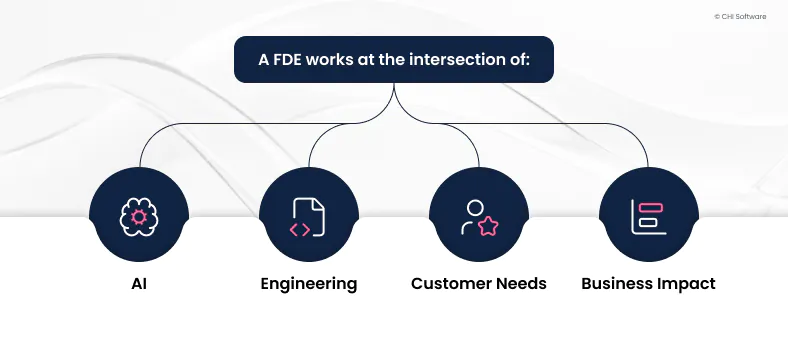
FDE work today focuses on three major areas: operationalizing AI, moving workloads to the cloud, and modernizing legacy applications. Each requires a unique skill set—from managing AI risks and optimizing cloud costs to navigating undocumented code that an FDE may encounter.
Customer Exposure and Operational Constraints
Direct contact with users changes how you build. DORA’s research on user-centric focus found that teams with a strong user focus have 40% higher organizational performance and recommends bringing engineers closer to user feedback. That’s the advantage of customer-facing engineering: shorter feedback loops and firsthand insight into real user problems.
How Closely FDEs Work With Customers
Close enough that they frequently can’t tell where their own team ends and the FDE team begins. Daily standups, direct access to the stakeholder, open discussions of whatever is actually broken. That’s not your standard report on what you did; this is you finding what they actually need and defining the tickets. Speed and trust come from this, but at the cost of doing all that stakeholder wrangling most engineers eschew.
How Ambiguity Shapes FDE Work
Product engineers usually get requirements. FDEs get symptoms. A customer says, “This is slow” or “Our team won’t use it,” and the FDE has to turn that into a diagnosis and a fix. Ambiguity is the norm, so FDEs build incrementally, validate assumptions early, and keep designs flexible as they learn more.
How Operational Constraints Affect FDE Delivery
Then there’s reality. The customer’s compliance rules, their approval chains, the one database from 2009 that can’t go down. These operational constraints shape every technical decision, and they rarely appear in a product backlog. An FDE plans around them from the start: choosing an integration pattern that fits the customer’s security posture, sequencing work so nothing critical breaks, weighing risks and trade-offs against what the customer can actually absorb. Ignoring the constraints is how deployments fail.
Applications Engineer vs Forward Deployed Engineer
These two get mixed up often, and fairly so, because the boundary really varies by company. Still, there’s a useful distinction. The applications engineer vs forward deployed engineer question usually comes down to mandate.
An applications engineer typically applies, configures, or integrates existing technology for defined use cases. The product exists, the patterns are known, and the job is to fit it to a customer’s setup well. It’s real engineering, but the scope is bounded.
A forward deployed engineer has a broader role. They can own discovery, build custom solutions when the product falls short, take them through production, and remain accountable for the customer outcome. An applications engineer focuses on making an existing solution work in a new environment. An FDE, on the other hand, figures out what the solution should be when the standard approach doesn’t fit. Titles may vary between companies, so the scope of responsibility matters more than the label.
When AI or Legacy Projects Need FDEs
This is a CTO and CEO decision, and it’s usually about a stuck initiative rather than headcount. McKinsey’s 2025 State of AI survey found that while 88% of organizations use AI in at least one function, most are still in experimentation or pilots, with only about a third scaling their AI programs. Separate McKinsey research argues that AI-enabled development can lower the cost of shipping new functionality and raise engineering productivity, especially once core platforms are modernized. The gap between those two facts is where FDE-style execution earns its place. None of this means the outcome comes from FDEs alone.
When AI Projects Stall Before Production
The demo worked. The pilot got applause. Then it sat. This is the most common AI failure, and it’s rarely a model problem. It’s the last mile: fitting AI into real workflows, handling edge cases, meeting data and compliance requirements, and earning user trust. In 2026, serious LLM engagements also require production experience with evaluation frameworks that catch hallucinations and regressions before they reach users. That takes someone who owns the path to production, not another researcher optimizing a benchmark nobody deploys against.
When Legacy Systems Block Modernization
Old systems are where good plans go to die. A modernization effort stalls because the legacy platform lacks clean interfaces, documentation, and a decade of business logic buried in code no current employee wrote. An FDE with modernization experience can work incrementally, standing up the new alongside the old without a risky big-bang cutover. CHI handles this through its legacy software modernization services, keeping the business running while the architecture changes underneath it.
When Customer Requirements Outgrow Standard Features
Sometimes the product is 80% right for a big customer and the missing 20% is why the deal stalls. Standard features don’t cover it, and pulling core engineers off the roadmap to build one-off work is expensive and distracting. This is a clean fit for FDE-style engineering: build the client-specific configuration and custom pieces that close the gap, without turning the main product into a tangle of special cases for one account.
When Enterprise Integrations Slow Delivery
Enterprise integration is where timelines quietly blow up. Connecting to a customer’s ERP, identity provider, data warehouse, and three internal APIs, each with its own owner and quirks, is slow, unglamorous work that product engineers rarely have bandwidth for. An FDE treats the integration as the deliverable, not a side task. Often that is the difference between closing this quarter and dragging into next.
When Faster Time to Value Needs FDEs
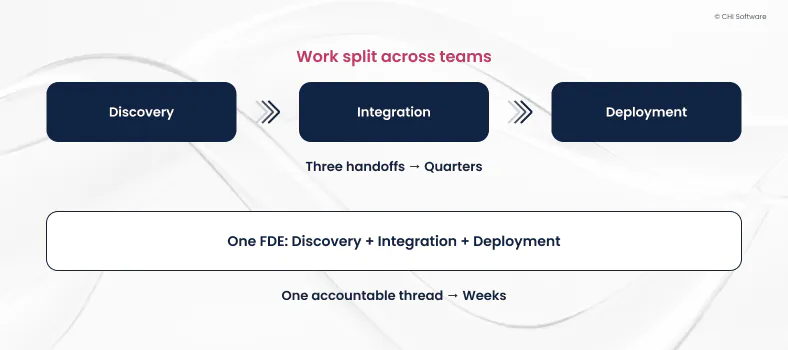
When the business needs a result in weeks, not quarters, the operating model matters more than raw talent. FDEs are built for speed to a measurable outcome. They compress discovery, integration, and deployment into one accountable thread instead of handing work across three teams. If time to value is the constraint, and it usually is when a customer is waiting, that end-to-end ownership is the fastest route there.
When Software Engineering Is the Better Fit
Not everything needs an FDE, and pretending otherwise wastes money. If the work is building and hardening your core product, if requirements are stable, if the win comes from depth and long-term maintainability rather than customer-specific execution, a software engineer is the right and cheaper choice. Reach for FDE-style engineering when a specific, high-stakes initiative needs environmental context and ownership through production. Otherwise, let your product team do what it does best.
How FDEs Extend Core Engineering Teams
The obvious objection: “We already have strong engineers.” You probably do. That’s not the point. FDE-style capacity is meant to complement a good team, not replace it.
The split works like this. Your internal engineers keep ownership of the product roadmap, the architecture, and the decisions that compound over years. The FDE absorbs the work that keeps pulling them off it: a painful customer integration, a modernization slog, a productionization push with a hard deadline. When the engagement ends, everything transfers: code ownership, documentation, and the context that makes the system maintainable, without the team having to depend on the vendor to operate what was built. Gartner predicts that by 2028, more than half of enterprises will move away from Big Tech Assistive AI precisely because that handoff never happens.
The mechanics matter here. Clear handoffs, shared context, and defined ownership boundaries are what keep this from turning into two teams stepping on each other. It’s flexible capacity aimed at the hard parts.
Your internal team knows the product. An FDE knows how to get a customer-specific problem solved without pulling your core engineers off the roadmap.
See what that looks like in practice
How CHI Supports FDE-Led Modernization
CHI Software brings FDE-style engineering through services already suited to this work. IT Consulting and Staff Augmentation provides embedded engineers who work in your context and own implementation without a long hiring cycle. Teams looking to hire forward deployed engineers can start here.
Software Modernization removes legacy and architecture blockers, while AI and Generative AI Development takes models from pilot to production with the integration, automation, and reliability work often left undone.
Cloud engineering, data engineering, DevOps/MLOps, and custom enterprise software development fill the remaining gaps, with software architecture consulting supporting architecture-heavy engagements.
The goal is faster production, lower risk, and flexible capacity. For a CEO or COO, this maps to a simple financial question: does a fixed-scope FDE engagement deliver the result faster than adding headcount at $300K-$700K+ market rate? Almost always, yes, and without the hiring cycle or the permanent org chart expansion.
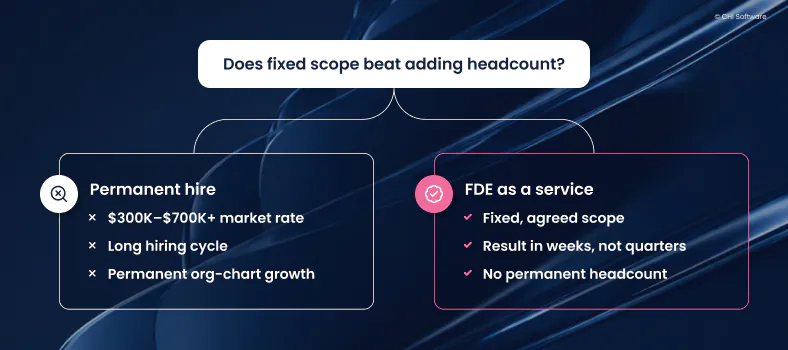
CHI offers this as FDE as a service, so you get outcome ownership without permanently expanding the org chart.
Choosing Between FDE and SWE
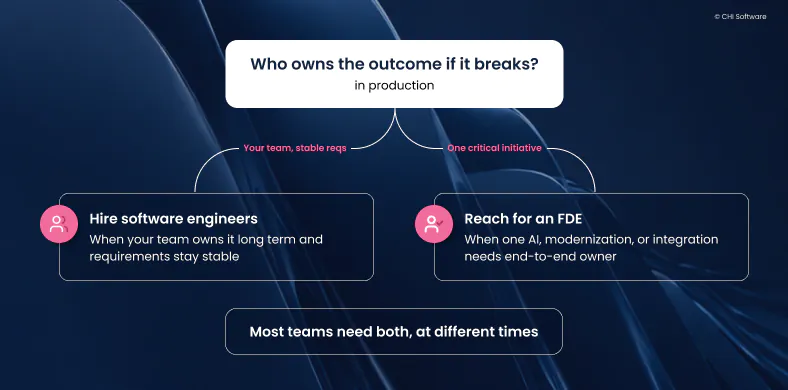
Strip away the terminology, and that comes down to operating-model decisions. Answer the question: Who owns the results if something goes wrong?
If the answer is your internal team and the priority is sustained product or platform ownership with reasonably stable requirements, hire software engineers. Depth, continuity, and system ownership are what you’re buying, and they’re worth a lot.
If the answer needs to be someone accountable end-to-end, because a strategically important AI, modernization, integration, or customer-specific initiative needs deep environmental context and cross-functional execution through production, that points to FDE-style engineering. The technical complexity isn’t the deciding factor. The ownership model is. Most organizations end up needing both, at different times, for different problems. The mistake is using one where the other fits.
FDE vs SWE FAQ
-
Why Are Forward Deployed Engineer Roles Becoming More Common?

Because more value now depends on getting complex technology, especially AI, to work within a specific customer environment. As standard products handle common cases, the remaining work is increasingly custom, integration-heavy, and outcome-driven. Demand for FDEs reflects this: job listings grew 729% year-over-year in 2026, while senior FDE compensation can reach $300K–$700K+ in total comp. For many companies, that makes flexible FDE capacity a faster alternative to expensive, competitive hiring.
-
Do Forward Deployed Engineers Usually Work On-Site With Customers?
Sometimes, but less than the name suggests. "Forward deployed" means working close to the customer, not necessarily in their building. Plenty of FDE work happens remotely, with deep access to the customer's systems and steady contact with their team. On-site time depends on the customer, the security rules, and the project phase.
-
What Background Do Forward Deployed Engineers Typically Have?
FDEs typically blend software engineering knowledge, business understanding, and customer communication skills with technical breadth. Many have consulting and start-up backgrounds, so FDE is just a natural extension of software engineering.
-
Do Forward Deployed Engineers Need Industry-Specific Domain Knowledge?
It can make a big difference, though the importance varies by industry. In highly regulated sectors like healthcare and finance, deep domain knowledge can determine whether a solution moves forward or gets stuck in compliance review. In other industries, strong engineering judgment and the ability to learn quickly may be enough. The best FDEs build industry domain expertise for a new sector early on and keep expanding it as they work.
-
Is Forward-Deployed Engineering the Same as Technical Consulting?
These areas do overlap, but are not the same. A tech consultant typically provides guidance and recommendations, then turns it over. FDE develops and ships it and is responsible for a working solution in the customer's environment. Consultants might end at strategy, while FDEs are measured by whether the code runs and whether the customer results hold. Implementation ownership separates them, and it's the same thread that runs through the whole forward deployed engineer vs software engineer question: who stays accountable once the code is live.
About the author
Ivan keeps a close eye on all engineering projects at CHI Software, making sure everything runs smoothly. The team performs at their best and always meets their deadlines under his watchful leadership. He creates a workplace where excellence and innovation thrive.
Rate this article
27 ratings, average: 4.8 out of 5