What Are AI Outsourcing Services?
In a nutshell, AI outsourcing services involve outsourcing the development, integration, automation, data engineering, MLOps, and AI agent work to a third-party tech company rather than building these internally. You will notice this offered under multiple guises. Some brands will market this as AI development outsourcing services, others as AI software outsourcing, yet another ‘outsource AI services,’ or ‘outsourcing artificial intelligence services.’ The name varies, but the meaning is unchanged.
Companies have been doing this for years, and for obvious reasons. They require skills and bandwidth they can’t keep up with recruiting, and they need features to go out the door faster, all while taking their fixed payroll expense and shifting it to be more fluid and effective, paying for results and not butts in seats. Nothing has changed on that front.
But what we actually do is super diverse. It involves process automation, data engineering, model building and training, MLOps, and full software development for AI features. The applications span across industries: computer vision on an assembly line, deep learning for fraud scoring, and construction estimation software that takes a blueprint and estimates a price. No matter what you’re doing in ML and generative AI, the underlying governance issue is the same.
And it is that question that’s actually transformed. In a world where a remote development team ships your code on your behalf via agents, that original contract won’t fly anymore. AI-powered outsourced dev solutions need to ship with oversight, designated human accountability, enterprise-specific policy, and traceable agent-level usage. That’s the heart of this story.
BCG Is Right But Governed Delivery Wins
In February 2026, Boston Consulting Group estimated that the rise of agentic AI will unlock $200B in net new demand for tech services in five years as it moves from single pilot to widespread enterprise use. The opportunity goes beyond market growth; agentic AI is changing the delivery model, shifting enterprises from body-shopping toward outcome-owned, governed delivery with partners accountable for business results. 65% of enterprises say they would look for an AI service provider for their most critical use cases.
Therefore, BCG is moving in the correct direction. But when it comes to deciding what to contract with a CIO or CTO, that model is not unrestrained freedom. It is regulated human accountability work with auditable controls. AI Governance failures are real and widely discussed, and letting agents be autonomous doesn’t fix them.
The practical takeaway for CTOs and CIOs is not that AI replaces outsourced delivery, but that it changes the contract from headcount to governed outcomes.
What BCG Gets Right About Agentic AI
The story about deflation, which will have agents automatically step in to replace paid human labor, only shows part of the situation. Some standard labor would be compressed, no doubt about that. However, the BCG study showed that a new kind of demand emerges with agentic systems; you will find that plugging agents into the systems the company is running (ERP, CRM, data pipe) is complex and requires specialized skills.
For both CTOs and CIOs, the practical takeaway is uncomfortable. The time to revisit your delivery design, operating model, and platform foundations is now, before your competitors do.
Why Delivery Models Must Change
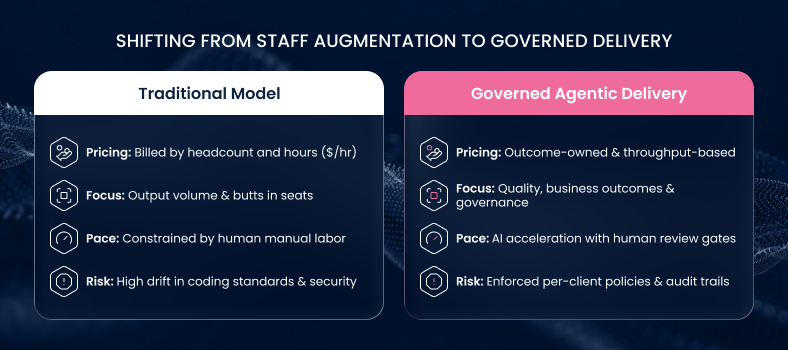
The standard “staff augmentation” model is charged by the hour and billed by headcount. Agentic delivery just doesn’t work like that. You can’t pay for hours of work or bill for individuals, if an agent can create an entire module in a matter of minutes.
You’ll need to be priced and measured by the outcomes, by the throughput of governed work, by the quality of the product. The goal is higher operational efficiency without sacrificing governance or accountability.
Old models will start to look both costly and slow.
Where Automation Pressure Hits First
Automation is never evenly distributed. It will always arrive first for high-volume, well-defined, structured tasks: code boilerplate, test harness code, data munging, basic documentation, and a first stab at migration. Work that relies on subjective judgment will resist it longer.
A useful lens for your own backlog is whether a task would be a good candidate for a rules-engine-style bot as part of a larger business process, or whether it has design and compliance risks where human judgment must dominate.
You’ll see process gains in the former more quickly.
Where Fully Autonomous Delivery Breaks Down
Let an agent run an outsourced project end-to-end with no human gate, and you will quickly find the failure modes. DORA’s 2025 research, drawn from close to 5,000 practitioners, is blunt about it. AI raises delivery throughput and, at the same time, tends to increase instability: more change failures, more rework, longer recovery times. It amplifies whatever system it lands in. A strong delivery system gets stronger. A shaky one gets worse, faster. In an outsourced setting, where a single provider serves multiple clients under different rules, autonomy alone breaks down for four specific reasons. It must also operate within regulatory and security frameworks such as GDPR, NIS2, and ISO 27001.
Every Codebase Has Different Rules
No two client codebases are the same, nor do they use the same conventions, branch strategy, review gates, or “Definition of Done”. An agent customized to one client can easily enforce the wrong practices for another.
Why does this matter to the business?
Scaling AI across multiple clients requires standardization, oversight, and clear delivery frameworks. Otherwise, faster output can lead to more inconsistencies and rework.
AI Policies Differ By Client
One client bans sending any source code to a third-party model. Another approves a named model list and nothing else. A third requires that every AI-assisted change be labeled in the commit history.
Why does this matter to the business?
AI policies are not simply preferences; they are contractual obligations. An agent who disregards these policies creates significant legal exposure for all parties involved.
IP And Security Change Risk
Each prompt within an enclosed system is a potential avenue for data leakage. Client IP ownership, training-data lines, and secret management all change the second the work hits the agent.
Why does this matter to the business?
Without proper safeguards, a single misconfiguration can expose client IP or data. Governance controls must protect intellectual property, security, and compliance.
Agents Need Stable Context
An agent is only as good as the context it has. Give an agent an old spec, an outdated diagram, or your client’s wrong coding standard, and you get good-sounding bad results.
Why does this matter to the business?
Reliable AI outcomes require strong knowledge management, clear ownership, and the right systems.
Outsourcing partners who cannot show per-client agent policies, audit trails, and human review gates create delivery risk that no SLA clause will cover after an incident.
See How We Govern AI-Assisted Delivery
Governed Agents Plus Human Accountability
The durable model for this audience is a balanced approach: constrained agents within a governed delivery system, with human checkpoints and clear ownership of outcomes. Governance is not overhead, but the system that makes AI delivery reliable and scalable.
DORA’s 2025 companion guide, the AI Capabilities Model, identifies seven organizational AI capabilities that determine whether AI creates value or introduces risks. What stands out is that most of these capabilities focus not on the agents themselves, but on the broader system around them: the processes, governance, people, and practices that enable AI to work effectively.
What Governed Agent Harnesses Mean
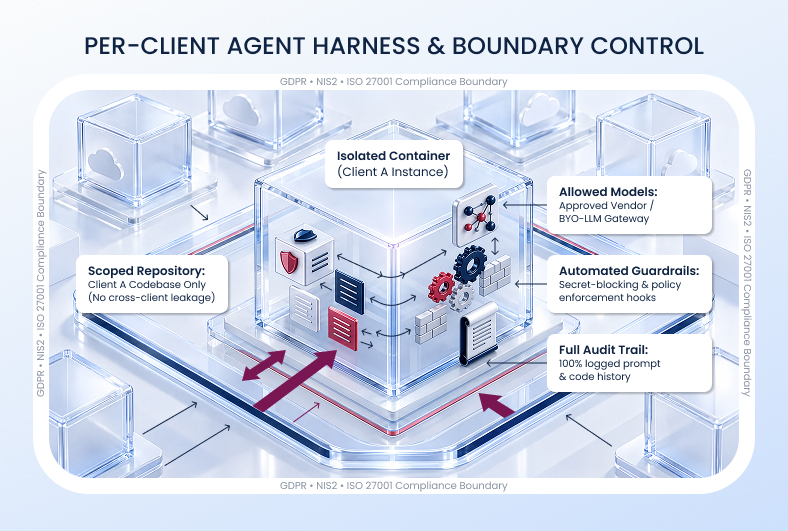
So, an agent harness is a list of permissions, and the tools an agent is wrapped with that dictate what an agent can and cannot do. Ideally, a harness confines the agent to a specific client’s repository, limits which AI models it can call, logs every action the agent takes, and denies all requests outside the designated policy. The agent is not slow, though, just focused.
Why Human Review Still Matters
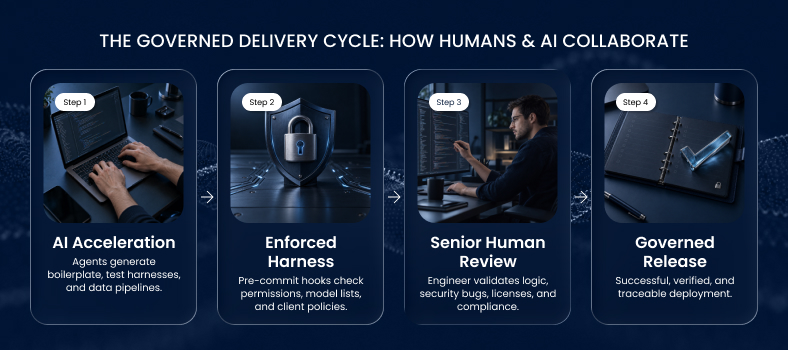
DORA’s survey says about 30% of devs have low to no confidence in AI-written code, and it counts that mistrust as a feature, not a bug. Trust, but verify. A senior engineer who reviews a diff is much more likely to spot the security bug, the license snafu, or the logical gotcha that slips through all automated tools.
How Agents Assist Without Owning Accountability
Here is the line that keeps delivery sane. An agent can assist, but a person owns the outcome. The agent drafts, suggests, and accelerates. The engineer decides, signs off, and answers for what ships. Accountability cannot be delegated to a model because a model cannot be held responsible under a contract or before a regulator.
AI Outsourcing Services Need Per-Client Controls
Serving many clients within a single delivery organization is where governance either holds or collapses. The AI outsourcing solutions that hold up are the ones where each account has its own standards, its own policy boundary, its own permissions, and an enforcement layer that does not rely on people remembering the rules. This is exactly the gap CIOs point to when they say AI governance maturity is thin, and the reliability gap CTOs feel when execution wobbles between accounts.
Client-Specific Policies And Coding Standards
Each client gets a written policy that outlines which models are allowed, what data may leave the environment, how AI-assisted changes are marked, and which coding standards apply. That document is not decoration. It drives the real configuration the team works under, so the same engineer moving between two accounts operates inside two clearly different sets of rules.
Managed Permissions, Tools, And Guardrails
Permissions decide what an agent and an engineer can reach. Tools decide what they can do. Guardrails decide what they are stopped from doing. Managed centrally, these three prevent a mistake in one project from ever becoming an incident in another. Left to individual setup, they drift within a week.
Separate Guidance From Enforcement
A wiki page that says “please do not paste secrets into a prompt” is a piece of guidance. A pre-commit hook that blocks the paste is an enforcement mechanism. Both matter, but only one survives a busy sprint. Serious providers write the guidance and then build the enforcement, so the guidance does not have to be remembered under pressure.
We deliver a governance package that includes client-specific policies, permissioning controls, and audit evidence for your procurement and legal teams to review before any engagement begins.
Request the Governance and Compliance Package
BYO-LLM Brings Control To Delivery
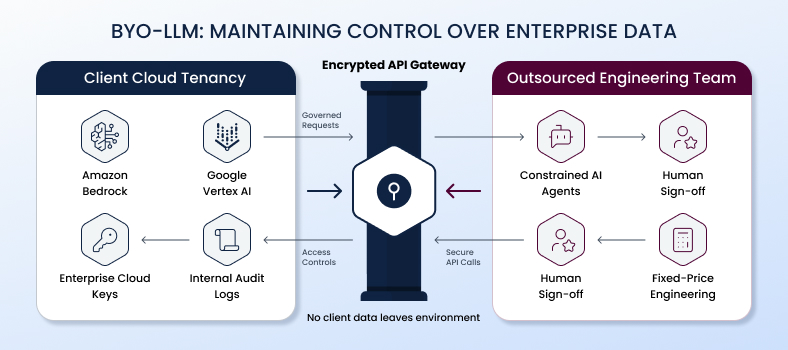
BYO-LLM, bring-your-own-LLM, means the client supplies and controls the model access rather than the vendor. For regulated or security-conscious buyers, this is often the better arrangement because it puts model routing, logging, and data boundaries within the infrastructure the client already owns and audits.
When Clients Should Bring BYO-LLM
If your procurement team needs to see every request that touches your data, if your security posture requires model calls to remain within your own cloud tenancy, or if you want a single audited path for AI usage across all vendors, BYO-LLM fits. If none of that applies and speed is all you want, a vendor-managed setup may be simpler. Pick the trade-off on purpose, not by default.
Routing Work Through Bedrock Or Vertex
Platforms like Amazon Bedrock and Google Vertex AI let clients expose approved models through their own accounts, with their own keys, quotas, and logging. The outsourcing team then routes AI-assisted work through that gateway. The client sees every call. The models stay within governed boundaries. Nobody is guessing where the data went.
How BYO-LLM Changes Security, Logging, And Procurement
Under BYO-LLM, the security review shifts from “trust the vendor’s setup” to “inspect our own logs.” Procurement negotiates model spend directly with the platform instead of through a vendor markup. Logging becomes one consistent trail that the client controls. It is more set up front. It buys real control afterward.
Token Costs Need Fixed-Price Visibility
Token spend is not an engineering footnote. At scale, it is a line item a CFO will ask about, and hiding it in a blended rate is how buyers get caught off guard. Treat it as a board-level transparency issue from the first conversation.
Why Token Spend Cannot Stay Hidden
When agents generate and revise large volumes of code, token consumption turns into a real, variable cost. Bury it in a fixed fee, and one of two things happens. The provider either pads the rate to protect its margin or absorbs the overruns until quality quietly drops. Neither serves the client. Visible token accounting is the honest option.
Token Budgets, Caps, And Change Requests
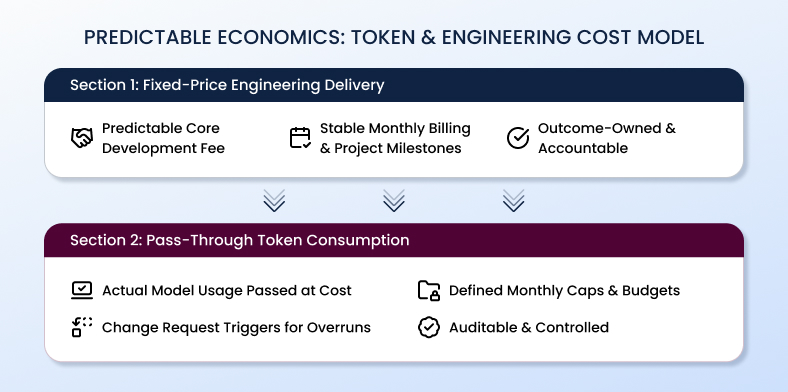
The fix is ordinary project discipline applied to a new cost. Set a monthly token budget per project. Put a cap in the contract. Define the threshold above which additional usage triggers a change request rather than a silent overrun. The client always knows where the number stands before it becomes a bill.
What Stays Fixed, What Passes Through
Split the economics cleanly. Engineering delivery stays fixed-price, so the client can plan. Token spend passes through at cost, with documented caps and monthly reporting tied to the project budget. Fixed-work and variable-model usage are different animals, and pretending they are one is where trust erodes.
What Buyers Need From AI Outsourcing Services
If you are a CTO or CIO choosing an outsourced AI development company, here is a short checklist that cuts through the pitch decks. Whether the provider brands itself as an AI outsourcing agency or an engineering partner, ask for evidence, not adjectives.
Agent-Ready Delivery Processes
Can the provider show a repeatable process for configuring, constraining, and reviewing agents? Mature MLOps pipelines manage agent configurations similarly to model versions: they are pinned, reviewed, and rolled back according to the same schedule as the models they orchestrate.
Client-Level Governance And Auditability
Ask to see the audit trail. Who changed what, which model produced which output, and when a human approved it. If the provider cannot produce that record on request, its governance lives on a slide and nowhere else.
Clear Accountability For AI-Assisted Code
Every line an agent helped write still needs a named human owner. Ask who signs off, how AI-assisted changes are labeled, and what happens when one causes a production incident. The answer reveals whether accountability was designed in or merely hoped for.
Secure Multi-Client Delivery Controls
Because the provider serves other clients too, ask how your code, data, and IP are isolated. Separate environments, scoped permissions, and per-client model policies should be standard in enterprise AI software outsourcing services. Sharing everything with good intentions is not a security model.
Common Agent Mistakes In Outsourced Delivery
Most agent failures in outsourced work are not exotic. They are the same few governance gaps, repeated across teams.
Letting Every Engineer Set Agents Differently
When each engineer configures their own agent, their own prompts, and their own tool access, you end up with twenty slightly different delivery pipelines and no way to reason about any of them. Configuration belongs to the team and the client policy, not to individual preference.
Ignoring Client AI Policies During Onboarding
The riskiest week is the first one. If onboarding does not load the client’s AI policy into how agents are set up on day one, engineers fall back on their own habits and breach terms before anyone notices. Policy has to come first, ahead of the first commit.
Using Agents Without Cost Attribution
Running agents without tracking which project spent which tokens turns the monthly model bill into a mystery nobody can allocate. Attribute cost per project from the start, or lose the ability to price and control it.
Treating AI Output As Delivery Evidence
A pile of AI-generated code is not proof of progress. Working, reviewing, testing, and deploying software is confusing. Volume of output with delivered value is the oldest trap in this business, wearing a new coat.
How CHI Approaches AI Outsourcing Services
CHI Software combines human-led engineering with controlled AI acceleration. AI, software modernization, cloud, data engineering expertise, DevOps, and MLOps operate under a single accountable delivery structure rather than fragmented vendors.
We strongly believe that governance controls are what transform an agent from an internal demo into a system that an enterprise legal team will approve.
Human-Led Engineering With Controlled AI Acceleration
Engineers own the work. Agents speed it up inside defined limits. CHI’s teams hold AWS and Microsoft certifications and have run DevOps practices since 2017, so acceleration rides on an existing delivery foundation rather than one improvised for the AI moment. For teams that want a structured way in, our agentic AI development services and AI transformation consulting services start from governance, not from hype.
Per-Client Governance For Multi-Project Delivery
Each client gets its own policy, permissions, and audit trail. That separation is what lets one team serve many accounts without leaking standards or data between them, and it is backed by ISO 27001 and ISO 9001 certifications, which give procurement and security reviewers documented evidence to check. As a machine learning development company and a legacy software modernization company, CHI has delivered for global brands and scale-ups alike, and applies the same governed model whether the work is new AI features or modernizing older systems so they can host them.
Practical AI Adoption Without Losing Delivery Accountability
The goal is governed acceleration, not autonomous sprawl. An AI-powered outsourcing solution is only as trustworthy as the governance beneath it. CHI pairs measurable ownership with repeatable engineering and brings in DevOps strategy consulting where the client’s platform foundation needs strengthening before agents can safely help.
Governed adoption also ensures internal teams understand where AI assists and where human responsibility remains, reducing the adoption friction that can derail AI programs after launch. AI adds speed. People keep answering for the result.
The Future Is Governed Not Autonomous
Agentic AI is reshaping delivery economics, and BCG is right: the market is expanding, not collapsing. The next generation of AI-driven outsourcing services will be defined by responsible adoption, strong governance, and human accountability.
The winners will be those who combine AI acceleration with modernization discipline and robust systems. DORA’s 2025 data confirms the same trend from the engineering side: AI amplifies strong foundations and exposes weak ones.
CHI holds ISO 27001 and ISO 9001 certifications and acts as one accountable partner across AI development, modernization, cloud, and DevOps, so your vendor consolidation ratio improves from day one.
Book a Governed AI Outsourcing Discovery Call
FAQs
-
Will Agentic AI Replace Outsourced Software Teams?

No, the market data indicates the opposite. BCG predicts that agentic AI will increase demand for technology services rather than reduce it, since incorporating an agent into an actual business system will be specialized and difficult. What will shift is how the engagement looks: from body-shopping and hours to controlled, outcome-owned delivery. And human delivery teams still take on what was shipped.
-
How Should An AI Outsourcing Company Manage Multiple Client Codebases?
With hard separation. Each client needs its own agent configuration, permissions, model policy, and audit trail, enforced centrally rather than left to individual engineers. The aim is for an engineer moving between accounts to automatically work under each client's rules, and for no output, data, or IP to ever cross between them.
-
What Is BYO-LLM In AI Development Outsourcing?
In AI development outsourcing, BYO-LLM means the client manages and provides access to a language model themselves via their cloud tenant on Bedrock or Vertex AI, rather than using the vendor's model. This offers them end-to-end logging, security, and purchasing oversight over how model services are used - a requirement often mandated by the regulator for Buyers.
-
Who Pays For Token Usage In Fixed-Price Contracts?
The cleanest structure keeps engineering cost as a fixed-price engagement and passes token usage through at cost, with a defined cap, a change-request floor, and a month’s run history. The client maintains a forecastable budget for the deliverable and sees their real spend (not padded blended rate).
About the author
Ivan keeps a close eye on all engineering projects at CHI Software, making sure everything runs smoothly. The team performs at their best and always meets their deadlines under his watchful leadership. He creates a workplace where excellence and innovation thrive.
Yana oversees relationships between departments and defines strategies to achieve company goals. She focuses on project planning, coordinating the IT project lifecycle, and leading the development process. In their role, she ensures accurate risk assessment and management, with business analysis playing a key part in proposals and contract negotiations.
Rate this article
27 ratings, average: 4.8 out of 5