Today, it is safe to say that data is one of the most valuable assets of any company. It’s the “new oil,” as every article likes to call it. However, without proper processing, cleansing, and rapid delivery to the consumer, data is just dead weight, which is also incredibly expensive to store.
That is exactly why business leaders are increasingly turning to complete data modernization, which helps reduce technical debt and noticeably boosts ROI.
In this guide, we will not only break down what modernization of data is and how it differs from data migration and data transformation, but we will also explore which strategy to choose to turn the chaos in your servers into a clear, manageable, and scalable ecosystem that meets your business goals.
What Is Data Modernization?
Simply put, what is data modernization?
Data modernization is a major overhaul of how an organization designs, operates, and governs its environment. It spans infrastructure, architecture, governance, and data analytics skills.
The main goal of the modernization process is to ensure that business leaders can forget about “legacy drag”, make decisions in minutes, and deploy analytics and artificial intelligence (AI) at an industrial scale, rather than in limited experimental modes.
According to a McKinsey study, companies often make the mistake of investing millions in the AI models themselves while ignoring the quality of their own data infrastructure. Business players are increasingly realizing that without a clear understanding of ROI and a simplified technology stack, any innovation just turns into burning money.
Therefore, it is important to understand: data modernization for businesses is primarily an essential necessity for market survival, not just a passing trend.
Why Data Modernization Matters
Why is data modernization increasingly being brought up at the board and C-suite level today? The reality is that fragmented, disparate data poses a direct threat to the business.
This is specifically confirmed by the World Economic Forum’s Global Cybersecurity Outlook report. According to its report, 49% of companies identified legacy data systems as the most major barrier to cyber resilience.
According to McKinsey, companies spend an additional 10-20% of their technology budget servicing technical debt — a budget that modernization can redirect toward new product development. When infrastructure remains fragmented and legacy-bound, this cost compounds, slowing delivery and reducing the ROI of digital transformation.
By modernizing their systems, organizations are able to better manage large and growing volumes of data, accelerate processing and improve reliability throughout all analytics workflows. A unified data ecosystem enables teams to access shared data assets, apply consistent governance and collaborate more effectively across functions. This foundation allows faster integrity and more flexible experimentation without sacrificing control.
Ultimately, this technical health translates directly to market value. Whether raising capital or preparing for an acquisition, a modernized data infrastructure serves as a powerful valuation driver and drastically reduces due diligence risks for prospective investors.
Breaking Down Data Silos
Segregated repositories hold back growth today. Imagine marketing working in one system, sales in another, and logistics not using the cloud at all. The assets within these departments can often contradict each other. One of the key values of data modernization is breaking down these barriers. It creates a single source of truth, allowing every department to see an up-to-date and consistent picture of the business.
Improving Accessibility, Speed, and Scalability
Modern business cannot afford to wait a week for analysts to compile last month’s report. What is needed is real-time capability. Modernization provides high-speed access to information, while cloud infrastructure ensures the system won’t crash if transaction volumes suddenly skyrocket tenfold. Flexibility and scalability become inherent characteristics of your IT system.
Strengthening Business Agility and Operational Resilience
When your data is well-organized, you become agile. Need to quickly shift your logistics strategy due to geopolitical changes? Or instantly recalculate prices because of a sudden currency spike? An updated architecture allows you to do this painlessly, boosting the overall operational durability of the business against any external shocks.
The Core Components of Data Modernization
Any data modernization strategy shouldn’t resemble chaotic Brownian motion. To be successful, it needs to be approached as a practical system — a data modernization framework made up of several linked elements.
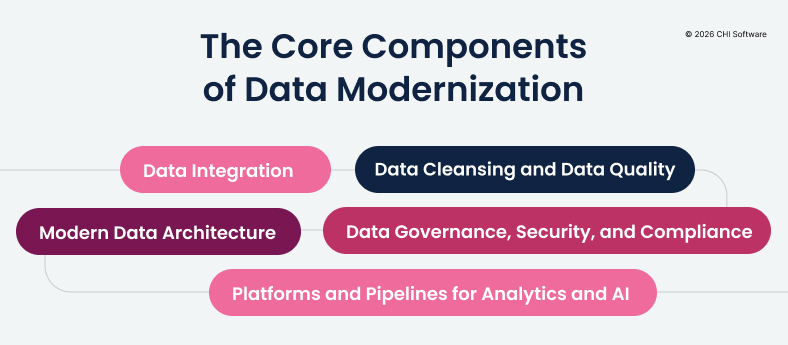
As Databricks experts point out in their enterprise governance guide, a modern data modernization framework shouldn’t just technically move bytes around; it must ensure regulatory confidence and deliver business outcomes. Snowflake representatives also add that customer trust and the secure scaling of artificial intelligence are only possible if every stage of this chain is transparent and controlled.
Data Integration
The process of combining analytics from various sources into a single stream. Instead of old, clunky ETL processes that heavily load systems overnight, modern integration relies on dynamic, lightweight solutions which ensure continuous data movement.
Data Cleansing and Data Quality
Garbage in, garbage out. If your files contain duplicates, errors, or outdated information, the resulting analytics will be flawed. Regular cleansing and verification ensure high quality assets for decision-making.
Modern Data Architecture
Moving from classic on-premises databases to concepts like a Data Lakehouse or Data Mesh. A modern architecture allows companies to efficiently store both structured information (transactions, tables) and unstructured information (audio, video, text documents) at the same time, offering true infrastructure flexibility.
Data Governance, Security, and Compliance
Who has access to financial reports? Are customers’ personal information protected in compliance with GDPR or NIS2? Strict data governance, security controls, and compliance are built directly into the system’s core logic rather than being slapped on later like a cosmetic fix.
Platforms and Pipelines for Analytics and AI
Building an environment where data scientists and analysts can instantly connect to the data sets they need. Reliable pipelines ensure a seamless supply of up-to-date information for machine learning models and data analytics dashboards.
Data Modernization Vs Data Migration Vs Data Transformation
In the business world, confusion frequently arises when non-technical stakeholders mistake simply copying files to the cloud for full-scale modernization. Let’s set the record straight and differentiate these concepts, drawing on insights from Databricks (who actively debunk data warehouse migration myths) and McKinsey.
| Concept |
What does it mean in practice? |
Main Goal |
| Data Migration |
Physically moving data from point A to point B (e.g., from an old legacy server to the cloud) without changing its structure. |
Changing location, ditching on-premise hardware. |
| Data Transformation |
Changing the format, structure, or values of data (e.g., file conversion, cleansing, or table aggregation). |
Getting data into the required format and shape. |
| Data Modernization |
A comprehensive overhaul of platforms, processes, management culture, data quality, and security. |
Business value, risk reduction, and AI readiness. |
As you can see, a data modernization approach is a much broader strategic process. Migration is just changing your information’s home address. Transformation is merely changing its clothes. Modernization, however, is a complete overhaul of your organization’s lifestyle and mindset, built for long-term future readiness.
Organizations that continue to rely on legacy systems often face increasing operational risk and unrealized revenue potential. A structured modernization roadmap can help reduce costs, strengthen resilience, and deliver measurable outcomes without disrupting the continuity of day-to-day operations.
Get a Modernization Roadmap Review
Common Approaches to Data Modernization
There is no silver bullet. It’s the same with data modernization: there is no universal blueprint that works for absolutely every business. Your choice of strategy always depends on your budget, risk tolerance, regulatory pressure, and the need to sustain operational continuity. Experts at IBM and Databricks recommend focusing on predictable ROI and minimizing business disruptions. At CHI Software, with our legacy software modernization services we offer four main approaches and techniques tailored to your specific situation.
Lift-And-Shift Migration
While complete modernization enables advanced capabilities immediately, a lift-and-shift approach grants organizations to quickly decommission legacy systems and reduce operational risk during cutover. Lift and shift is the recommended migration approach when the primary drivers are time to migrate, ease and accuracy of planning, or the criticality of downstream applications that depend on a stable schema and behavior.
Replatforming Legacy Data Systems
This approach includes moving data and services to a modern cloud platform with partial infrastructure modernization and minimal changes to existing applications. A company might replace legacy databases with managed cloud services, optimize storage, automate backups, and improve scaling mechanisms. Replatforming allows you to quickly reap the benefits of cloud technology — higher performance, flexibility, security, and fault tolerance — without the heavy costs of a total system redesign. That is why this option is often considered the optimal compromise between speed of implementation and long-term operational efficiency.
Cloud-Native Redesign
The most comprehensive approach, which involves completely rethinking the data architecture and building a brand-new ecosystem designed specifically to run in a cloud environment. Instead of migrating existing solutions, the company designs a modern platform using microservices architecture, containerization, automated data processing pipelines, and cloud analytics tools. This approach delivers maximum scalability, cost efficiency, high-speed processing for massive data volumes, effortless integration with AI solutions, and future readiness for business growth. At the same time, a cloud-native redesign requires significant investment, meticulous planning, and a lengthy implementation period, making it viable primarily for strategic transformations.
Hybrid and Phased Modernization
One of the most practical scenarios for large enterprises that cannot afford a full migration in a single stage. Under this approach, a portion of the systems and data continues to run on local infrastructure, while new services, analytical tools, and innovative solutions are gradually deployed in the cloud. This is especially relevant for companies with strict security, regulatory compliance, or sensitive data storage requirements. Phased modernization helps mitigate risks, avoid lengthy downtimes, spread investments over time, and gradually validate the performance of new technologies. As a result, the business gets a flexible path to digital transformation without the need to radically overhaul the entire IT ecosystem all at once.
How a Data Modernization Process Usually Works
A real data modernization process is not a one-time data migration or a simple replacement of a legacy system; it is a comprehensive transformation of the entire ecosystem. Successful companies don’t try to modernize everything at once. Instead, they roll out changes incrementally, starting with the highest-value business domains, regularly assessing results, and scaling successful solutions.
Research by DORA (in the context of preparing enterprise data for AI readiness) shows that a phased approach significantly mitigates risks, faster demonstrates the business value of investments, and simplifies future scaling. At the same time, modern transformation goes beyond technology, reshaping processes, team roles, and the overall corporate data culture.
A typical process consists of several related stages.

1. Assess the Current Environment
Any modernization effort begins with a deep dive into the current IT environment. The team evaluates existing databases, repositories, system integrations, data sources, and quality levels. An audit of technical debt is conducted to uncover legacy services, duplicates, performance bottlenecks, and security risks.
Special attention is paid to mapping out data lineage: where the information comes from, how it gets transformed, who uses it, and which business processes depend on it. This stage forms a realistic picture of the modernization scale and highlights the most critical areas for immediate improvements.
2. Define Goals, Priorities, and Use Cases
The next step is defining the business goals that modernization should achieve. It’s not just about updating technology; it’s about driving concrete impact on business metrics — reducing reporting time, increasing forecasting accuracy, automating analytics, powering AI solutions, or improving customer experience.
At this point, the company curates a list of priority use cases, evaluating their potential business value and expected ROI. It is equally important to establish key performance indicators (KPIs) to measure modernization efficiency, making sure that investments are validated through business outcomes, not just technical milestones.
3. Choose the Right Architecture and Platform
Once the goals are crystal clear, the target data architecture and technology stack are selected. This decision relies on the company’s scale, performance requirements, security, regulatory limitations, and budget. It could lead to a fully cloud-native infrastructure, a hybrid model, or a modern lakehouse architecture that blends the best elements of data lakes and data warehouses.
This phase also nails down specific platforms and tools — such as AWS, Microsoft Azure, Google Cloud, Databricks, Snowflake, or other solutions for integration, management, and data analytics. In parallel, a detailed data modernization roadmap is drafted, outlining the sequence of stages, timelines, owners, budget, potential risks, and success criteria for each phase of the project.
4. Migrate, Validate, and Optimize
Only after detailed preparation does the actual modernization begin. Data is migrated to the new platform, modern ETL/ELT pipelines are built, and integration, cleansing, and transformation processes are automated. Concurrently, backup mechanisms, monitoring, quality control, and access management are configured.
Once the migration dust settles, it’s time for a proper reality check. You don’t just cross your fingers and hope it works — you test the living daylights out of the new system to make sure every single byte is accurate, intact, and fast.
But here’s the real talk: modernization doesn’t end on launch day.
Hitting “go” is just the starting line. True transformation is a never-ending journey. Once you’re live, your team will constantly need to keep an eye on how to continuously use the platform, cut unnecessary costs, fine-tune data pipelines, and tweak the architecture as the business scales.
It’s this relentless, day-by-day tweaking that actually unlocks the true power of your data setup. That’s how you make sure your infrastructure is genuinely ready for AI, machine learning, and massive analytics — not just on paper, but in the real world.
Scaling AI and data capabilities on top of fragile legacy architecture creates risk, not value. We partner with CTOs and VPs of Engineering to modernize the data layer, clear technical debt, and establish a cloud-native foundation that your engineering team can actually build on.
See How We Reduce Technical Debt
Real-World Data Modernization Use Cases
Let’s take a look at specific legacy modernization examples that deliver measurable business value and are top priorities for CIOs and economic buyers. Successful use cases are always focused on solving actual business problems rather than simply testing new technology tools.
Enabling Real-Time Reporting and Analytics
Imagine a retail chain that previously could only see warehouse inventory levels at the end of the day. Thanks to data modernization and the shift to real-time analytics, management can track the movement of every single item the moment it is scanned at the checkout. This allows them to optimize purchasing, prevent stockouts, and dynamically manage pricing.
Supporting Customer 360 and Personalization
To create the perfect customer experience, you need to unite every single user touchpoint with your brand: purchase history, website behavior, support tickets, and social media activity. An updated data platform puts these puzzle pieces together into a unified “Customer 360” profile, enabling hyper-personalized marketing offers.
Building a Foundation for AI and Machine Learning
Any machine learning (ML) or generative artificial intelligence model requires colossal amounts of high-quality data to train and operate. Modernization builds the necessary infrastructure where AI algorithms get uninterrupted access to cleansed, structured information at the required scale.
In this context, it is highly beneficial to track global market shifts: you can learn more about current technology vectors in our article on legacy modernization trends.
Your data infrastructure is the foundation upon which every AI initiative succeeds or fails. We help CIOs design a modern, governed data estate that reduces legacy drag and accelerates time to value.
Book a Data Modernization Consultation
Common Data Modernization Challenges
The modernization process is no walk in the park. Business leaders will inevitably face serious challenges and barriers along the way, which are crucial to anticipate in order to mitigate risks. Global regulatory frameworks (such as NIS2 in the EU or DORA for the financial sector) impose strict requirements on digital operational durability, meaning missteps can be incredibly costly.
- Poor Data Quality: If you lift and shift chaos from on-premises servers to the cloud, you simply end up with “cloud chaos”. Taming dirty data during the migration phase demands significant effort.
- Security and Compliance Risks: Moving financial or healthcare information to the cloud requires strict compliance. A single misconfiguration in access permissions can trigger data breaches and staggering fines.
- Legacy System Complexity: Sometimes, legacy systems are so entangled and poorly documented that unraveling their underlying logic feels like a full-blown detective investigation.
- Skills Gaps and Change Management: Your current team might perfectly navigate old SQL databases but lack hands-on experience with modern cloud data analytics tools. On top of that, people naturally resist new processes.
- Business Disruption During Transition: A CIO’s ultimate nightmare is that during the switchover, the live CRM or ERP system crashes, grinding sales or product shipments to a halt.
Best Practices for a Successful Data Modernization Strategy
To bypass these sharp edges and guarantee a high ROI, you should implement proven, practical data modernization principles:
Start With Business Outcomes, Not Tools
Don’t start by choosing between AWS, Azure, or Google Cloud. Start with the business problem. Technology is merely a means to an end. First, define exactly what business challenge you are solving (e.g., cutting order processing time by 20%), and only then pick the tools to match. For growth-stage SaaS and PE-backed software companies, reduced maintenance costs can improve EBITDA margin, which directly increases the Rule of 40 score used by investors and acquirers to assess business health.
Build Governance and Data Quality Early
Data governance, security, and quality controls must be baked into the architecture from day one. It is much easier to set up the right “gateways” and access rules right off the bat than to try to clean up a messy, live cloud database later on.
Modernize in Phases
Don’t try to do everything all at once (the Big Bang approach). Break your grand plan into distinct, manageable phases. Step-by-step modernization allows your team to learn from mistakes, keeps the business stable, and showcases early wins to stakeholders much faster. To map out these steps properly, you will need a comprehensive application modernization roadmap.
Use a Pilot to Prove Value Before Scaling
Pick one small yet highly visible project (an analytics dashboard for a specific regional office) and launch it as a pilot. This allows you to test the chosen tech stack, check pipeline speeds, prove the approach’s value to leadership and secure the green light for wider scaling.
To minimize financial risk and ensure alignment, keep the pilot tightly structured with a fixed cost, a strictly defined scope of work, and milestone-based payments tied to concrete deliverables.
FAQ
-
Is data modernization the same as cloud migration?

No. Although these concepts are often used interchangeably, they mean completely different things. Cloud migration involves moving existing databases, applications, or infrastructure to a cloud environment, often without making any significant changes to their architecture. While this allows you to leverage cloud benefits like flexible scaling or reduced physical infrastructure costs, it doesn't solve the core problems of legacy systems.
Data modernization is a much broader process. It involves rethinking architecture, implementing modern approaches to information integration and governance, cleansing and standardization, automating pipelines, strengthening security, and building an environment that is fully ready for analytics, machine learning, and artificial intelligence. In other words, migration might just be one step in the modernization journey, but it cannot replace it.
-
What are the first steps in data modernization?
Any successful project kicks off with a detailed assessment of the current environment. The team audits the existing infrastructure, evaluates data quality, and identifies technical debt, duplicates, legacy systems, and potential risks. At the same time, business processes are analyzed to understand exactly which problems the modernization needs to solve.
Following this, strategic business goals, priority use cases, success criteria, and key performance indicators (KPIs) are defined. The final preparation step is creating a comprehensive data modernization roadmap that outlines the future architecture, implementation sequence, budget, owners, and risk mitigation plan.
-
What technologies are usually involved?
The tech stack depends entirely on the needs of the specific organization, but most modernization projects combine several categories of solutions. The foundation typically includes cloud platforms (AWS, Microsoft Azure, or Google Cloud), modern data repositories (warehouses or lakehouse platforms), integration and big data processing tools, and services to automate ETL/ELT processes.
In addition, companies use solutions for quality management, metadata cataloging, access control and security systems, monitoring tools, backups, and regulatory compliance features. If a company plans to leverage artificial intelligence, platforms for machine learning, real-time analytics, and AI model building are also integrated into the ecosystem.
-
How long does a data modernization project take?
There is no one-size-fits-all timeline, as project duration depends on the business scale, the complexity of the existing IT ecosystem, the number of data sources, and the volume of technical debt. For smaller companies or specific business units, initial results can be achieved in just a few months through pilot projects or by modernizing individual services.
If you’re running a massive enterprise, this isn’t a weekend project. We’re talking anywhere from one to several years, and trying to do it all at once is a recipe for disaster. You have to roll it out in phases. Taking it step-by-step keeps your critical, day-to-day systems from suddenly going dark. It lets you move services over gradually, double-check that each stage actually works, and flip the script or tweak your strategy if your business goals shift mid-way through.
The truth is, data modernization is never really "done". It’s a continuous evolution that grows right alongside your business and whatever crazy new tech drops tomorrow.
About the author
Ivan keeps a close eye on all engineering projects at CHI Software, making sure everything runs smoothly. The team performs at their best and always meets their deadlines under his watchful leadership. He creates a workplace where excellence and innovation thrive.
Rate this article
27 ratings, average: 4.8 out of 5