Most teams don’t intentionally use AI without governance, but some do. It just happens, and there’s nothing you can do to prevent it. For instance, a product squad might integrate a copilot into the build pipeline. A support lead might start routing customer tickets through a third-party model. The finance department uses a generative tool to draft board summaries, and nobody documents the decision. Each choice is small on its own. Together, however, they create a system that no one can fully account for. This is exactly what regulators, auditors, and your own board are now asking about.
An AI governance maturity model can help you identify and close that gap in stages. Rather than undergoing a single pass-or-fail audit, use the model to assess your current controls and determine the next concrete step. This article walks you through the relevant levels and dimensions, a practical assessment you can perform, and the frameworks that transform good intentions into audit evidence.
What Is An AI Governance Maturity Model For Audit-Ready AI Delivery?
An AI governance maturity model is a stepwise description of how an organization governs its use of AI, from scattered, ad-hoc experiments to a state where you can prove what ran, who approved it and why. The point isn’t to add any ceremony at all. It’s about moving from invisible AI to audit ready delivery without actually slowing down the teams that are actually shipping.
That distinction is far more important than it used to be. Google’s DORA research positions AI as a force which amplifies the existing strengths and weaknesses of your engineering systems rather than a force which fixes them. Put a capable model into a team that has poor feedback loops and no clear ownership and you end up with a much faster rate of production of work that nobody can trace. It’s governance maturity that determines which way that amplification goes.
Regulation has already caught up with this. Under the EU AI Act AI literacy has gone from being a nice to have to an active requirement from 2nd February 2025. If you’re building or using AI then your staff actually have to be AI literate. A maturity model is the way you turn that kind of obligation into something you can actually demonstrate rather than just say you’ve done it.
At CHI Software, we integrate governance into the work of our teams across AI, generative AI, software modernization, data engineering and analytics, DevOps, and MLOps. Governance isn’t an additional workstream that you tack on at the end just for the sake of having it. It isn’t a standalone technology decision, either. Rather, governance lives inside delivery, right next to the pipelines and data flows where AI risk is actually created.
Shipping AI without audit trails, without explainability and without ownership creates governance debt which will prevent you from being compliant with the EU AI Act.
Get a Free AI Governance Readiness Check
The 4 AI Governance Maturity Model Levels From Ad Hoc Control To Audit Readiness
Think of the AI governance maturity model levels as a progression from AI you can’t see to AI you can prove. Each level adds one thing that the previous one was missing: level 1 is visibility, level 2 is documented ownership, level 3 is evidence and monitoring and level 4 is continuous improvement. The red flags at each stage are very easy to spot once you know what to look for, particularly in teams that are operating under legacy constraints, have shadow AI and the kind of tech debt that AI output can quite easily accumulate.
Google’s DORA research and GitClear’s analysis of AI-assisted code both point to the same conclusion: when AI is used without management, the risk of delivery delays and the need for rework increase rather than decrease. The levels below help you identify this issue early on.
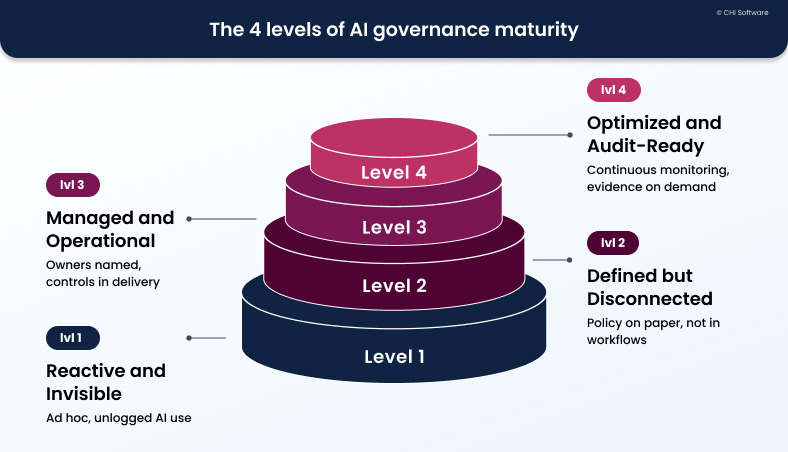
Level 1: Reactive And Invisible
AI use is ad hoc and pretty much entirely unlogged. Engineers and analysts just go and pick up the tools as and when they see fit. Approvals, if they’re needed at all, happen in the chat threads. There’s no one with a full picture of what models are being used on what data. There’s no policy (or indeed the policy predates the tools that people actually use). If an auditor walked in and asked “where is AI making decisions in this company?” the honest answer would be ‘I have no idea’. That’s where most organizations start and it’s not in any way a moral failing. It’s just untracked.
Level 2: Defined But Disconnected
There’s now a policy. Someone’s written an AI governance document, the leadership have signed it and it’s in the shared drive. The issue is that it doesn’t get implemented. The delivery teams are still shipping AI features through their own tools and their own vendors, completely unconnected to the policy that’s supposed to be in place. You’ve got a policy on paper and a very different reality in production and the two simply don’t meet. It’s very common for organisations to get stuck in this state for a very long time which is why there’s a whole section later on about why Level 2 is so sticky.
Level 3: Managed And Operational
Governance is starting to show up in the work. AI use cases have named owners, there is risk assessment prior to deployment rather than after an incident has occurred and the controls (access restrictions, logging, human review etc) are actually embedded in the delivery workflows. You can say who owns a given model, what it’s permitted to do and where its decisions are recorded. The controls are real and in place, even if they’re not yet feeding back into the improvement process.
Level 4: Optimized And Audit-Ready
Governance at the top level is a loop not a checklist. Monitoring is ongoing, incidents and near misses feed back into the controls, audit evidence is a by-product of the normal running of the system rather than something you do in preparation for an audit. You can produce on short notice a record of who decided what, which controls ran and how issues were escalated. That’s what audit ready actually means. It doesn’t mean you’ve got a binder together in the run up to an audit. It means the system produces its own evidence.
5 Core Dimensions Every AI Governance Maturity Model Must Cover For Control And Scale
Levels tell you how far along you are. Dimensions tell you along which axes. A credible AI governance maturity model framework will measure maturity across a number of interconnected domains because an organization can be very strong on policy and completely lacking in monitoring, or very strong on security and completely lacking in explainability.
Here’s a quick test that a CTO or CIO can use for each dimension: Does it extend to delivery workflows, vendor tools, and legacy systems, or does it end with a slide deck? ISO/IEC 42001 is helpful in this regard because it links AI management to real responsibilities, risk management, data governance, transparency, performance evaluation, and continual improvement. The five dimensions that follow that logic transform it into something you can use.
Risk Management, Compliance, And Model Misuse
Every AI use case has a different risk profile. A model which is simply summarizing internal notes is not the same model which is making the decision as to who gets a loan. Mature risk management involves classifying your use cases by impact, conducting a proper risk assessment prior to deployment and then building the appropriate controls to prevent misuse. The controls would be in place to stop the model being used outside of its intended scope, being fed data it shouldn’t see and producing output which leads to a decision that it has never been validated for. Of course compliance obligations will also be relevant here and they will be mapped to the actual use cases which trigger them rather than being applied on a blanket basis.
Accountability, Roles, And Human Oversight
Someone has to be the owner of each AI decision. Not the AI. A person. Mature governance will identify that owner, will define where a human has to be in the loop and will make the escalation paths explicit so that if an output is flagged it gets to someone with the authority to act. Human oversight is very much a theme of the EU AI Act and it only works if the human in charge is properly assigned rather than just assumed. Ambiguous ownership is the route to risks being left unattended until they become incidents.
Data Stewardship, Security, And Access Control
AI inherits all the weaknesses of the data that it’s fed. Mature data governance will have controls in place around what data a model can access, will ensure that sensitive inputs aren’t being fed into systems that aren’t cleared to receive them and will treat security as a first order concern rather than something you just do at the end of the process. Access control is relevant in two ways with AI: first of all in terms of who can use the model and secondly in terms of what the model itself is allowed to access. This is where government agencies and regulated organizations feel it most, but it’s a principle that applies in all sectors.
Transparency, Explainability, And Audit Trails
If you can’t explain why a model produced an output then you can’t justify it to a regulator, a customer or a court. Transparency is about documenting what the model does and on what basis. Explainability is about being able to retrace a decision afterwards. Audit trails are the thing that make this all durable, capturing the inputs, the versions, the approvals and the outputs so that the record is there whether or not anyone ever thought they’d need it. Those are the dimensions that go to prove you have control rather than just tell a story about it.
Monitoring, Auditing, And Continuous Improvement
Models drift. Data changes. A control that was good at launch can quite easily stop working. Mature governance is the one that monitors the AI in production, audits it on a regular basis rather than just after something goes wrong and then feeds that back into the next cycle of controls. That’s the dimension that takes you from Level 3 to Level 4 in a maturity model because without a feedback loop the controls will inevitably erode over time.
Governance Maturity For Generative AI

Generative tools bring with them risks that the older models don’t really cover. Governance maturity for generative AI has to deal with prompt injection (where you can actually craft inputs to get the model to do something that you didn’t intend), the issue of unpredictable output (you can’t test it all in advance), and supply chain exposure through the models, plugins and data sources you didn’t build. The controls are different too: input and output filtering, usage limits and much more rigorous review of the third party components. Any model that is generating content rather than just classifying it requires this additional layer and this is where the majority of the maturity gaps will be.
We map your existing AI controls against the requirements of ISO/IEC 42001 and the EU AI Act and provide you with a fully board-ready gap report in just two weeks with absolutely no impact on your live operations.
Request a Board-Ready AI Governance Gap Report
How To Run An AI Governance Maturity Assessment In 5 Practical Steps
An AI governance maturity assessment is something a CTO or CIO could actually run across their own models, their own copilots and their third party AI tools without having to wait for a consultant to build it from the ground up. NIST’s AI RMF Playbook is a good basis to work from as it maps out the actions to the four functions of Govern, Map, Measure and Manage. The steps below take those functions and make them something that can be run repeatedly. There are six of them as legacy and third party exposure are worthy of their own iteration.
Build A Complete AI And Model Inventory
You can’t govern what you can’t see. The first step is to build a complete inventory of every place AI is in the business. That’s not just the official AI in the business but includes internal models, embedded copilots, vendor features that have AI in them and the various experiments that teams have quietly run on their own. Shadow AI will be in that gap so the inventory has to go beyond the official list. For each item in the inventory you need to record what it does, what data it consumes and who is responsible for it. A half baked inventory is by far the most common reason for an assessment to produce false confidence.
Compare Documented Policies With Actual AI Use
Now put the policy up against reality. Where does the documented practice actually match what the teams are doing and where does it differ? That’s where Level 2 organizations get a real sense of just how wide the gap is. It’s not about tripping people up. It’s about identifying the places where the rules and the work have diverged because it’s in those places that risk is going to be concentrated.
Test Risk Controls For Each AI Use Case
For each use case in the inventory, verify that the controls you believe are in place are actually running. Is access really restricted as the policy states? Is there an actual human review, or is it just a checkbox? Are the inputs and outputs logged? Testing the controls is very different from merely documenting them, and that’s where the surprises will come from.
Identify Who Owns Each AI Risk And Decision
Just walk through the inventory again and assign an owner to every AI risk and every AI driven decision. If a use case has no owner then that is a finding in itself. Ownership is what makes every other control enforceable and unassigned risk is the silent default that an assessment is designed to bring to light.
Verify Post-Deployment Controls, Logs, And Reporting
Governance doesn’t end at deployment. You need to check what happens after the model is live: is monitoring actually running? Are the logs good enough to allow you to go back and reconstruct a decision? Is anything being reported up the chain when a control gets triggered? Post-deployment is where you really test maturity as it’s the bit that gets ignored by most teams once the feature has gone live.
Map Legacy Dependencies And Third-Party Models
Final one: trace the connections that hide risk. Which of your AI systems are reliant on legacy platforms which sit outside of your delivery controls? Which third party models are processing your data under terms that you haven’t had the opportunity to review? Legacy estates and third parties are where governance tends to lose the line of sight and an assessment that stops at your own code is completely inadequate.
What AI Governance Maturity Means For EU AI Act Readiness, Human Oversight, And Audit Evidence
The unfortunate reality of the EU AI Act is that your level of maturity determines whether you are truly prepared or merely putting on a show. Meeting the requirements of the Act is not guaranteed just because you can produce all the necessary documentation. The law is not concerned with paperwork; it seeks evidence of operational capability.
The timeline makes the stakes very real. The AI literacy obligations come into force on 2 February 2025. The governance rules and obligations for general purpose AI models come into force on 2 August 2025. From 2 August 2026 the member state authorities and the AI Office will be responsible for the supervision and enforcement of the Act (including the literacy obligations which have already been in force). The period in which we could treat this as future work has now passed.
In that context, maturity gives you the ability to prove things. Who made a given decision? Which controls were in place when it was made? How was an issue escalated, and how was it resolved? AI literacy is demonstrated by whether your employees can explain the systems they’re working in. Human oversight is demonstrated by whether flagged output reaches someone with the power to stop it. The existence of internal records is demonstrated by whether your audit trail will survive contact with an actual auditor. At low maturity, you’re making it up as you go along. At a high level of maturity, everything is in place because that’s how the system was designed. In the regulated spaces in which CHI works so much (fintech, healthcare, etc.), that difference is the entire point.
AI Governance Maturity Model Frameworks That Support Assessment And Audit Evidence
Frameworks are building blocks not a replacement for an operating model. There’s no framework that will govern your AI for you. What the good frameworks do is provide structure to the risk work, institutionalize the management controls and turn the governance activity into something that an auditor will accept as evidence. Here’s how the main ones fit together.
NIST AI RMF For AI Risk Management
The NIST AI Risk Management Framework organizes the risk work around four functions (Govern, Map, Measure and Manage) and its Playbook provides suggested actions under each. It’s guidance rather than a checklist which is its strength in that it enables you to structure your approach to identifying, assessing and treating AI risk without pretending that every organization is going to face the same risks. It’s a way of giving your risk management a common language and a defensible structure.
ISO/IEC 42001 For AI Management Systems
ISO/IEC 42001 is the first management system standard for AI and it embeds the controls that a maturity model describes. It maps AI management to accountability, risk management, data governance, transparency, performance evaluation and continual improvement. It is voluntary and certification against it is a clear sign of a serious commitment to responsible AI rather than a requirement that you’re meeting from a legal perspective. Where NIST helps you think about risk, ISO/IEC 42001 helps you build the repeatable system around that.
Internal Control Frameworks For Audit Evidence
The frameworks above are specifically about AI. Your existing internal control mindset (the same mindset that produces the financial and security audit evidence) is what will actually turn AI governance into something that an auditor can understand. Treat your AI controls in the same way that you treat any other material control: documented, tested, owned and evidenced. That’s often the missing piece for organizations that have AI policies but can’t yet produce audit quality evidence.
OWASP Top 10 For LLM App Security
For generative AI, security becomes a practical delivery risk and the OWASP Top 10 for LLM Applications is very much a reality. Prompt injection, supply chain issues and unsafe handling of model output aren’t just theoretical risks, they’re the very things that will break your generative features in production. You need to fold those into your application layer controls so that the risks specific to LLMs are treated as engineering issues, which is precisely what they are.
Why Most Organizations Stall At Level 2 And How To Break Through Legacy And Workflow Gaps
The vast majority of organizations get stuck at Level 2 and it’s important to understand why because it’s a structural issue rather than a lack of effort. Governance exists in slide decks and the engineering teams are shipping AI through a whole range of different tools, vendors and legacy workflows. Policy and work exist in completely different worlds. That’s precisely where the CIO’s worry about run vs change and the CTO’s worry about AI induced tech debt come together. DORA research makes the mechanism perfectly clear: AI amplifies whatever system it’s in. A disconnected governance model therefore produces disconnected results at speed. GitClear’s analysis adds the delivery cost to that, showing how unmanaged AI output can lead to increased duplication and rework. There are four patterns that keep teams stuck.
Governance Exists On Paper, Not In Workflows
The policy is written, it’s approved and it’s ignored. It’s never been linked to the pipelines, the review gates and the tools where the AI actually runs so it has absolutely no impact whatsoever. The only way to get through that is to take the controls out of the policy and into the workflow where they can fire automatically rather than relying on someone remembering to check.
There Is No Executive Sponsorship Beyond Initial Policy Sign-Off
A leader approved the policy, and that was that. Without ongoing sponsorship, governance has no budget, authority, or claim on anyone’s time once the launch moment passes. For a project to mature, there needs to be someone at the top who treats it as live work, not a one-time sign-off.
AI Literacy Gaps Keep Teams From Acting On Policies
A policy only works if the people it applies to understand the systems it’s governing. If AI literacy is low then teams simply can’t apply the rules they don’t understand and the policy is just words they can’t operationalise. That’s precisely where the EU AI Act’s literacy requirement and practical governance come together: closing the knowledge gap is what enables everything else to work.
Legacy Systems Keep Controls Outside Delivery
Legacy architecture and disparate toolchains mean that governance remains physically separate from where the AI actually runs. If you’re shipping AI features via modern pipelines but those features are reliant on older systems then your governance simply can’t get there. The oversight just doesn’t exist in that gap between the two. You need to extend your governance into the legacy estate and into the delivery pipeline as well so that there’s no gap for risk to get through.
The legacy architecture and disparate toolchains have kept governance outside of the delivery workflows. We bring AI governance right into your CI/CD pipeline and your MLOps stack.
See How We Embed Governance Into AI Delivery
Maturity isn’t the goal in itself. Audit-ready AI that keeps shipping is. If that’s the work in front of you, CHI’s AI transformation consulting services connect governance to the delivery pipelines where AI risk is actually created, and our agentic AI development services build the controls in from the start.
FAQs
-
What Is The Difference Between AI Governance And Data Governance?

Data governance is about how the data itself is governed: how it's collected, how it's stored, how it's accessed and how it's kept accurate. AI governance builds on that and adds a layer of governance over the models that consume the data and the decisions they make. You can't have mature AI governance without underpinning it with good data governance as the model is only as trustworthy as the data it's trained on. The other way around though is not true at all. Good data governance tells you nothing about whether the model that's using that data is owned, is monitored, is explainable. That's the remit of AI governance. It's about the model, it's about the model's behavior and it's about the model's accountability. Data governance was never intended to cover any of that.
-
What Is A Good AI Governance Maturity Score?
There's no single number that applies to all. Anybody selling you a number is overreaching. The score you achieve will be entirely dependent on the model you're using and, more significantly, on your own risk profile. A government body or a regulated bank will need to be at a much higher level than a small company running one internal copilot. A more pertinent question than "what score" is "what level is appropriate for our risk"? For most organizations that are in fact managing some degree of AI risk, Level 3 (where the controls are operational and owned) is a perfectly reasonable near term target. Level 4 is the one that really matters when you're under constant audit.
-
How Long Does It Take To Move From Level 1 To Level 3?
It really depends on where you start and how much legacy complexity you've got in the way. A realistic timescale for a focused effort would be several months to about a year. The inventory and policy work can be done fairly quickly. The wiring of the controls into the delivery workflows and assigning real ownership is where it gets much slower as it's about how the teams actually work. Trying to go straight to Level 4 is almost guaranteed to fail. The way to get to Level 4 is to get Level 3 right first with controls that actually run and owners that actually own them.
-
Do Small Companies Need An AI Governance Maturity Model?
Yes, but a lighter version. While a small company doesn't need the machinery that a large enterprise requires, it still needs to understand where AI touches the business, who owns the risk, and what happens when something breaks. The cost of ignoring governance increases slowly, and regulatory obligations rarely shrink to match a smaller size. A right-sized maturity model provides small teams with the same visibility without the overhead. It's far easier to implement early on than to add after AI adoption has spread.
-
How Does Governance Maturity For Generative AI Differ?
Generative AI emphasizes a few dimensions more. Its output is more unpredictable than that of classification models, so it's impossible to test every possible result before shipping. New risks emerge as well, such as prompt injection, unsafe handling of output, and supply chain exposure from models and components that you didn't develop. Older governance didn't have to address these issues. Accordingly, the controls shift toward input and output filtering, clear boundaries on how a tool is used, and closer examination of third-party elements. Even when the rest of their governance looks solid, teams adopting generative tools usually hit their maturity gaps here first.
-
Is There An AI Governance Maturity Model Template?
Templates exist, and they're a good place to start when structuring an assessment. Instead of a blank page, an AI governance maturity model template provides a ready set of levels and dimensions to work with. The catch is that a template captures a general shape, not your specific risks, legacy systems, or regulatory exposure. Use a template to get started, and then adapt it to how your organization actually runs AI. A partner can help you do this quickly without locking you in because the goal is to create a model that your team owns rather than one that you rent.
About the author
Ivan keeps a close eye on all engineering projects at CHI Software, making sure everything runs smoothly. The team performs at their best and always meets their deadlines under his watchful leadership. He creates a workplace where excellence and innovation thrive.
Rate this article
27 ratings, average: 4.8 out of 5