Real time payment rails have changed the game for fraud teams. A payment that used to sit in a batch queue for hours will now settle in seconds and once it’s moved, it’s very rarely going to come back. That’s the benefit of the rail. That’s also the problem. The window in which you can make a judgment as to whether a payment is legitimate has gone from hours down to milliseconds. The fraud that’s being aimed at these rails is constantly evolving. That’s where AI risk scoring in real-time payments comes in. It doesn’t come in to replace every control that a bank already has in place, it’s the layer that’s fast enough to make a defensible call before authorization.
Why Traditional Risk Scoring Falls Short in Real-Time Payments
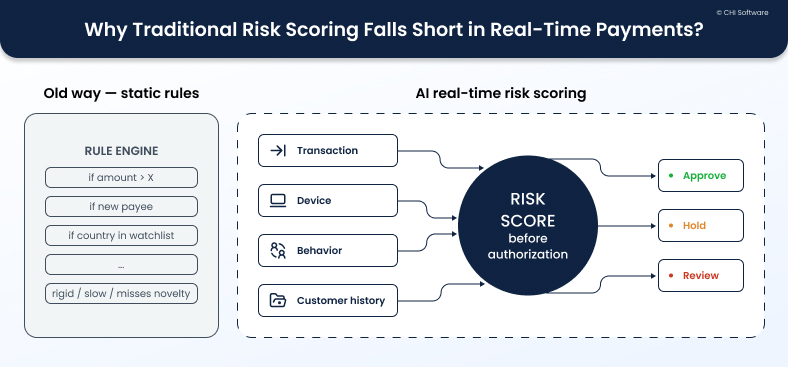
Static rules were built for a much slower world. You’ve got a rule engine which is going to look at a transaction and check it against a set of conditions that someone has written down in advance (amount over X, new payee, country on a watchlist etc). That logic is obviously readable and easily auditable which is why it still forms the core of most payment stacks. The problem is of course that fraud doesn’t stand still and a rule only ever catches what it’s been told to catch.
The EBA’s 2026 Risk Assessment Report was very much in the same camp. The banks surveyed identified fraud as the second most significant driver of operational risk with payment fraud, credential theft and social engineering all cited as the key types of fraud. For a CFO that’s a very straightforward case of financial loss. For a CIO running a legacy transformation program, it’s a control gap which gets bigger every quarter as the old system remains in place.
Static Rules and Manual Reviews
Rule based systems have two failures to deal with. They’ll go past fraud that doesn’t match any of the rules and they’ll flag legitimate customers whose behavior just happens to trigger a threshold. The second of those (the legitimate customer) gets passed off to analysts for manual review and manual investigation doesn’t scale with the volume of instant payment. A queue that clears overnight in the card world is already too slow when you’re talking about settlement in seconds.
The Speed Challenge of Instant Payments
With instant payments, the very gap on which older fraud controls relied is eliminated. There is no “pending” state to pause in, nor is there a clearing delay to perform slower checks. Real-time transaction monitoring must make a decision within the authorization process itself, usually in a matter of milliseconds. This process cannot include controls that require a batch job, an overnight model run, or an analyst review. Assessing damage after the fact is the only option for such controls.
Static fraud rules will reject legitimate transactions and will also fail to pick up on novel fraud patterns. Both of those failures have direct implications for revenue and for regulatory compliance in an instant payment environment.
Talk to a Real-Time Payments AI Specialist
How AI-Powered Risk Scoring Works in Real Time
AI powered risk scoring replaces the simple yes/no rule check with a model that looks at a whole host of signals and returns a probability. The flow is easy to describe, hard to run in production. Data comes in, features are calculated, a model scores the transaction and a decision comes back prior to the payment being authorized. The BIS noted in 2026 that banks are already using AI for fraud detection and risk management, with the caveat that any consequential financial decisions still need governance, accountability and explainability. The objective of AI in real time payment for risk scoring and decisioning is to achieve that speed without sacrificing any of those three.
Transaction, Customer, Device, and Behavioral Data
A score is only as good as the information used to calculate it. There are four main types of input. The most obvious is transaction data, which is the data around the transaction itself (amount, currency, payee, channel, and time). The history and context of a customer’s account is provided by customer data, which also reveals what is considered normal for that account. Device intelligence provides the device and session fingerprint, flagging an account normally known to you that is reaching the rail from an unusual device. Behavioral signals refer to the signals that indicate how the person is interacting with the system. These signals can include the cadence of typing, how they move around the screen, and other subtle nuances that are difficult to fake. The model is able to assess transaction risk based on the customer behavior, rather than using data from an average stranger. This is made possible by the contextual data that is available.
Machine Learning, Pattern Recognition, and Anomaly Detection
Under the surface machine learning models do the work that rules can’t. Pattern recognition learns the shape of known fraud from the history of labeled fraud. Anomaly detection then takes over to catch the transactions that don’t conform to an account’s established pattern even if they don’t match any known fraud type. Behavioral analytics brings all of that together over time so that it’s looking at a sequence of actions rather than a single event. That’s what AI real time payments for risk scoring and fraud detection is meant to do really: it’s a read on both the fraud you’ve seen and the fraud you haven’t.
Dynamic Risk Scores and Transaction Decisions
The output is a dynamic risk score which is recalculated for every transaction against the current situation rather than being pulled from a fixed table. Dynamic risk scoring allows the response to be risk-appropriate. A low score will clear straight through. A medium score can trigger a step up such as an extra auth. A high score will hold the payment or route it for review. Pre-transaction risk scoring means that real-time transaction scoring occurs prior to transaction authorization, which is the only point at which a bank can actually stop a real time payment rather than chasing it.
Every 1% reduction in false positives on a high volume payment platform is a direct translation into authorization revenue. AI risk scoring is changing the economics of fraud management.
See How CHI Builds AI Risk Scoring for FinTech
How AI Improves Payment Risk Decisions
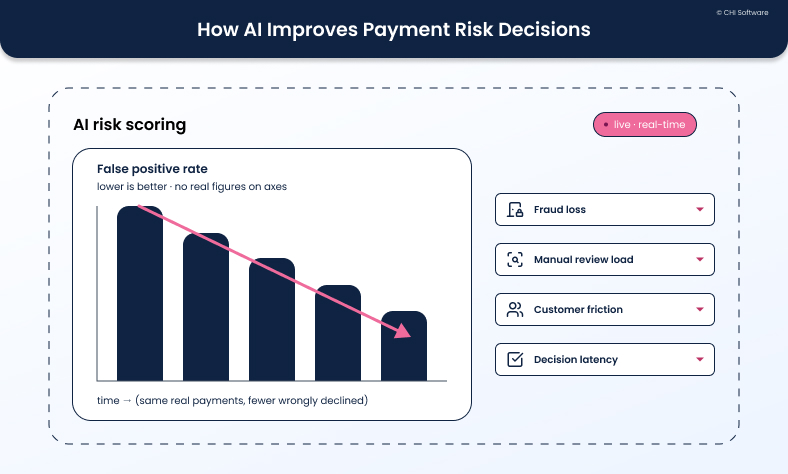
Speed is the entry ticket. The reason to move to AI support for smarter risk scoring in real-time payments is its impact on the metrics that payment leaders report: fraud loss, false positive rate, manual review load, customer friction, and decision latency. The EBA’s 2026 assessment made it clear that technology-driven fraud will continue to evolve, requiring institutions to implement robust monitoring systems as fraudsters adopt AI and other digital technologies. A fixed control won’t be able to deal with a moving threat. You need a learning one.
Detecting New and Changing Fraud Patterns
Fraud patterns evolve as the people doing it adapt the moment a particular tactic stops being effective. A model that’s looking for anomalies rather than just known signatures will surface the first wave of a new scheme in terms of how far out it is from the norm. That little head start is the difference between catching a fraud ring in its infancy and reading about it in a quarterly loss review. Real time fraud detection is most valuable when it’s picking up something that hasn’t even been named yet.
Reducing False Positives
False positives are the hidden cost of a fraud program. Every false positive is a lost sale, a support call and a customer who may never come back. The model can look at the context and decide whether a large genuine purchase is legitimate or not and will allow the good purchase to go through. On a high volume platform even a small reduction in the false positive rate is a real gain in authorized revenue and a real reduction in the load on the people doing the human review. That’s fraud prevention measured in the way the business wants it.
Continuous Learning, Feedback Loops, and Model Updates
A fraud model is not a one off. Every fraud that’s confirmed and every cleared dispute is a label and the feedback loops feed those labels back in so the model can be updated as behavior changes. Done properly it will prevent accuracy from drifting as both the customer and the fraudster evolve. Done the wrong way it’s a mechanism for teaching the model the wrong lesson which is why model updates need to be part of a monitored, governed pipeline rather than just an ad hoc retrain.
AI Risk Scoring, Compliance, and Human Oversight
The most effective setups build on what’s already working. Rather than quietly replacing them, AI risk scoring should be added to the existing controls. The EBA’s 2026 report called for a transparent and risk-sensitive approach to AI, including improved governance, better data, and cybersecurity, as well as the incorporation of AI tools into DORA compliance frameworks. In the context of payments, this translates to a specific design involving models and rules, clear escalation procedures, and a record of every decision.
Combining AI Models With Rules-Based Controls
Rule based systems still get the job done. There are some obligations that are absolute, you just hit a sanction, you have a hard regulatory block and you need that to be enforced by logic that you can point to rather than something that’s inferred by a model. The practical pattern is to have a layer of deterministic rules for the non-negotiables and the model to deal with the wide gray area in between where a simple threshold would be wrong more often than it would be right. That’s how AI in real-time payment risk management works best, as a combination of the two rather than one or the other winning out.
Human Review for High-Risk and Edge Cases
Automation should handle the volume, not the tough calls. The high-value cases should all have a human in the loop. The genuinely ambiguous ones should have a human in the loop. The ones with real consequences should have a human in the loop. A sensible design will route the small percentage of high-risk and edge cases to the analyst, providing all the necessary context. This allows the human review to focus on what actually matters, rather than being overwhelmed by a massive queue of cases.
Explainability and Regulatory Requirements
A score that the bank can’t explain is a score that it can’t defend. In the world of regulatory compliance in payments you’re increasingly expected to be able to explain why a transaction was declined or held. That rules out the black box scenario where you have no idea what the reasoning was. Explainability has to be built in. You have to be able to log the signals that went into each score and be able to audit them. That’s the sort of thing that you can then bring to bear in the event of a customer complaint or a supervisory review. It’s less a modeling issue and more an operations issue and that’s where a lot of the really good pilots get stuck.
AI risk scoring deployed without any form of explainability, without human escalation paths and without audit trails creates a DORA compliance exposure which is effectively unremediable once a supervisory review has started.
Review Your AI Governance for Payment Systems
CHI Software Experience in Building Secure FinTech and Payment Solutions
The model is not the hard part. The real challenge lies in integrating a real-time scoring layer into a payment platform that was never designed for it and maintaining its stability once it’s live.
That is the work CHI Software does for fintech software development clients: the engineering around the model, not a slide about it.
The capabilities that actually matter here are the ones that CHI brings to production. Data engineering and analytics provide the real time pipelines that feed a score in time to be used. AI and generative AI development (together with DevOps and MLOps) is what gets the fraud detection models into production and keeps them in production (monitored, versioned, ready to retrain). Custom software development and software modernization are what connect the scoring layer to the existing payment systems without the usual rip and replace (which is invariably the CIO’s first constraint). Cloud engineering is what delivers on the latency and resilience requirements that the whole thing has to meet.
The ESA’s 2026 DORA reporting really highlights the extent to which ICT risks are now interwoven as AI capability increases. You can see it in the way a fraud model is treated as part of the platform’s resilience narrative rather than a feature simply added on to the edge of the platform.
For a fintech CTO, that means real-time fraud ML that survives contact with production traffic. For a CIO, it means modernizing a legacy platform without taking payment processing offline to do it. For a CEO or CFO, it means financial and regulatory risk kept inside defined limits. Where governance is the pressing question, CHI’s AI governance consulting brings explainability and audit into the design from the start. And when a team needs senior engineers inside the build, CHI offers FDE as a service and the option to hire forward deployed engineers who work within your environment rather than at arm’s length.
Conclusion
Building AI risk scoring on top of legacy payment infrastructure is an integration problem first and a modeling problem second. The model itself is rarely going to be the deciding factor. It’s the data pipeline that delivers the data to the model in time, the controls that keep it explainable and the architecture that delivers on the promises of latency and DORA resilience that will determine whether it works in production or simply dies in the pilot. How AI enables smarter risk scoring in real time payments comes down to those decisions and the earlier ones are the most important. If you get the architecture right at the outset then the model has a good solid base to stand on.
Building an AI risk scoring capability on top of existing payment infrastructure is an integration challenge before it is a model challenge. The architecture decisions you make at the outset will determine whether the system is capable of meeting the real time latency and DORA resilience requirements.
Book a FinTech AI Architecture Consultation
FAQs
-
What is AI-powered risk scoring in payments?

AI-powered risk scoring is used to assess the fraud risk of a payment in real time. The model doesn't just check a transaction against fixed rules. It considers multiple factors at once. These factors include transaction details, customer history, device information, and user behavior. The model then provides a probability estimate of whether the payment is fraudulent. This score informs the decision to approve, challenge, or hold the payment.
-
How does AI assess payment risk in real time?
Data about the transaction is collected and transformed into features. A model then scores the features and returns a decision, all within the authorization path and usually in tens of milliseconds. Since the score is produced before authorization, the bank can act on it and stop the payment.
-
What data is used for real-time payment risk scoring?
Four types, typically combined: transaction data (amount, payee etc.), customer data and history, device intelligence from the hardware and session, and behavioral signals from how the user behaves. The model can then compare the payment against the customer's own normal behavior.
-
How does AI reduce false positives in payment fraud detection?
A model weights the context rather than just firing on one threshold so it can distinguish between a legitimate but odd payment and a genuinely suspicious one. That means more legitimate transactions get through and fewer are sent to manual review which in turn reduces both lost revenue and analyst effort.
-
Can AI risk scoring replace rules-based fraud controls?
Not entirely, and it usually shouldn't. Some controls, such as sanctions enforcement, require deterministic rules that a bank can reference. A stronger design incorporates models and rules together, with human review for high-risk cases and transparency behind every decision.
About the author
Yana oversees relationships between departments and defines strategies to achieve company goals. She focuses on project planning, coordinating the IT project lifecycle, and leading the development process. In their role, she ensures accurate risk assessment and management, with business analysis playing a key part in proposals and contract negotiations.
Rate this article
27 ratings, average: 4.8 out of 5